AMD Ryzen 7 8745HS
vs
AMD Ryzen 7 H 255
CPU Comparison Result
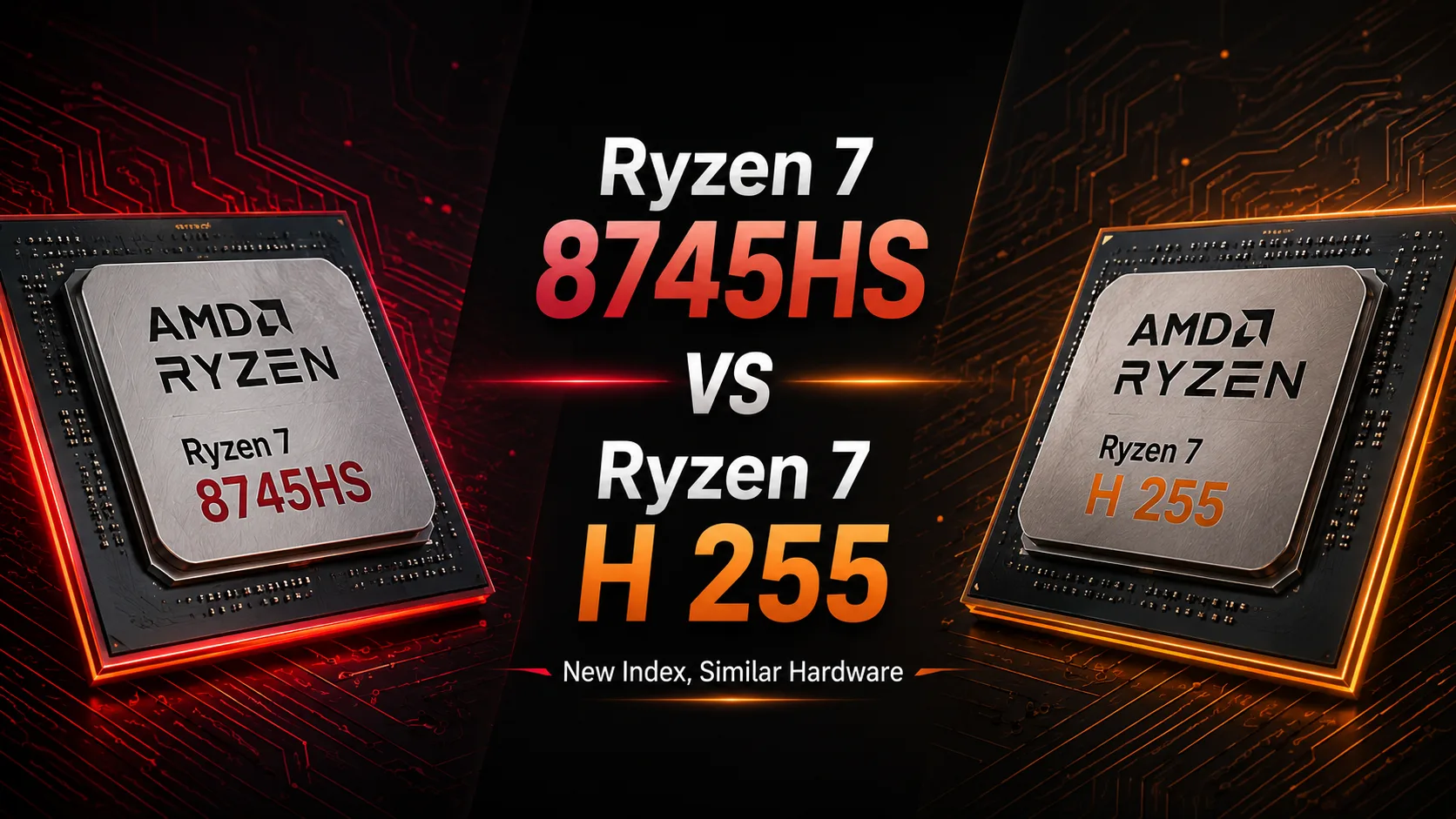
AMD Ryzen 7 8745HS vs Ryzen 7 H 255: the same Hawk Point under a new index
The Ryzen 7 H 255 appears to be a new processor only because of its name. Inside, it's the same Hawk Point: eight Zen 4 cores, 16 threads, clock frequencies of 3.8-4.9 GHz, and a Radeon 780M, just like the Ryzen 7 8745HS. The identification even matches: Family 25 Model 117 Stepping 2. AMD has changed the name and positioning, but not the processor itself.
| Characteristic | Ryzen 7 8745HS | Ryzen 7 H 255 |
|---|---|---|
| Codename | Hawk Point | Hawk Point |
| Architecture | Zen 4 | Zen 4 |
| Cores / Threads | 8 / 16 | 8 / 16 |
| Base Frequency | 3.8 GHz | 3.8 GHz |
| Boost | up to 4.9 GHz | up to 4.9 GHz |
| L3 Cache | 16 MB | 16 MB |
| TDP | 45 W | 45 W |
| cTDP | 35-54 W | 35-54 W |
| Process Technology | TSMC 4 nm | TSMC 4 nm |
| Integrated Graphics | Radeon 780M | Radeon 780M |
| GPU | 12 CU, up to 2.6 GHz | 12 CU, up to 2.6 GHz |
| Memory | DDR5 / LPDDR5X | DDR5 / LPDDR5X |
| PCI Express | PCIe 4.0 | PCIe 4.0 |
| Platform | FP7r2 / FP8 | FP8 |
In fact, there is only one noticeable difference: H 255 is listed only for FP8, while the Ryzen 7 8745HS also supports FP7r2. This has no relation to computing performance.
Why did AMD need the Ryzen 7 H 255?
H 255 is not a successor to the Ryzen 7 8745HS. It is the old Hawk Point transferred to AMD's new naming system.
And here begins a more important issue: the series number now poorly informs the buyer about which generation of architecture is inside.
In Ryzen 100, both Zen 3+ and Zen 4 are present. Ryzen 200 uses Zen 4 and Zen 4c. The real transition to Zen 5 is already occurring in Ryzen AI 300.
| Series | Architectures Inside | Year of Architecture Introduction |
|---|---|---|
| Ryzen 100 | Zen 3+ / Zen 4 | 2022 |
| Ryzen 200 | Zen 4 / Zen 4c | 2022 / 2023 |
| Ryzen AI 300 | Zen 5 / Zen 5c | 2024 |
The Ryzen 7 H 255 belongs to the 200 series but uses Zen 4, which was introduced back in 2022.
Moreover, even Ryzen 100 cannot be considered a separate architectural generation. For example, Ryzen 7 170 is based on Rembrandt with Zen 3+, while the same series features Hawk Point with Zen 4.
Therefore, the chain "100 → 200 → 300" does not mean a simple progression from the old generation to the new one. The model number cannot reliably indicate either the age of the architecture or the origin of the die anymore.
In the case of H 255, everything is particularly clear: the new index has been given to a processor that AMD was already selling as Ryzen 7 8745HS.
Performance: it’s more useful to compare Hawk Point with Intel
It makes no sense to compare the 8745HS and H 255 as two different CPUs - they are one Hawk Point. It’s much more beneficial to see where it stands relative to a real competitor. For reference, we’ll take the Intel Core Ultra 7 155H - a Meteor Lake of the same class with 16 cores and 22 threads.
| Processor | Device | Geekbench 6 Single-Core | Geekbench 6 Multi-Core |
|---|---|---|---|
| Ryzen 7 8745HS | Lenovo IdeaPad Slim 3 14AHP10 | 2460 | 10 786 |
| Ryzen 7 H 255 | Lenovo IdeaPad Slim 5 14AHP10R / XiaoXin 14 AHP10R | 2357 | 10 308 |
| Core Ultra 7 155H | ASUS Zenbook 14 UX3405MA | 2421 | 12 515 |
| Core Ultra 7 155H | Dell XPS 13 9340 | 2324 | 10 748 |
These results are from specific laptops, not a laboratory test in identical conditions, so a few percentage points of difference do not prove anything. However, the overall level is clearly visible.
In single-core performance, Hawk Point stays close to the Core Ultra 7 155H. In multi-threaded workloads, Intel can pull ahead under favorable power limits: the ASUS Zenbook 14 shows 12.5 thousand points compared to 10-10.8 thousand for Lenovo with AMD.
Additionally, another Core Ultra 7 155H in the Dell XPS 13 drops to 10.7 thousand. This is more important than any comparison between 8745HS and H 255: in mobile systems, the chassis, cooling, and power limits can change the results more significantly than the label on the CPU.
If H 255 turns out to be faster in one laptop than the 8745HS in another, it does not make H 255 a faster processor. It only means that one laptop better utilized the same Hawk Point.
What really needs to be compared
Since the processor hasn’t changed, choosing a laptop based on the label 8745HS or H 255 is meaningless.
The Radeon 780M remains the same as well: 12 compute units and a frequency up to 2.6 GHz. The new index provides no separate gain in gaming.
One should look at:
- cooling system and real power limits;
- configuration and speed of RAM;
- display;
- battery;
- noise level;
- price.
Memory is especially important in models without a discrete graphics card. The Radeon 780M uses system RAM, so two laptops with the same Hawk Point may significantly differ in FPS.
Conclusion
The Ryzen 7 H 255 is the Ryzen 7 8745HS under a new index. The same Hawk Point, the same eight Zen 4 cores, the same 16 threads, the same frequencies, the same cache, and the same Radeon 780M. Even the Family 25 Model 117 Stepping 2 matches.
AMD's new nomenclature only makes the situation more confusing. Ryzen 100 can contain both Zen 3+ and Zen 4, Ryzen 200 continues to use architectures from 2022-2023, and the real transition to Zen 5 is found only in Ryzen AI 300. The series number can no longer be accepted as the generation of the processor.
Against the backdrop of Core Ultra 7 155H, it’s clear that Hawk Point is still quite competitive. But between Ryzen 7 8745HS and Ryzen 7 H 255, there is no architectural choice.
If a laptop with Ryzen 7 8745HS is cheaper with comparable other characteristics, there’s no reason to pay extra for H 255. The new index here indicates a new line in AMD's catalog, not a new processor.
Advantages
- Newer Launch Date: January 2025 (June 2024 vs January 2025)
Basic
CPU Specifications
Memory Specifications
GPU Specifications
Interfaces and Ports
Miscellaneous
Benchmarks
Related CPU Comparisons



Share in social media
Or Link To Us
<a href="https://cputronic.com/cpu/compare/amd-ryzen-7-8745hs-vs-amd-ryzen-7-h-255" target="_blank">AMD Ryzen 7 8745HS vs AMD Ryzen 7 H 255</a>