AMD Ryzen AI Max PRO 490
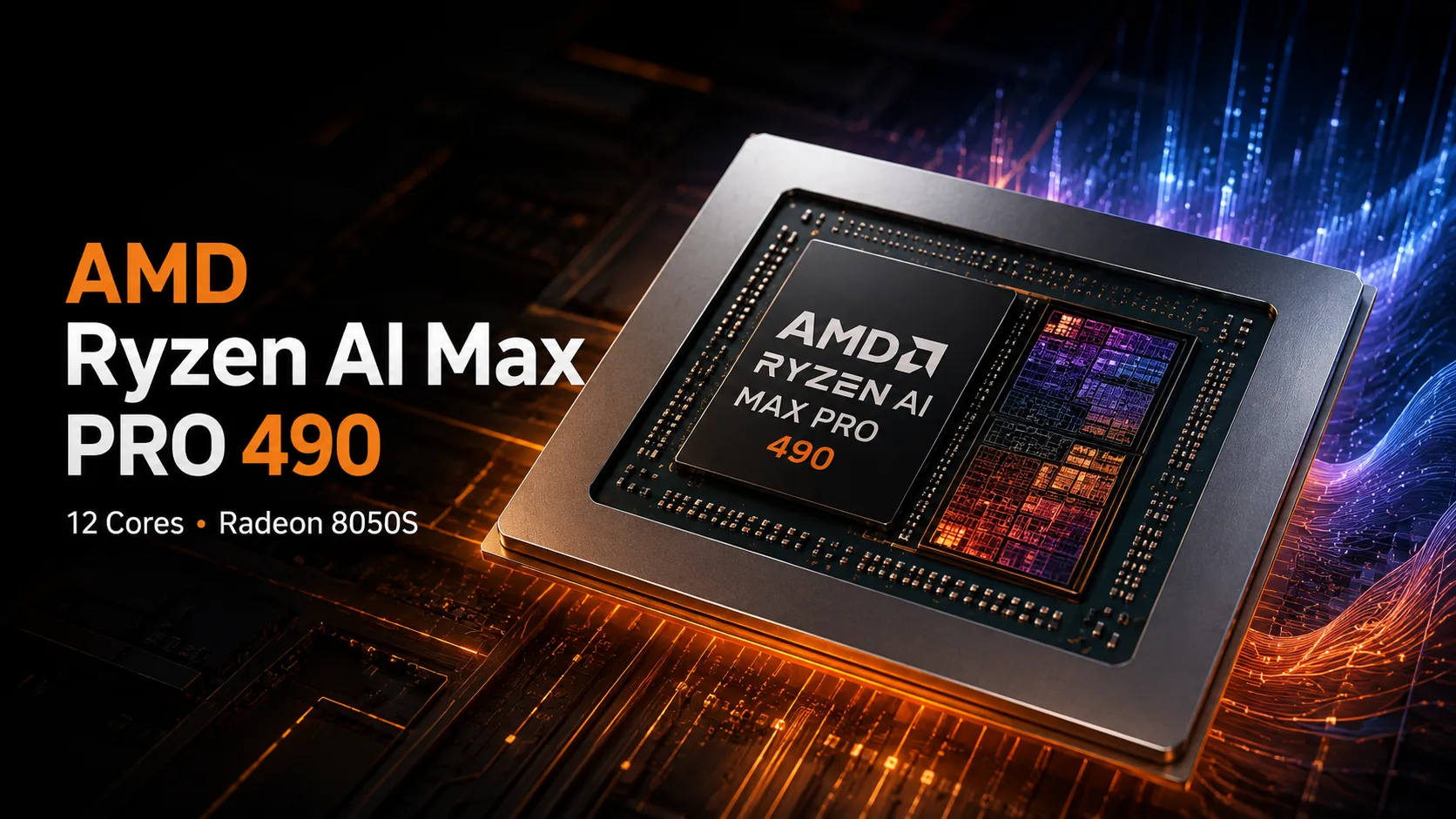
AMD Ryzen AI Max PRO 490: The Most Balanced Halo Chip
The AMD Ryzen AI Max PRO 490 is possibly the most interesting model in the Ryzen AI Max PRO 400 lineup. Not because it is the fastest, but because it strikes the best balance: it features 12 Zen 5 cores, the same large Radeon 8050S, up to 192 GB of memory, and does not fall into the maximum segment of the Ryzen AI Max+ PRO 495.
The main idea of this model is balance. The Ryzen AI Max PRO 485 serves as an entry point into the Halo platform but is limited to 8 cores. The higher-end Ryzen AI Max+ PRO 495 offers maximum CPU and graphics performance but moves into the upper segment. The Ryzen AI Max PRO 490 stands between them: 12 Zen 5 cores, 24 threads, Radeon 8050S, 256-bit LPDDR5x memory, up to 192 GB of memory, and an NPU with up to 50 TOPS.
Not Maximum, But Already Serious Level
The Ryzen AI Max PRO 490 utilizes 12 Zen 5 cores and 24 threads. For a mobile or compact workstation processor, this is already a strong configuration: this amount of power is sufficient for compiling, rendering, editing, running virtual machines, processing photos and videos, heavy multitasking, and professional applications.
Compared to the Ryzen AI Max PRO 485, the increase is significant, particularly in terms of CPU. The younger model has 8 cores and 40 MB of total cache, while the 490 has 12 cores and 76 MB of cache. In tasks that scale well across threads, the difference should be noticeable.
At the same time, the Ryzen AI Max PRO 490 does not attempt to replace the higher-end 495. The flagship has more cores and stronger graphics, but not everyone needs the maximum configuration. For many work systems, 12 cores, Radeon 8050S, and a large memory pool represent a more rational combination.
Radeon 8050S: The Same Graphics as the 485
An important detail: the Ryzen AI Max PRO 490 uses the same Radeon 8050S as the Ryzen AI Max PRO 485. It features 32 graphics blocks and a frequency of up to 2800 MHz. Thus, switching from the 485 to the 490 is not about a faster iGPU but rather about a more powerful CPU section.
The Radeon 8050S remains one of the main reasons to consider this class of chips. It is not a small integrated graphics solution only meant for displaying images, videos, and light gaming. In a suitable device, it can be useful for editing, graphics, mid-level 3D scenes, GPU-accelerated tasks, and many games at 1080p without a discrete graphics card.
Here, the Ryzen AI Max PRO 490 looks particularly solid: the CPU is already serious, while the graphics remain substantial. For many compact workstations, this is sufficient without moving to the 16-core 495.
Unified Memory: Not a New Idea, But on a Different Scale
Integrated graphics have long made use of system RAM, so unified memory should not be viewed as a new magic concept. A typical iGPU also draws memory from RAM.
The difference with the Ryzen AI Max PRO 490 lies in scale. Many mobile Ryzen and Core processors organize memory as dual-channel, which means 2 × 64 bits. The Ryzen AI Max utilizes a 256-bit LPDDR5x subsystem, comparable in width to four 64-bit channels. This is important for the Radeon 8050S: a powerful iGPU requires high bandwidth.
The second aspect is capacity. The Ryzen AI Max PRO 490 supports up to 192 GB of LPDDR5x-8533. Not every device will achieve this amount, but the limit itself indicates the platform's intended use. This memory is not for browsing and office tasks but for local AI, graphics, development, visualization, large projects, and work scenarios where the GPU can utilize a shared memory pool.
PyTorch and Local AI
The Ryzen AI Max PRO 490 is well-suited for local AI experimentations. It has 12 Zen 5 cores, a Radeon 8050S, an NPU of up to 50 TOPS, and a large shared memory pool. Here, the importance lies not in abstract "AI," but in a more specific scenario: PyTorch through ROCm for Ryzen APU.
In such tasks, the 490 appears more practical than the 485. Both share the same GPU, but 12 CPU cores are more convenient for data preparation, running environments, compiling, parallel processes, and overall system performance. Therefore, the Ryzen AI Max PRO 490 is interesting not only as an APU with strong graphics but also as a more balanced platform for developers.
The PRO suffix reinforces this positioning. For businesses, it signifies AMD's corporate features: manageability, data protection, and a more predictable lifecycle for the platform. For general users, this may not be a primary argument, but for workstations and corporate systems, such a version appears logical.
Estimated Performance
The performance of the Ryzen AI Max PRO 490 depends on TDP, cooling, and the specific device. The cTDP range for the platform is broad-between 45 and 120 watts-so the same chip can behave differently in a mini-PC, laptop, or well-cooled workstation.
| CPU Test | Estimated Range | How to Read the Result |
|---|---|---|
| Geekbench 6 Single-Core | 2600-3100 | High single-core performance level for Zen 5 |
| Geekbench 6 Multi-Core | 16500-21000 | Notably higher than the 8-core 485, but lower than the 16-core 495 |
| PassMark Single Thread | 3800-4300 | High responsiveness in work applications |
| PassMark CPU Mark | 36000-46000 | Level of a powerful 12-core mobile/workstation chip |
The Radeon 8050S should be evaluated separately. In 3DMark Time Spy Graphics, it achieves an estimated score of around 8900-10100 points. This is already not at the level of typical mobile iGPUs but rather in the range of entry-level discrete laptop graphics cards.
| Graphics Test | Estimated Range | How to Read the Result |
|---|---|---|
| 3DMark Time Spy Graphics | 8900-10100 | Very strong integrated graphics, close to entry-level discrete GPUs |
| Many Games at 1080p | Medium or High Settings | Depends on the game, TDP, cooling, and FSR |
It’s important to note that the graphics in the Ryzen AI Max PRO 490 are not faster than those in the 485. The difference between them lies elsewhere: the 490 offers a stronger CPU component around the same Radeon 8050S. This is beneficial in tasks where the CPU, graphics, and memory are all critical at the same time.
How It Differs from the Ryzen AI Max PRO 485
The Ryzen AI Max PRO 490 is a more robust version of the same idea. It features 12 cores and 24 threads compared to the 8 cores and 16 threads of the 485. There is also significantly more cache: 76 MB versus 40 MB. In multi-threaded tasks, this is the main advantage.
At the same time, memory, graphics, and NPU are similar: Radeon 8050S, 32 CU, 256-bit LPDDR5x, up to 192 GB of memory, and an NPU of up to 50 TOPS. Therefore, the 490 is the choice when the Halo platform is appealing, but 8 cores seem too modest.
The Ryzen AI Max PRO 485 is the entry model. The Ryzen AI Max PRO 490 is already a full-fledged working configuration.
How It Differs from the Ryzen AI Max+ PRO 495
The Ryzen AI Max+ PRO 495 is stronger: 16 cores, 32 threads, Radeon 8065S with 40 CU, and an NPU of up to 55 TOPS. This is the flagship for those who need the maximum CPU and GPU in the Halo format.
But the Ryzen AI Max PRO 490 can be more practical. It retains the 256-bit LPDDR5x, up to 192 GB of memory, Radeon 8050S, and an NPU of up to 50 TOPS, but does not move into the highest segment. For many tasks, the difference between 12 and 16 cores may be less important than price, cooling, and the configuration of the final device.
Thus, the 490 appears not as a compromise for savings but as the most balanced model in the lineup.
Who Is the Ryzen AI Max PRO 490 For
The Ryzen AI Max PRO 490 is best suited for compact workstations, powerful mini-PCs, professional laptops, and systems for local AI. It is an option for those who find 8 cores insufficient but do not need to upgrade to the maximum 16-core Halo chip.
It will be suitable for development, working with local models, editing, graphics, visualization, engineering tasks, virtual machines, and corporate work systems. Especially where a discrete graphics card is undesirable due to size, noise, power consumption, or limited VRAM capacity.
For a typical home laptop, the Ryzen AI Max PRO 490 is excessive. For purely gaming systems, a discrete graphics card will often still be more practical. However, as a compact workstation platform with a strong CPU, powerful iGPU, and a large memory pool, this processor appears very convincing.
Conclusion
The AMD Ryzen AI Max PRO 490 is the most balanced model in the Ryzen AI Max PRO 400 lineup. It is not as affordable as the 485 and not as maximal as the 495, but it successfully strikes a middle ground: 12 Zen 5 cores, Radeon 8050S, 256-bit LPDDR5x, up to 192 GB of memory, and an NPU of up to 50 TOPS.
Its value lies not in one characteristic but in the combination. The Ryzen AI Max PRO 490 provides a strong CPU section, substantial integrated graphics, a large shared memory pool, and a solid foundation for local AI and workstation tasks. If the Ryzen AI Max PRO 485 is the entry to the Halo platform, and the 495 demonstrates the maximum, then the Ryzen AI Max PRO 490 stands out as the most rational working option.
CPU Comparison
Compare Ryzen AI Max PRO 490 with other CPUs
Basic
CPU Specifications
Memory Specifications
GPU Specifications
Miscellaneous
Benchmarks
Compared to Other CPU
Related CPU Comparisons

Share in social media
Or Link To Us
<a href="https://cputronic.com/cpu/amd-ryzen-ai-max-pro-490" target="_blank">AMD Ryzen AI Max PRO 490</a>