AMD Ryzen AI Max PRO 485
AMD Ryzen AI Max PRO 485: the entry-level Halo chip with robust graphics and memory
The AMD Ryzen AI Max PRO 485 is an unconventional processor that is hard to evaluate solely based on its core count and frequency. Formally, it is an 8-core mobile Ryzen based on the Zen 5 architecture, but conceptually it is closer to a compact workstation than to a typical mobile processor. Its main idea is not record-breaking multi-threaded performance but rather a combination of strong integrated graphics, broad memory support, and capabilities for local AI tasks.
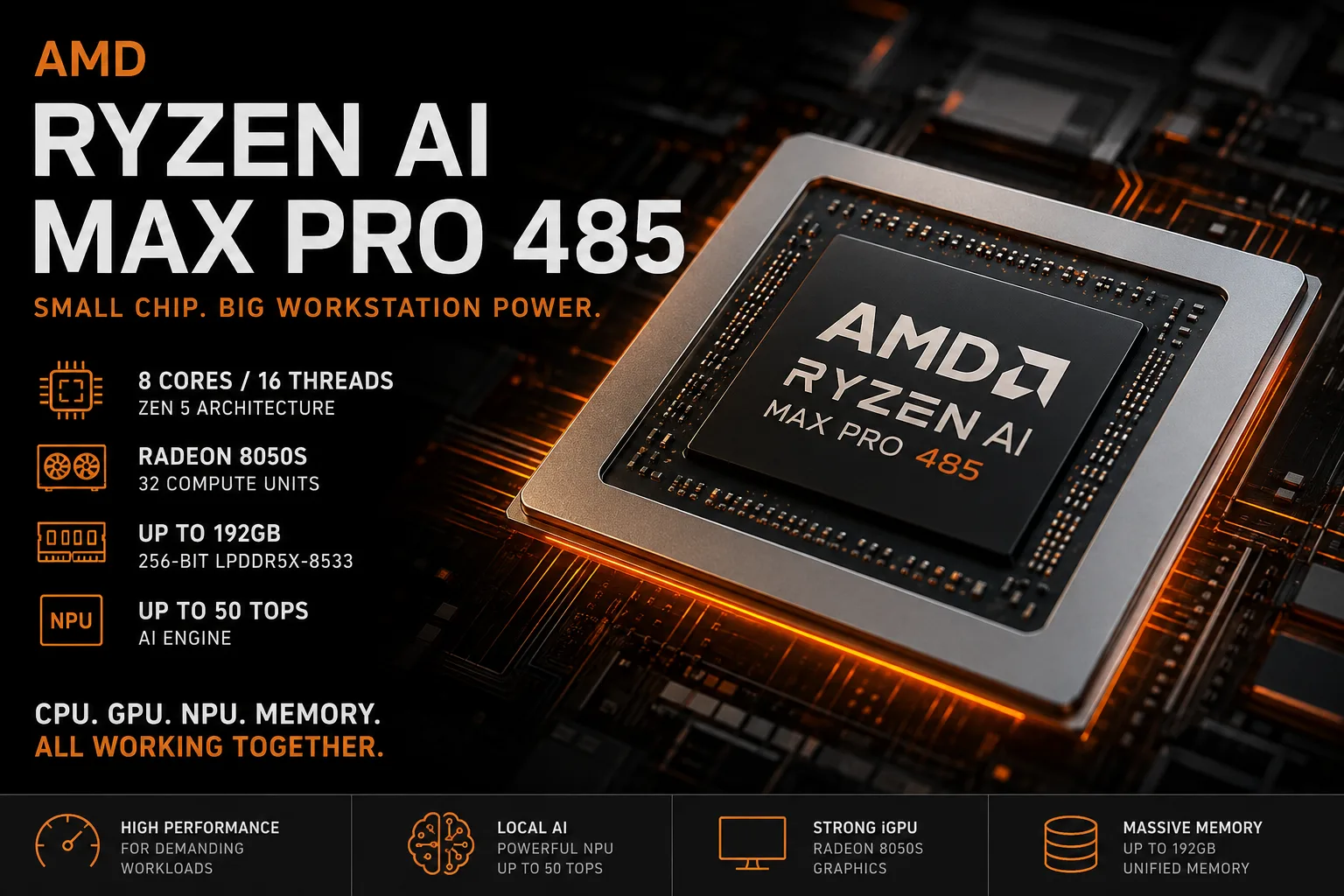
In the Ryzen AI Max PRO 400 lineup, this model sits below the Ryzen AI Max PRO 490 and Ryzen AI Max+ PRO 495. The higher versions provide more CPU cores and greater headroom for rendering, compiling, and other heavy tasks. However, the Ryzen AI Max PRO 485 retains key elements of the Halo platform: Radeon 8050S, 256-bit LPDDR5x memory, NPU with up to 50 TOPS, and support for up to 192 GB of memory. Therefore, it is not simply a "cut-down higher chip" but rather an entry-level offering into an unusual class of AMD APU.
Not your ordinary mobile Ryzen
If we look only at the CPU, the Ryzen AI Max PRO 485 seems modest: 8 cores, 16 threads, modern Zen 5 architecture, and a boost clock of up to 5.0 GHz. This is a good level for a powerful laptop or mini-PC, but such a CPU alone is no longer surprising.
The intrigue begins where typical mobile Ryzen processors leave off. The Ryzen AI Max PRO 485 utilizes large integrated graphics with the Radeon 8050S featuring 32 compute units and a frequency of up to 2800 MHz. This is not a small iGPU for mere display output, video playback, and casual gaming. Conceptually, the Radeon 8050S is one of the main components of the entire platform. AMD is betting that the CPU, GPU, NPU, and large unified memory pool will work seamlessly within a compact system without the need for a discrete graphics card.
Thus, the Ryzen AI Max PRO 485 should be viewed not just as “a processor with good integration” but as a workstation-class APU. The CPU is important, but it is not the only reason to consider this model.
Unified memory: not a new idea, but a different scale
The term unified memory can easily be misunderstood. Integrated graphics have been utilizing system RAM for years. In this sense, the Ryzen AI Max PRO 485 does not introduce anything fundamentally new: regular iGPUs also draw memory from RAM.
The distinction lies in scale. Many mobile Ryzen and Core processors configure memory as dual-channel, meaning 2 × 64 bits. The Ryzen AI Max employs a 256-bit LPDDR5x subsystem. In terms of width, this is comparable to four 64-bit channels, which is critical for such substantial integrated graphics: the Radeon 8050S requires significantly more bandwidth than a typical small iGPU.
The second aspect is volume. The Ryzen AI Max PRO 485 supports up to 192 GB of LPDDR5x-8533 memory. This does not mean that every device with this processor will have 192 GB, but the limit itself indicates the platform's intended purpose. Such a capacity is not meant for browsing and office tasks but rather for work projects, local AI, graphics, development, visualization, and scenarios where the GPU can leverage a large unified memory pool.
This is where unified memory becomes intriguing-not because shared memory for iGPUs is a new concept but because AMD has taken an old idea and scaled it up to a compact workstation level: wide LPDDR5x, robust Radeon 8050S, and a memory volume that typical mobile APUs simply do not require.
Radeon 8050S - the key argument for this model
The Radeon 8050S in the Ryzen AI Max PRO 485 is more significant than it may initially appear. In most mobile processors, integrated graphics are merely an enhancement to the CPU. Here, it becomes one of the key reasons for the chip's existence.
With 32 compute units, the Radeon 8050S stands considerably above conventional integrated solutions like the Radeon 760M, 780M, or 890M. It is still integrated graphics, but it is no longer “just an integration for display.” In a suitable device, it can be useful for video editing, graphics work, moderate 3D scenes, GPU-accelerated workloads, local AI experiments, and gaming without a discrete graphics card.
There is a downside: the Ryzen AI Max PRO 485 is highly dependent on the specific chassis. The platform's cTDP range is broad, from 45 to 120 watts. In a compact mini-PC, thin workstation, and well-cooled device, the same chip can perform differently. Therefore, the Radeon 8050S should be evaluated not only by its name but also by its implementation: cooling, power limits, and manufacturer settings.
PyTorch and local AI
The Radeon 8050S is intriguing not only as powerful integrated graphics. AMD is developing ROCm scenarios for Ryzen APUs, and the main practical focus here is on PyTorch. Therefore, the Ryzen AI Max PRO 485 can be viewed as a compact platform for local AI experiments where GPU acceleration, large memory capacity, and operation without needing to offload tasks to the cloud are essential.
This aligns well with the very concept of the Halo platform. The processor features a substantial iGPU, a 256-bit LPDDR5x setup, and up to 192 GB of unified memory pool. For some AI tasks, the available memory capacity can be just as important as raw graphical performance. Thus, the Radeon 8050S is not merely a graphics core for gaming and interfaces, but a computational resource that makes the Ryzen AI Max PRO 485 intriguing for developers and enthusiasts alike.
The "PRO" suffix also aligns with this positioning. For businesses, it signals support for enterprise features from AMD: manageability, data protection, and more predictable platform lifecycle. For the average consumer, this may not be the primary argument, but for workstations and corporate AI systems, such a version makes logical sense.
Estimated performance
The performance of the Ryzen AI Max PRO 485 should be evaluated within a range, as results heavily depend on TDP, cooling solutions, memory, and the specific device. In one chassis, the chip may operate as a quiet compact system, while in another, it might resemble a nearly full-fledged mobile workstation.
| CPU Test | Estimated Range | How to interpret the result |
|---|---|---|
| Geekbench 6 Single-Core | 2500-3000 | A high level for a single core of a modern mobile CPU |
| Geekbench 6 Multi-Core | 13500-17000 | Strong results for an 8-core Zen 5, but below 12- or 16-core Max models |
| PassMark Single Thread | 3700-4200 | Good responsiveness in regular and professional applications |
| PassMark CPU Mark | 28000-36000 | Comparable to a powerful 8-core mobile or compact processor |
The Radeon 8050S deserves particular attention: it is one of the main reasons to consider the Ryzen AI Max PRO 485. In 3DMark Time Spy Graphics, this GPU is estimated to score around 8900-10100 points. This level is already beyond that of standard mobile iGPUs, comparable to entry-level discrete graphics cards in laptops.
| Graphics Test | Estimated Range | How to interpret the result |
|---|---|---|
| 3DMark Time Spy Graphics | 8900-10100 | Extremely powerful integrated graphics, nearing entry-level discrete GPUs |
| Many games at 1080p | medium or high settings | Depends on the game, TDP, cooling, and FSR |
For the Ryzen AI Max PRO 485, the graphical performance is especially important: the CPU part here is the entry-level in the lineup, while the iGPU remains substantial. Coupled with 256-bit LPDDR5x and a large unified memory pool, the Radeon 8050S can be useful not only for gaming but also for work-intensive GPU scenarios.
How it differs from the Ryzen AI Max 385
The Ryzen AI Max PRO 485 doesn’t appear to be an entirely new chip compared to the Ryzen AI Max 385 or Ryzen AI Max PRO 385. Their basic ideas are closely aligned: 8 Zen 5 cores, Radeon 8050S, 32 CUs, and an NPU of up to 50 TOPS. Therefore, don’t expect a dramatic leap in CPU or graphics just because of the new designation.
The main distinction lies in memory and positioning. The Ryzen AI Max 300 already featured 256-bit LPDDR5x, but the new PRO 400 series elevates the maximum memory capacity to 192 GB while more closely tying the platform to local AI, workstations, and corporate systems. In essence, the Ryzen AI Max PRO 485 is a more capacious and professionally oriented version of the Halo concept, rather than a fundamentally new architecture.
For buyers, this is an important nuance. If you simply need a fast 8-core laptop, this platform may feel excessive. However, if you require the Radeon 8050S, a large unified memory pool, and PyTorch/AI scenarios, then the Ryzen AI Max PRO 485 begins to look much more appealing.
Who is the Ryzen AI Max PRO 485 for
The Ryzen AI Max PRO 485 is particularly well-suited for compact workstations, powerful mini-PCs, professional laptops, and systems for local AI experiments. This processor is designed for tasks where not only CPU performance matters but also the synergy of graphics, memory, and local computations.
It can be appropriate for development, working with local models, video editing, graphics, visualization, engineering tasks, and corporate work systems-especially where a discrete graphics card is undesirable due to size, noise, power consumption, or limited VRAM.
For an ordinary home laptop, the Ryzen AI Max PRO 485 seems excessive. For maximum CPU rendering, the higher Ryzen AI Max PRO 490 or 495 would be more logical. For a purely gaming system, a discrete graphics card will often remain more practical. However, as a compact platform with powerful iGPU and a large memory pool, this processor appears quite intriguing.
Conclusion
The AMD Ryzen AI Max PRO 485 is interesting not because it is an 8-core Zen 5 processor-there are already plenty of those. Its value lies elsewhere: it is the entry-level option in the Halo platform, featuring Radeon 8050S, 256-bit LPDDR5x memory, NPU with up to 50 TOPS, and support for up to 192 GB of memory.
It is not a universal processor for everyone. But for compact workstations and tasks where large integrated graphics and a unified memory pool are more critical than the sheer number of CPU cores, the Ryzen AI Max PRO 485 is a strong and unconventional option. It is the lowest in the lineup in terms of CPU, but not in the essence of the platform: graphics, memory, and local computations here are just as important as the CPU cores.
CPU Comparison
Compare Ryzen AI Max PRO 485 with other CPUs
Basic
CPU Specifications
Memory Specifications
GPU Specifications
Miscellaneous
Benchmarks
Compared to Other CPU
Related CPU Comparisons

Share in social media
Or Link To Us
<a href="https://cputronic.com/cpu/amd-ryzen-ai-max-pro-485" target="_blank">AMD Ryzen AI Max PRO 485</a>