AMD Ryzen 9 180
AMD Ryzen 9 180: Why the New Ryzen 9 is Slower than the Ryzen 7 8845HS
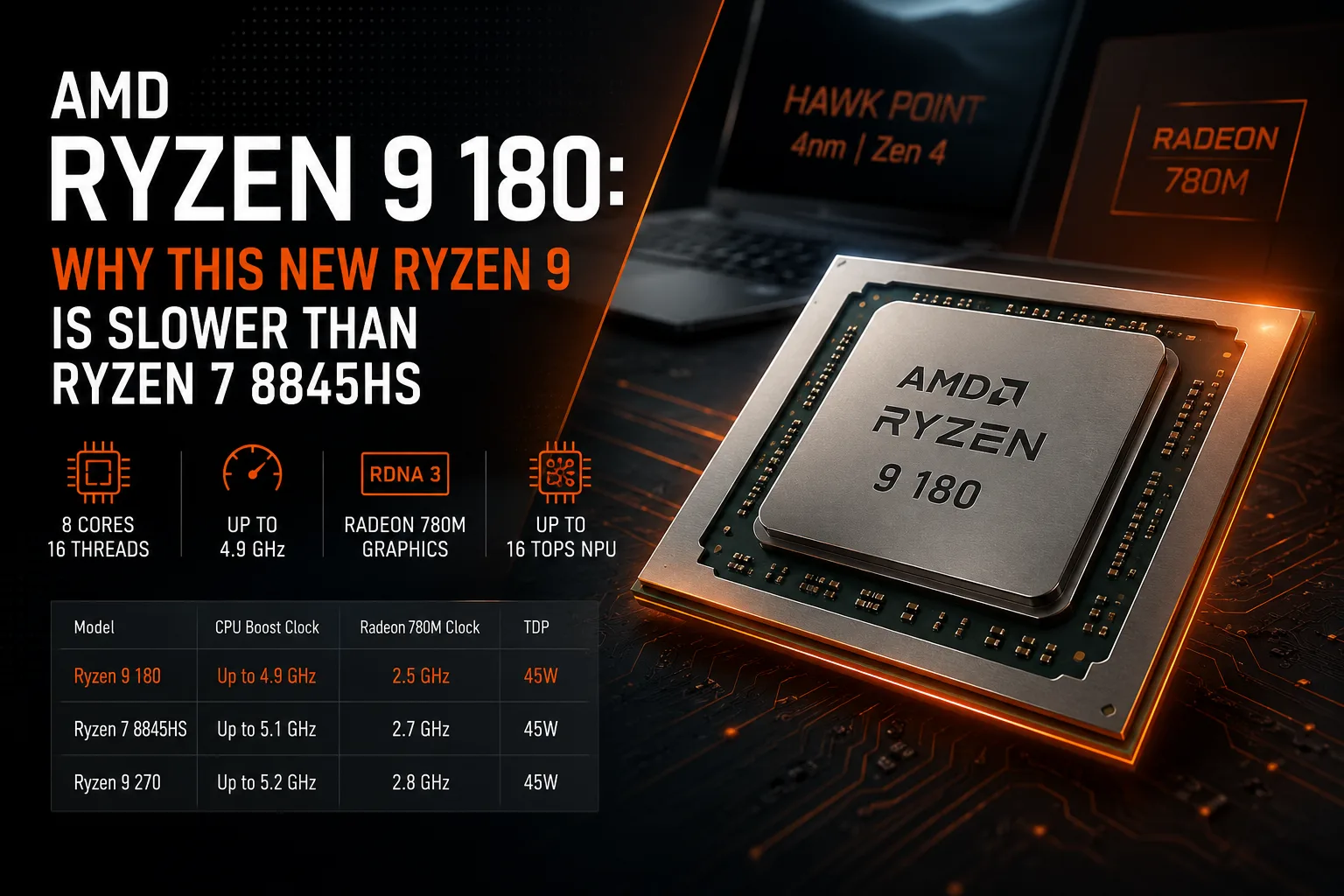
The Ryzen 9 180 has received a higher designation in AMD's new mobile series, but calling it a flagship is difficult. In terms of configuration, it follows the familiar Hawk Point architecture with eight cores, Radeon 780M graphics, and a first-generation NPU. However, both the CPU and integrated GPU frequencies are lower than those of the Ryzen 7 8845HS.
Thus, the main question is not how fast the Ryzen 9 180 is, but rather why AMD felt the need to release it under the Ryzen 9 name.
Familiar Hawk Point Under a New Index
The Ryzen 9 180 is manufactured using a 4nm process and features eight cores with support for sixteen threads. The maximum frequency reaches 4.9 GHz, the third-level cache is 16 MB, and the standard TDP is 45 W with the possibility of adjustment in a range from 35 to 54 W.
The processor belongs to the Hawk Point platform, which has already been used in the Ryzen 8000HS and some models of the Ryzen 200 series. There is no fundamentally new architecture, graphics, or NPU here. The Ryzen 9 180 is just another version of the familiar chip, differing in frequencies and its position in AMD's catalog.
A particular point of confusion is the official specification, which lists the architecture of the processor as Zen 3+. Other parameters contradict this: the codename Hawk Point, 4nm process, RDNA 3-based Radeon 780M graphics, and the presence of an NPU are characteristic of the Zen 4 platform.
Based on the combination of characteristics, the mention of Zen 3+ appears to be an error in the description. However, until AMD corrects the product page, this remains a reasonable conclusion rather than an official clarification from the company.
Ryzen 9 Only by Name
The position of the new processor is best illustrated when compared to other versions of Hawk Point.
| Processor | Cores / Threads | CPU Frequencies | Radeon 780M Frequency | NPU | TDP |
|---|---|---|---|---|---|
| Ryzen 9 180 | 8 / 16 | 3.6-4.9 GHz | 2.5 GHz | up to 16 TOPS | 45 W |
| Ryzen 7 8845HS | 8 / 16 | 3.8-5.1 GHz | 2.7 GHz | up to 16 TOPS | 45 W |
| Ryzen 9 270 | 8 / 16 | 4.0-5.2 GHz | 2.8 GHz | up to 16 TOPS | 45 W |
The Ryzen 9 180 uses the same base configuration but has the lowest frequencies in this trio. Even the Ryzen 7 8845HS operates faster both in CPU performance and integrated graphics.
The difference is not significant, but it illustrates how little the Ryzen 9 designation now conveys. A higher class in name does not guarantee a new architecture, additional cores, or an advantage over Ryzen 7 models.
With the same cooling solution, the Ryzen 7 8845HS and the Ryzen 9 270 should be faster. In real laptops, the gap can either narrow or widen due to power settings, temperature, and cooling system quality.
What Performance to Expect
Eight cores and sixteen threads allow the Ryzen 9 180 to be used not only in office models but also in laptops for programming, photo processing, editing, and compiling large projects.
However, the Ryzen 9 name should not create expectations on par with modern flagship mobile processors. There are no twelve or sixteen cores, no new Zen 5 architecture, or powerful NPU. In terms of CPU capabilities, it is more akin to the upper end of the mass market segment rather than a full-fledged flagship.
The maximum frequency of 4.9 GHz also limits single-threaded performance compared to faster versions of Hawk Point. The difference in everyday tasks will be small, but in rendering, compiling, and prolonged workloads, the Ryzen 9 180 won't gain an advantage solely due to the "9" in its name.
For a specific laptop, it is more important to check:
- the sustained power limit of the processor under long loads;
- temperature and noise levels;
- the volume and speed of RAM;
- the ability to operate without noticeable frequency drops.
A well-tuned Ryzen 9 180 can outperform a formally faster chip in a thin chassis. But this will be a result of the laptop, not the processor itself.
Radeon 780M Without Maximum Frequencies
The integrated Radeon 780M has 12 RDNA 3 compute units and operates at a frequency of up to 2.5 GHz. The GPU configuration is not scaled back, but its frequency is lower than that of the Ryzen 7 8845HS and Ryzen 9 270.
This means that the Ryzen 9 180 is not the fastest implementation of the Radeon 780M. With the same memory, it will slightly lag behind the higher-end versions of Hawk Point, although in a real laptop, the result will again depend on power limits and cooling.
The key factor for integrated graphics remains the memory bandwidth. The Radeon 780M does not have its own video memory, so a configuration with fast LPDDR5x can significantly outperform a laptop with standard DDR5.
For gaming and graphic tasks, it is advisable to choose a model with at least 16 GB of memory in dual-channel mode. If the memory is soldered and not replaceable, a configuration with 32 GB looks more reasonable, as a portion of the capacity will be continuously used by the integrated graphics.
Radeon 780M allows for running online games and less demanding projects without a discrete graphics card. In modern heavy games, lower settings, image scaling, and sometimes dropping below 1080p will be required. The presence of a Ryzen 9 in the name does not change the situation-the performance of the GPU is still defined by the same Radeon 780M.
Ryzen AI is Present, but Capabilities are Limited
The Ryzen 9 180 features a first-generation NPU with performance of up to 16 TOPS. It can accelerate background blur, noise suppression, image processing, and other functions in software that supports AMD XDNA.
However, by modern standards, this NPU is already weak. The Copilot+ PC category requires at least 40 TOPS, so the Ryzen 9 180 does not belong to the current generation of AI laptops, despite supporting Ryzen AI.
The practical value of the NPU will depend on the specific software. For the majority of users, the eight CPU cores, Radeon 780M, and the amount of RAM will be of greater importance.
For locally running generative models, the Ryzen 9 180 also does not appear to be a specialized solution. Smaller models can be used, but for serious AI work, a discrete graphics card or a newer platform with a more powerful NPU is preferable.
The Platform is Still Relevant
Reusing the Hawk Point architecture does not make the processor outdated. The Ryzen 9 180 supports PCI Express 4.0, fast memory, and USB4 with speeds of up to 40 Gbps. The integrated graphics can output through modern versions of DisplayPort and HDMI.
For a mass-market laptop, this is sufficient. The absence of PCIe 5.0 will rarely become a real limitation, especially in models without a powerful discrete graphics card.
However, processor support for an interface does not mean that the laptop manufacturer will necessarily implement it. A specific model may lack USB4, a second slot for SSDs, or a full-fledged video output. Therefore, it is necessary to evaluate the entire configuration, not just the CPU name.
When the Ryzen 9 180 Makes Sense
A laptop with the Ryzen 9 180 is worth considering in three scenarios:
- It is significantly cheaper than comparable models with the Ryzen 7 8845HS or Ryzen 9 270.
- The manufacturer offers a good screen, cooling, and 32 GB of fast memory.
- Strong integrated graphics are needed, but a discrete graphics card is not required.
Overpaying for the Ryzen 9 designation makes little sense. The Ryzen 7 8845HS uses the same platform and has received higher frequencies. The Ryzen 9 270 also looks more preferable based on the claimed specifications.
Particularly careful comparisons should be made between finished laptops rather than processors in isolation. A model with the Ryzen 9 180 may turn out to be a better value due to a better screen, battery, or cooling system. But with the same price and other specifications, there are few reasons to choose it over the Ryzen 7 8845HS.
Conclusion
The AMD Ryzen 9 180 is not a new mobile flagship, but yet another version of Hawk Point. It has eight cores, Radeon 780M, and a 16 TOPS NPU, but operates at lower frequencies than the Ryzen 7 8845HS and Ryzen 9 270.
The processor itself cannot be called weak. Its performance is sufficient for work tasks, programming, content processing, and gaming on integrated graphics. The problem lies in the name, which promises more than the actual configuration delivers.
The Ryzen 9 180 makes sense only within a well-balanced and fairly priced laptop. Buying it for the sake of the Ryzen 9 label is unwise: in this part of AMD's catalog, the number in the name no longer reflects the true standing of the processor.
CPU Comparison
Compare Ryzen 9 180 with other CPUs
Basic
CPU Specifications
Memory Specifications
GPU Specifications
Miscellaneous
Share in social media
Or Link To Us
<a href="https://cputronic.com/cpu/amd-ryzen-9-180" target="_blank">AMD Ryzen 9 180</a>