AMD Ryzen 5 125

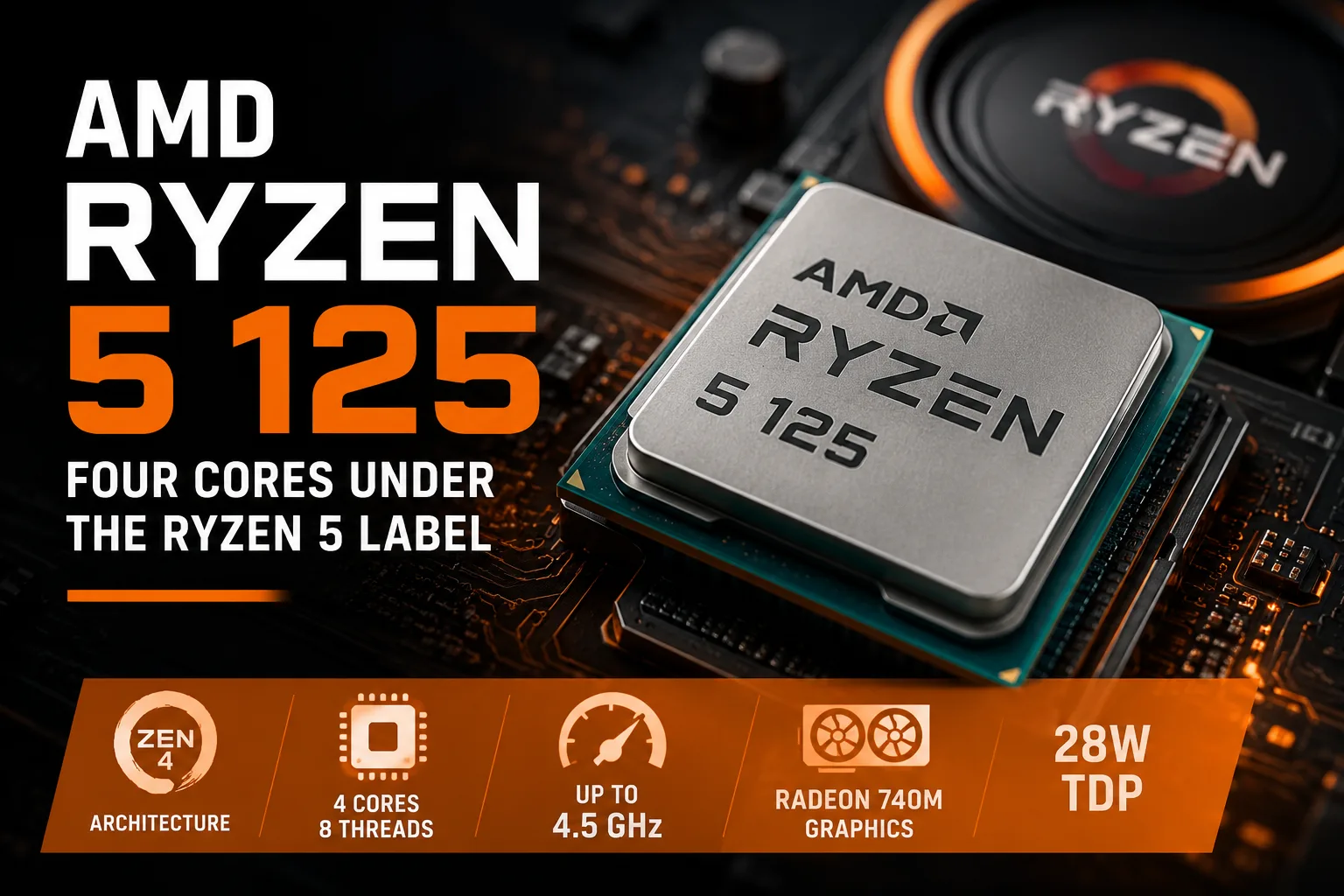
AMD Ryzen 5 125: Four Cores Under the Ryzen 5 Label
The AMD Ryzen 5 125 features four Zen 4 cores and eight threads-a modest configuration for a mobile Ryzen 5. In terms of architecture, it is closer to the Ryzen 3 8440U, so the high designation here does not imply a corresponding boost in multi-threaded performance.
The processor is based on a 4nm Hawk Point die. Its base clock speed is 2.8 GHz, with a maximum boost of 4.5 GHz. The L3 cache size is 8 MB, and its nominal TDP is 28 watts. Laptop manufacturers can adjust the power consumption within the range of 15-40 watts.
The integrated Radeon 740M is based on RDNA 3 architecture, contains four compute units, and can boost up to 2.3 GHz.
Laptops with AMD Ryzen 5 125
Currently, the Ryzen 5 125 is mainly found in budget models from Lenovo designed for work, study, and home use.
| Laptop | Size | RAM | Storage |
|---|---|---|---|
| Lenovo IdeaPad Slim 3 14AHP10 | 14 inches | 16 GB DDR5-4800 | 512 GB SSD |
| Lenovo IdeaPad Slim 3 16AHP10 | 16 inches | 8 GB DDR5-4800 | 512 GB SSD |
| Lenovo V15 G6 ARP | 15 inches | 16 GB DDR5-4800 | 512 GB SSD |
Configurations with 16 GB of memory are preferred. For Windows 11, browsing, and multiple concurrently open applications, 8 GB can quickly become a limitation, especially if the memory is soldered or only one slot is available.
There are currently too few independent tests of the Ryzen 5 125 to confidently compare specific laptops. The results from Ryzen 3 7440U and Ryzen 3 8440U should not be taken as benchmarks for the new model: the outcome depends not only on CPU clock speeds but also on power limits, cooling solutions, and memory configurations.
CPU Performance
Zen 4 delivers high performance in single-threaded tasks and short bursts of load. In browsing, office applications, and video calls, the lack of CPU performance should not be apparent. In typical use cases, delays are more likely to stem from insufficient memory rather than the CPU itself.
The limitation of the Ryzen 5 125 lies in its four cores. During tasks such as compilation, rendering, video editing, and dealing with large archives, eight threads quickly become inadequate. Six-core models like the Ryzen 5 150, Ryzen 5 8540U, and Ryzen 5 8640U handle sustained workloads better and are suitable for regular heavy use.
The closest analog to the Ryzen 5 125 is the Ryzen 3 8440U. Both processors have four cores, eight threads, 8 MB of L3 cache, and Radeon 740M graphics. However, the Ryzen 3 8440U can boost up to 4.7 GHz, while its integrated graphics can reach 2.5 GHz. The maximum frequencies for the Ryzen 5 125 are reduced to 4.5 GHz and 2.3 GHz, respectively.
The paradox is that the Ryzen 5 125 has lower claimed frequencies than the Ryzen 3 8440U. Thus, the main argument in its favor might only be the appealing price of the entire laptop rather than the processor's name.
Radeon 740M Capabilities
The Radeon 740M is the entry-level integrated graphics on RDNA 3 architecture. Its capabilities are sufficient for video playback, connecting multiple displays, and basic image processing.
Less demanding and competitive games can run on low settings. More demanding games will require lowering the resolution to 720p or 900p and enabling scaling. For new games at Full HD, the Radeon 740M is too weak.
In terms of performance, it significantly lags behind Radeon 760M and Radeon 780M. A laptop with the Ryzen 5 125 is suitable for older games, less demanding online projects, and occasional sessions, but it cannot replace a model with a discrete graphics card.
For the Radeon 740M, dual-channel memory is important. Using only one DDR5 module reduces memory bandwidth and further limits the integrated graphics. If the laptop allows for a second module to be installed, doing so will increase memory bandwidth and help the Radeon 740M unleash its available performance more effectively.
Who Should Consider the Ryzen 5 125
The Ryzen 5 125 is suitable for budget work and study laptops. The four Zen 4 cores are adequate for everyday tasks, but in rendering, editing, and other prolonged workloads, six-core models are significantly faster.
A laptop with this processor should only be considered if there is a considerable price difference, preferably equipped with 16 GB of RAM. If there is only a slight additional cost for the Ryzen 5 150, Ryzen 5 8540U, or Ryzen 5 8640U, it is better to choose a six-core model.
CPU Comparison
Compare Ryzen 5 125 with other CPUs
Basic
CPU Specifications
Memory Specifications
GPU Specifications
Miscellaneous
Benchmarks
Compared to Other CPU
Related CPU Comparisons

Share in social media
Or Link To Us
<a href="https://cputronic.com/cpu/amd-ryzen-5-125" target="_blank">AMD Ryzen 5 125</a>