Qualcomm Snapdragon 8 Gen 4
vs
Qualcomm Snapdragon 8s Gen 4

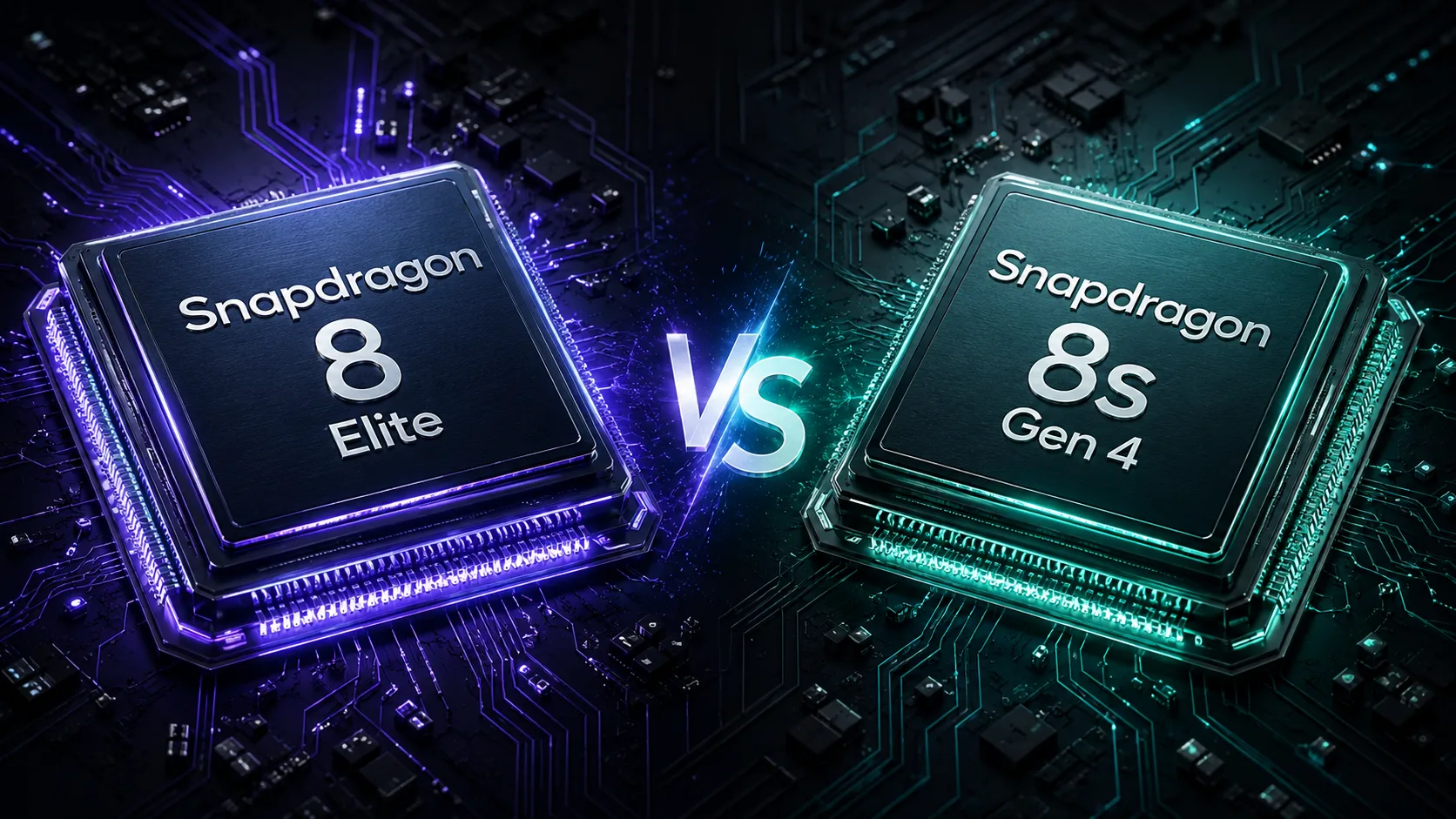
SoC Comparison Result
Qualcomm Snapdragon 8 Elite / 8 Gen 4 vs Snapdragon 8s Gen 4: What's the Difference
Snapdragon 8 Gen 4 and Snapdragon 8s Gen 4 can easily be confused by name, but these are chips from different classes. Snapdragon 8 Gen 4 was released in real devices as Snapdragon 8 Elite - Qualcomm's flagship platform for 2024/2025. Snapdragon 8s Gen 4 is a separate sub-flagship SoC, not just a slightly throttled version of the Elite.
Summary
Snapdragon 8 Elite is the choice for expensive flagships. It is more powerful in CPU, faster in graphics, better suited for heavy gaming, camera phones, local AI, and smartphones with a significant performance reserve.
Snapdragon 8s Gen 4 is a more rational choice for devices priced lower than classic flagships. It is also very fast, but it lags behind Elite in CPU architecture, GPU, modem, and overall power reserve.
The key difference is simple: Snapdragon 8 Elite represents maximum capabilities, while Snapdragon 8s Gen 4 offers high performance for more reasonable money.
Key Differences
| Characteristic | Snapdragon 8 Elite / 8 Gen 4 | Snapdragon 8s Gen 4 |
|---|---|---|
| Class | Flagship | Sub-Flagship |
| CPU | Qualcomm Oryon | Qualcomm Kryo |
| CPU Configuration | 2 Prime Oryon cores + 6 Performance Oryon cores | 1 Cortex-X4 + 7 Cortex-A720 |
| Maximum Frequency | up to 4.47 GHz, in some devices up to 4.32 GHz | up to 3.2 GHz |
| GPU | Adreno 830 | Adreno 825 |
| Process Technology | 3 nm | 4 nm |
| Modem | Snapdragon X80 5G | Snapdragon 5G Modem-RF |
| Peak 5G Download Speed | up to 10 Gbps | up to 4.2 Gbps |
| Typical Devices | expensive flagships | powerful smartphones cheaper than flagships |
The main difference of Snapdragon 8 Elite is the custom Oryon cores. This is not just an increase in frequencies, but a more serious change in CPU architecture. Snapdragon 8s Gen 4 uses a more familiar ARM Cortex scheme, and therefore is closer in spirit to past flagship Snapdragons than to the new Elite.
Performance and Benchmarks
In regular tasks, both chips will feel fast: interface, browser, messengers, social networks, YouTube, and navigation will not create problems for either of them.
The difference is more noticeable in heavy scenarios: gaming, emulation, video editing, photo processing, and prolonged loads. Here, Snapdragon 8 Elite is faster in single-threaded tasks, stronger in multi-threading, and better performs in smartphones with good cooling.
Snapdragon 8s Gen 4 cannot be called weak either. It is a fast sub-flagship chip that approaches the level of recent flagships in many tasks. But compared to Snapdragon 8 Elite, it ranks a notch lower.
| Benchmark | Snapdragon 8 Elite / OnePlus 13 | Snapdragon 8s Gen 4 / iQOO Z10 Turbo Pro |
|---|---|---|
| Geekbench 6 Single-Core | around 2900 | around 2200 |
| Geekbench 6 Multi-Core | around 8900 | around 7100 |
| AnTuTu 11 | around 3.1 million | around 2.4 million |
| 3DMark Steel Nomad Light | around 2450 | around 1800 |
| 3DMark Solar Bay | around 11,300 | around 7600 |
These numbers should be viewed as a reference. Final scores depend on cooling, firmware, power limits, memory, and the specific smartphone. But the overall gap is clear: Snapdragon 8 Elite is faster, especially in graphics and prolonged loads.
Gaming and Graphics
For gaming, Snapdragon 8 Elite is preferable. Its Adreno 830 is more powerful than the Adreno 825 in Snapdragon 8s Gen 4, making it better suited for maximum settings, high FPS, and heavy scenes in modern games.
Snapdragon 8s Gen 4 also remains a strong gaming solution. In popular titles like PUBG Mobile, Call of Duty Mobile, Genshin Impact, and Honkai: Star Rail, its performance is more than adequate. However, if maximum performance is needed for several years, Elite looks more convincing.
At the same time, much depends on the specific smartphone. Good cooling in a model with Snapdragon 8s Gen 4 can yield more stable results than a weak cooling system in a slim flagship with Snapdragon 8 Elite.
Camera, AI, and Connectivity
Snapdragon 8 Elite is better suited for expensive camera phones: it has more capacity for photo and video processing, night modes, stabilization, and local AI features. However, the final camera quality still depends not only on the SoC but also on sensors, optics, and manufacturer algorithms.
In smartphones with Snapdragon 8s Gen 4, savings are often not made on speed but on secondary cameras, optics, memory, or cooling. Therefore, a device with 8s Gen 4 can be very fast but may not always compete with full-fledged flagships in photo and video quality.
In terms of connectivity, Snapdragon 8 Elite is also a higher class: it has a more advanced modem block and greater 5G capabilities. Snapdragon 8s Gen 4 is simpler, but for most users, this is sufficient: mobile internet, Wi-Fi, Bluetooth, and navigation will remain up to modern standards.
Smartphones with These Chips
Examples of devices clearly demonstrate the positioning of the platforms:
| Snapdragon 8 Elite | Snapdragon 8s Gen 4 |
|---|---|
| OnePlus 13 | Poco F7 |
| Xiaomi 15 | Nothing Phone (3) |
| Samsung Galaxy S25 Ultra | Redmi Turbo 4 Pro |
| iQOO 13 | iQOO Z10 Turbo Pro |
Snapdragon 8 Elite is more commonly found in expensive flagships with strong cameras, premium designs, and a complete set of features. Snapdragon 8s Gen 4 is usually used where speed, screen, battery, and price are more important.
Conclusion: Which to Choose
Snapdragon 8 Elite / 8 Gen 4 should be chosen if a true flagship is needed: maximum performance, best gaming capabilities, strong camera, fast modem, advanced AI, and power reserve for several years.
Snapdragon 8s Gen 4 is better suited if you want a powerful smartphone for less than flagship prices. For everyday tasks, gaming, social media, video, browsing, and most demanding applications, its performance is sufficient.
Overpaying for Snapdragon 8 Elite for regular tasks is not always reasonable. If the user is not gaming at maximum settings, not shooting a lot of video, and not using heavy applications, Snapdragon 8s Gen 4 could prove to be a more cost-effective purchase.
The conclusion is simple: Snapdragon 8 Elite is for those who need the maximum. Snapdragon 8s Gen 4 is for those who value a balance of price, speed, and practicality.
Advantages
- Higher Technology: 3 nm (3 nm vs 4 nm)
- Higher Frequency: 4000 MHz (4000 MHz vs 3200 MHz)
- Newer Launch Date: April 2025 (October 2024 vs April 2025)
Basic
6x 0 GHz – Cortex-A730
3x 3 GHz – Cortex-A720
2x 2.8 GHz – Cortex-A720
2x 2.02 GHz – Cortex-A720
GPU Specifications
Connectivity
Memory Specifications
Miscellaneous
- AIFF
- CAF
- MP3
- MP4
- WAV
- H.265
- AV1
- VP9
Benchmarks
Related SoC Comparisons




Share in social media
Or Link To Us
<a href="https://cputronic.com/soc/compare/qualcomm-snapdragon-8-gen-4-vs-qualcomm-snapdragon-8s-gen-4" target="_blank">Qualcomm Snapdragon 8 Gen 4 vs Qualcomm Snapdragon 8s Gen 4</a>