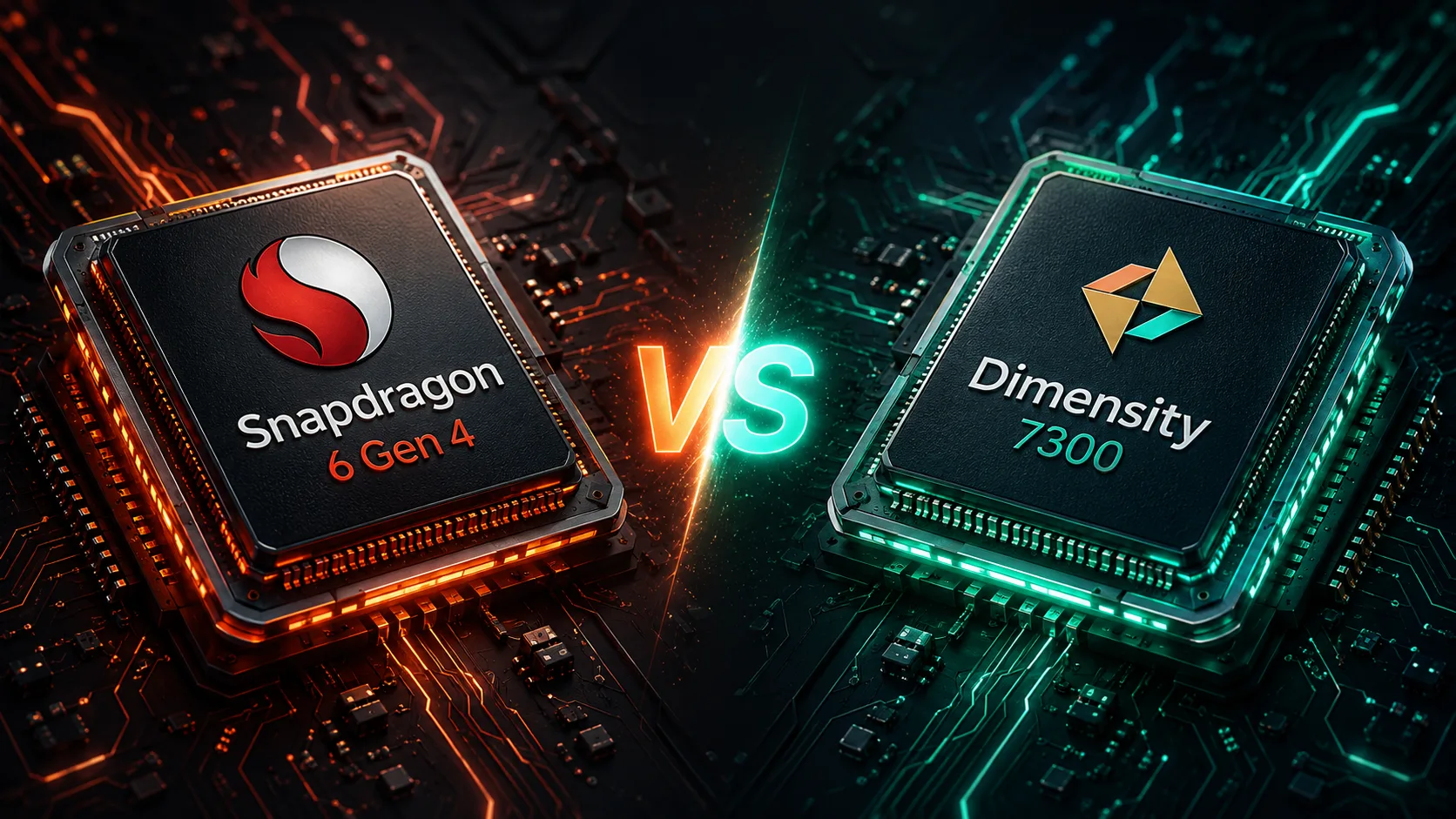
Qualcomm Snapdragon 6 Gen 4
vs
MediaTek Dimensity 7300
SoC Comparison Result
Snapdragon 6 Gen 4 vs Dimensity 7300: Why Qualcomm is Faster at Lower Frequencies
Four performance cores of the Dimensity 7300 can be boosted up to 2.5 GHz, but the Snapdragon 6 Gen 4, with its peak frequency of 2.3 GHz, is generally faster in most CPU tests. Its modern architecture allows it to accomplish more work per clock cycle, so MediaTek's advantage in megahertz does not translate to a performance edge.
The gap between the platforms is small. Both are aimed at mid-range smartphones, produced using a 4nm process, support similar memory standards, cameras of up to 200 MP, and modern wireless interfaces. Overall, Snapdragon is stronger, but when choosing a smartphone, the display, camera, cooling, and support lifespan are often more important than the processor.
| Area | Who is Ahead |
|---|---|
| CPU Performance | Snapdragon 6 Gen 4 |
| Gaming and Emulators | Snapdragon 6 Gen 4 |
| Energy Efficiency | No clear leader |
| Cameras | Depends on the smartphone |
| Connectivity | Parity |
| Local AI Functions | Snapdragon 6 Gen 4 |
Modern Architecture Bridges the Frequency Gap
The Snapdragon 6 Gen 4 features a configuration of “1+3+4”: one high-performance core runs at up to 2.3 GHz, three performance cores at up to 2.2 GHz, and four efficiency cores at up to 1.8 GHz. It utilizes Armv9 architecture and newer Cortex-A720 and Cortex-A520 cores.
The Dimensity 7300 is structured as “4+4”: four Cortex-A78 cores can run up to 2.5 GHz, while four Cortex-A55 cores can reach up to 2.0 GHz. While the frequencies are higher, the cores belong to the previous generation.
In Geekbench 6, Snapdragon typically outperforms its competitor by about 5-7% in single-threaded tasks and up to 10% in multi-threaded tasks. The difference is small, but it can manifest in demanding web pages, photo editing, and file decompression.
The Dimensity 7300 cannot be called slow. Its four performance cores help reduce the gap in sustained multi-threaded workloads. However, in short everyday operations, Snapdragon often retains the advantage.
Adreno is Better Suited for Gaming and Emulators
The Snapdragon 6 Gen 4 is equipped with Adreno graphics and supports image scaling, software frame rate boosts, and other Snapdragon Elite Gaming features. These are beneficial in games optimized for Qualcomm graphics.
The Dimensity 7300 uses the Mali-G615 MP2 and the HyperEngine package, which manages load, network, and energy consumption. However, this graphics unit is not designed for stable performance in heavy games at maximum settings.
The advantage of Adreno varies by test. In compute-heavy workloads, it can be considerable, while in demanding 3D graphics, results are often close. Thus, the main advantage of Snapdragon is not a significant increase in FPS but rather fewer issues with games and emulators.
Both platforms are better suited for medium graphics settings. Under sustained loads, the final frame rate is more influenced by cooling and the power limits of a specific smartphone. A well-optimized model on Dimensity 7300 can run more stably than a slim device on Snapdragon 6 Gen 4.
There is No Clear Winner in Battery Life
Both platforms are produced using a 4nm process and target smartphones within the same price segment. The newer energy-efficient cores give Snapdragon a potential edge, but the overall processor specifications do not reliably predict device runtime.
Battery life is more heavily influenced by the display, battery capacity, modem settings, background services, and power constraints. Two smartphones using the same processor can differ in runtime more than models powered by Snapdragon and Dimensity.
Snapdragon's AI Accelerator Supports Newer Formats
The Hexagon NPU in the Snapdragon 6 Gen 4 supports INT4 computations. These allow for reducing the size of local AI models and lowering RAM requirements.
The NPU 655 in the Dimensity 7300 is primarily used for camera processing, noise reduction, and voice functions. It also accelerates local algorithms, but MediaTek reveals less information about working with compact generative models.
However, INT4 support alone does not guarantee a broader range of AI features. It all depends on the manufacturer's software and available memory. In smartphones of this class, NPU mainly serves camera algorithms.
Cameras: Identical 200 MP Sensors Offer No Guarantees
Both platforms support sensors with resolutions of up to 200 MP and 4K video recording at 30 frames per second. Snapdragon employs a triple 12-bit ISP Spectra, while Dimensity uses a 12-bit Imagiq 950.
Image quality is more dependent on the sensor, optics, and manufacturer algorithms. Factors such as optical stabilization and the quality of HDR, night mode, and face processing are much more crucial.
A smartphone powered by Dimensity 7300 with a good sensor and optics could outperform an inexpensive model using Snapdragon 6 Gen 4. The processor's name alone cannot determine camera quality.
No Clear Advantage in Connectivity Features
The Dimensity 7300 supports 5G in the sub-6 GHz range, aggregation of three carriers, Wi-Fi 6E, and Bluetooth 5.4. The Snapdragon 6 Gen 4 also supports Wi-Fi 6E and Bluetooth 5.4, and in certain configurations, mmWave.
MediaTek claims a slightly higher maximum download speed, but in real mobile networks, the difference does not play a significant role. More important are the supported bands, antenna quality, and device firmware.
What to Choose
At the same price, Snapdragon 6 Gen 4 is preferable. It is faster in CPU tasks and better suited for gaming and emulators thanks to Adreno graphics. INT4 support also gives it more potential for local AI models, although manufacturers rarely leverage this advantage in practice.
Choose Dimensity 7300 if a smartphone using it is cheaper or better equipped. A quality display, optical stabilization, a large battery, and long support are more important than a few percentage points in tests.
Snapdragon 6 Gen 4 wins in processor comparisons, but not necessarily in comparisons of finished devices. Therefore, it’s essential to choose a smartphone, not just a processor: display, camera, cooling, and support duration are more critical than a slight performance gap.
Advantages
- Newer Launch Date: February 2025 (February 2025 vs June 2024)
- Higher Frequency: 2500 MHz (2300 MHz vs 2500 MHz)
Basic
3x 2.2 GHz – Kryo Gold (Cortex-A720)
4x 1.8 GHz – Kryo Silver (Cortex-A520)
GPU Specifications
Connectivity
Memory Specifications
Miscellaneous
- AIFF
- CAF
- MP3
- MP4
- WAV
- H.265
- VP9
Benchmarks
Comparison of Devices
Related SoC Comparisons




Share in social media
Or Link To Us
<a href="https://cputronic.com/soc/compare/qualcomm-snapdragon-6-gen-4-vs-mediatek-dimensity-7300" target="_blank">Qualcomm Snapdragon 6 Gen 4 vs MediaTek Dimensity 7300</a>