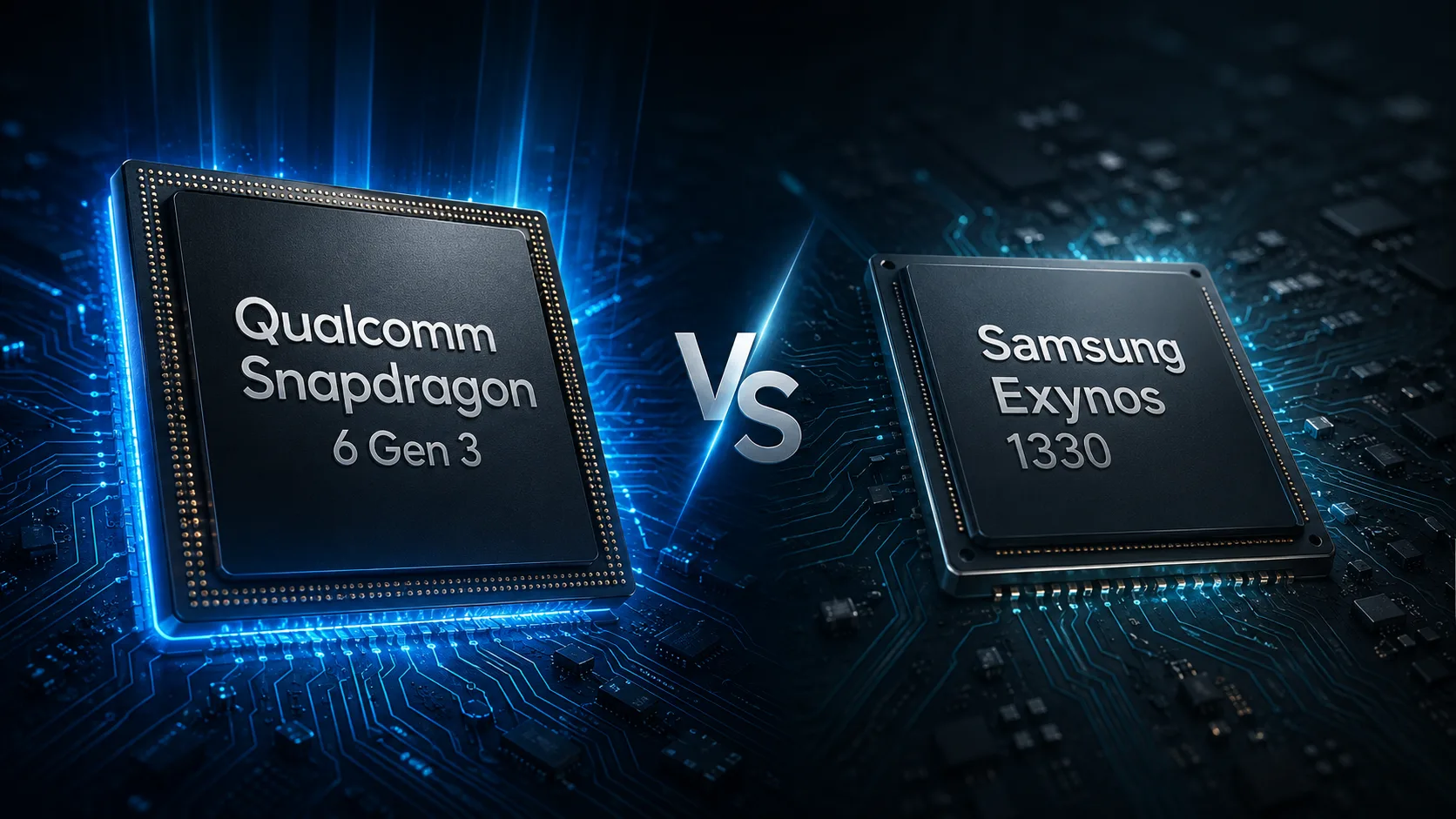
Qualcomm Snapdragon 6 Gen 3
vs
Samsung Exynos 1330

SoC Comparison Result
Qualcomm Snapdragon 6 Gen 3 vs Samsung Exynos 1330: Why This Is Not an Equal Match
Qualcomm Snapdragon 6 Gen 3 and Samsung Exynos 1330 are both formally categorized in the budget 5G segment, but comparing them as equals is incorrect. The Exynos 1330 serves as the foundation for inexpensive Samsung smartphones, where the primary goal is to provide 5G, reasonable battery life, and acceptable everyday performance. Snapdragon 6 Gen 3 is positioned higher: it has a stronger CPU, noticeably better graphics, and a greater performance headroom for several years of use.
The main difference lies not in the name or frequency, but in the core configuration. Snapdragon 6 Gen 3 features four powerful Cortex-A78 cores, while Exynos 1330 has only two. For simple tasks, this may not always be evident, but under heavy workloads, the difference quickly becomes apparent: a smartphone with Snapdragon handles multitasking more confidently, processes photos faster, operates more stably in browsers, and performs better in games.
Key Differences
| Characteristic | Snapdragon 6 Gen 3 | Exynos 1330 |
|---|---|---|
| Manufacturing Process | 4 nm | 5 nm |
| CPU | 4× Cortex-A78 + 4× Cortex-A55 | 2× Cortex-A78 + 6× Cortex-A55 |
| Maximum Frequency | up to 2.4 GHz | up to 2.4 GHz |
| GPU | Adreno 710 | Mali-G68 MP2 |
| Camera | up to 200 MP | up to 108 MP |
| Video | 4K 30 fps | 4K 30 fps |
| Typical Devices | mid-range 5G class | budget Samsung Galaxy models |
| Positioning | more powerful mid-range segment | budget 5G segment |
On paper, both chips have 8 cores and a frequency of up to 2.4 GHz, but this is one of those cases where identical numbers can be misleading. The four fast cores in Snapdragon 6 Gen 3 provide a noticeable advantage in tasks where the entire CPU block is loaded, not just a single core.
Performance
In everyday tasks, both chips can handle messengers, YouTube, browsers, navigation, and banking apps. However, the Snapdragon 6 Gen 3 will feel more responsive, especially with active smartphone usage: many tabs open in the browser, switching between apps, camera usage, background processes, and installing updates.
The typical results in Geekbench 6 and AnTuTu 10 highlight the gap well:
| Test | Snapdragon 6 Gen 3 | Exynos 1330 |
|---|---|---|
| Geekbench 6 Single-Core | around 1000 | around 880-950 |
| Geekbench 6 Multi-Core | around 2900-3000 | around 1900-2000 |
| AnTuTu 10 | around 840K | around 420K |
These numbers depend on the specific smartphone, memory, cooling, and firmware version, so they should not be viewed as absolutely fixed. However, the trend is clear: Snapdragon 6 Gen 3 is noticeably faster, especially under multi-threaded workloads.
Graphics and Gaming
In gaming, the advantages of Snapdragon 6 Gen 3 become even more pronounced. Adreno 710 is generally better suited for the mid-range market than Mali-G68 MP2 in Exynos 1330. This does not make the Snapdragon 6 Gen 3 a gaming flagship, but it allows more freedom with graphics settings and greater FPS stability.
Exynos 1330 is adequate for casual games, light projects, and not-too-demanding online games. However, in more demanding titles, it will quickly require a reduction in settings. Snapdragon 6 Gen 3 should not be purchased as a replacement for flagship chips, but it offers significantly better performance for a budget smartphone.
Camera, Connectivity, and Multimedia
Snapdragon 6 Gen 3 appears more modern in terms of platform capabilities. It supports cameras up to 200 MP, Wi-Fi 6/6E, and has a more advanced image processing block. Of course, photo quality depends not only on the processor: the sensor, optics, and manufacturer's algorithms are all important. However, Qualcomm's platform has higher potential.
Exynos 1330 is simpler: camera support is up to 108 MP, 4K video at 30 fps, 5G, and a sufficient feature set for a budget smartphone. The issue is not that it is bad, but that it is often placed in simpler devices-with slower memory, basic screens, and modest cooling. Therefore, in real-world usage, smartphones with Exynos 1330 often feel cheaper not only because of the chip itself.
Smartphones and Model Selection
Snapdragon 6 Gen 3 can be found in models like the Motorola Moto G75 5G and Samsung Galaxy A36 5G. These already fall into the mid-range category, where not only 5G and battery life matter, but also performance headroom.
Exynos 1330 is almost exclusively tied to Samsung smartphones. It appears in inexpensive Galaxy A, M, and F series models, such as Galaxy A14 5G, Galaxy M14 5G, and Galaxy F14 5G. This is an important practical point: the choice of devices with Exynos 1330 is essentially limited to the Samsung ecosystem, while Snapdragon 6 Gen 3 offers more freedom across different brands.
What to Choose
If smartphones are priced similarly, it is better to opt for the model with Snapdragon 6 Gen 3. It has a stronger CPU, better graphics, higher benchmark scores, and greater future-proofing. This is especially important if the smartphone is not intended for a single year of use, and if the user plans on gaming, frequently using the camera, and keeping many apps in memory.
Exynos 1330 only makes sense at a significantly lower price point. For calls, messaging, video, navigation, and light gaming, it is sufficient. However, it is not worth paying extra for a smartphone with Exynos 1330: it is a standard budget 5G chip from Samsung, not a direct competitor to Snapdragon 6 Gen 3.
Conclusion
Qualcomm Snapdragon 6 Gen 3 is notably better than Samsung Exynos 1330. Its main advantages include four efficient Cortex-A78 cores instead of two, stronger Adreno 710 graphics, and a more modern platform overall. Exynos 1330 remains a reasonable choice for a budget Galaxy smartphone, but only if the price is genuinely lower.
The better choice is Snapdragon 6 Gen 3. Exynos 1330 should be considered as a budget alternative within Samsung's lineup, not as its equal competitor.
Advantages
- Higher Technology: 4 nm (4 nm vs 5 nm)
- Newer Launch Date: September 2024 (September 2024 vs February 2023)
Basic
4x 1.8 GHz – Cortex-A55
6x 2 GHz – Cortex-A55
GPU Specifications
Connectivity
Memory Specifications
Miscellaneous
Benchmarks
Comparison of Devices
Related SoC Comparisons





Share in social media
Or Link To Us
<a href="https://cputronic.com/soc/compare/qualcomm-snapdragon-6-gen-3-vs-samsung-exynos-1330" target="_blank">Qualcomm Snapdragon 6 Gen 3 vs Samsung Exynos 1330</a>