MediaTek Helio G100
vs
Qualcomm Snapdragon 7s Gen 4
SoC Comparison Result
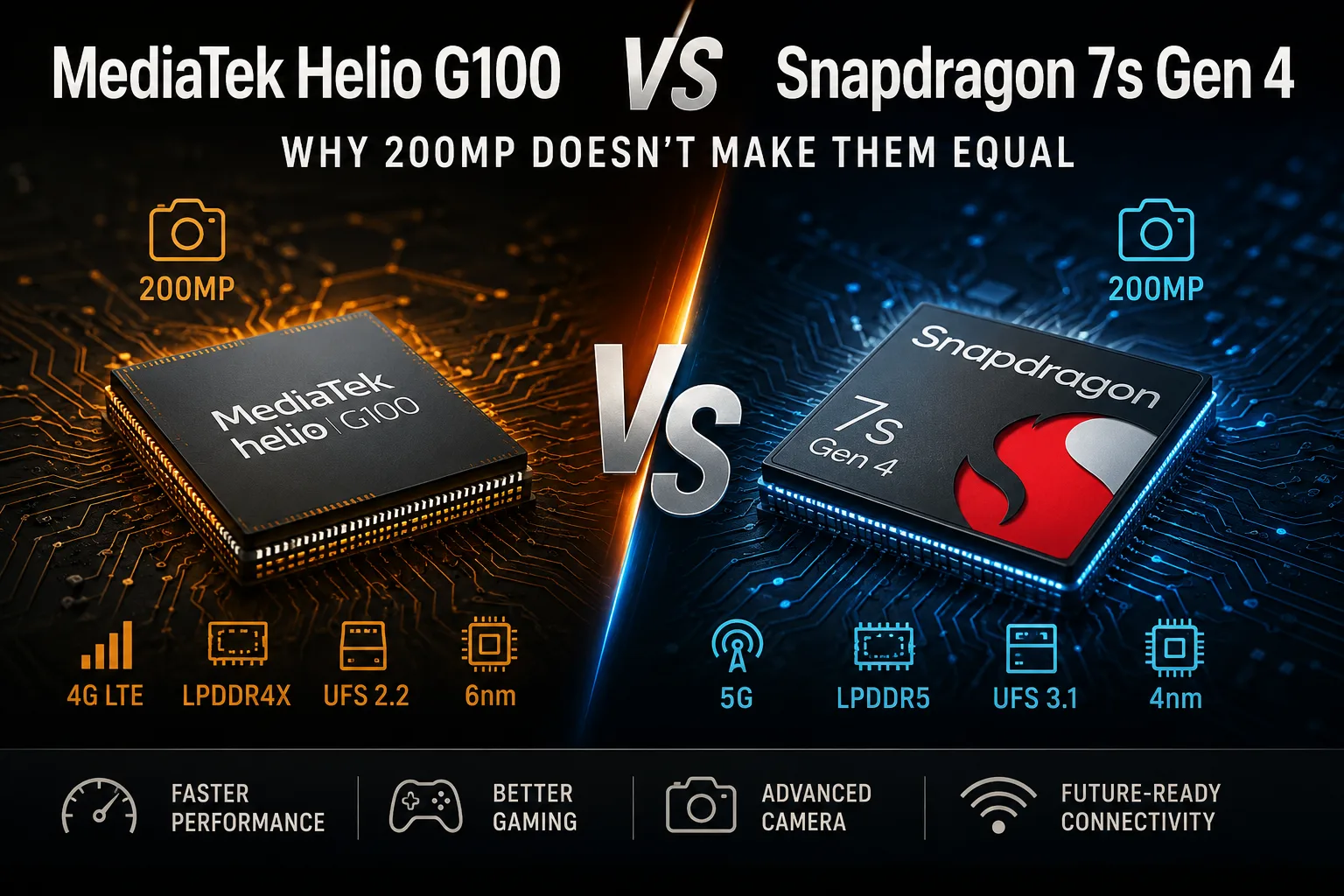
MediaTek Helio G100 vs Snapdragon 7s Gen 4: Why 200 Mp Doesn't Make Them Equal
On paper, the MediaTek Helio G100 and the Qualcomm Snapdragon 7s Gen 4 may appear to be similar chips. Both boast eight cores, support for cameras up to 200 Mp, and target mainstream Android smartphones. However, this is where the similarities largely end. The Helio G100 serves as the foundation for budget 4G smartphones. In contrast, the Snapdragon 7s Gen 4 is significantly more modern: it features newer cores, 5G capabilities, faster memory, stronger graphics, and is better equipped for long-term use.
The Main Difference Is Not in Megapixels
The Helio G100 is structured like a typical budget 4G chip: it has two Cortex-A76 cores clocked at up to 2.2 GHz, six Cortex-A55 cores up to 2.0 GHz, Mali-G57 MC2 graphics, LPDDR4X memory, UFS 2.2 storage, Wi-Fi 5, and a Cat-13 LTE modem. It also supports Full HD+ displays at up to 120 Hz and cameras up to 200 Mp.
For a basic smartphone, this setup is sufficient. The interface, messaging apps, browsing, video playback, navigation, and simple games will perform adequately. However, this is not mid-range hardware with a significant performance margin; rather, it is a 4G platform for inexpensive models.
The Snapdragon 7s Gen 4 belongs to a more contemporary class. It has one Cortex-A720 core clocked at up to 2.7 GHz, three Cortex-A720 cores at 2.4 GHz, and four Cortex-A520 cores at 1.8 GHz. Additionally, it employs a 4nm manufacturing process, features Adreno 810 graphics, supports LPDDR5 memory, UFS 3.1 storage, Wi-Fi 6E, Bluetooth 5.4, and a 5G modem with download speeds up to 2.9 Gbps.
The differences extend beyond benchmarks. Qualcomm's infrastructure is more modern overall: processor cores, graphics, memory, storage, and connectivity.
| Parameter | Helio G100 | Snapdragon 7s Gen 4 | Practical Significance |
|---|---|---|---|
| CPU | 2× Cortex-A76 + 6× Cortex-A55 | 1× Cortex-A720 + 3× Cortex-A720 + 4× Cortex-A520 | Snapdragon performs faster in demanding applications and multitasking |
| Manufacturing Process | 6 nm | 4 nm | Potentially lower power consumption and heat at the same load |
| GPU | Mali-G57 MC2 | Adreno 810 | Higher gaming performance and better driver support |
| Memory | LPDDR4X | LPDDR5 | Snapdragon supports faster memory |
| Storage | UFS 2.2 | UFS 3.1 | Faster boot times, app installs, and file handling |
| Connectivity | 4G, Wi-Fi 5 | 5G, Wi-Fi 6E | Less risk of rapid obsolescence in connectivity |
| Display | FHD+ up to 120 Hz | up to 144 Hz, HDR10+ | Supports more advanced displays |
Benchmarks: They Are Not Close Rivals
In Geekbench 6, the Snapdragon 7s Gen 4 scores around 1238 points in single-core tests and 3272 points in multi-core tests. In comparison, the Helio G100's average results are lower: about 709 and 1822 points, respectively. In AnTuTu v10, the scores are also telling: approximately 801,000 points for the Snapdragon against 433,000 for the Helio.
| Test | Helio G100 | Snapdragon 7s Gen 4 | Difference |
|---|---|---|---|
| Geekbench 6 Single-Core | ~709 | ~1238 | Snapdragon is about 75% faster |
| Geekbench 6 Multi-Core | ~1822 | ~3272 | Snapdragon is about 80% faster |
| AnTuTu v10 | ~432,700 | ~801,400 | Snapdragon is about 85% faster |
And this isn't just a gaming issue. The Snapdragon launches heavy applications faster, handles multitasking better, and runs less into CPU bottlenecks while processing photos, navigation, and installing software. The Helio G100 is adequate for its price segment, but it's closer to the basic 4G segment than to the modern mid-range.
Gaming: Helio G100 for Light Projects, Snapdragon for Graphics Headroom
The Helio G100 can only be called a gaming chip with caveats. It is suitable for popular lightweight games, but the Mali-G57 MC2 will quickly become a bottleneck in projects like Genshin Impact, Wuthering Waves, Fortnite, or heavier racing games. It is playable, but often at low settings; stability will depend on the cooling of the specific model.
The Snapdragon 7s Gen 4 is significantly stronger in gaming. It has a more powerful GPU, a more modern architecture, and a better set of gaming features: Qualcomm mentions the Adaptive Frame Motion Engine 3.0 and Snapdragon Game Super Resolution. While not at flagship levels, this chip allows for higher settings more frequently and maintains more stable fps.
Camera: 200 Mp Is Not a Guarantee of Equal Quality
Support for a 200-Mp camera is the primary marketing advantage of the Helio G100. The manufacturer can install a large sensor, feature “200 MP” in advertisements, and position the budget model as visually premium. However, camera performance hinges on more than just resolution. Key factors include ISP, memory speed, processing algorithms, video capabilities, and thermal management.
The Helio G100 features a 3× ISP, electronic stabilization, noise reduction, and support for a 200-Mp sensor, but video capabilities max out at 2K 30 fps or Full HD 60 fps. For a budget smartphone, this is adequate, but it does not reach the level of platforms designed for complex processing and advanced video capture.
The Snapdragon 7s Gen 4 is better suited for smartphones where the camera is needed for more than just daytime shots. It has more resources for HDR video, complex processing, rapid burst shooting, and consistent performance in demanding scenarios.
Therefore, two smartphones flaunting the "200 MP" label may deliver vastly different photography results. For the Helio G100, this figure often serves simply to help sell a budget model. The Snapdragon 7s Gen 4 has more resources to fully utilize a good sensor.
Connectivity: Helio Stays in the 4G Segment
The Helio G100 is a 4G platform. If 5G is not required, and the smartphone is significantly cheaper, that is not an issue. Such a device will work well for calls, messaging, video, maps, banking applications, and light gaming.
For a purchase intended to last a few years, the Snapdragon 7s Gen 4 is a more rational choice. This is not just about 5G. It boasts faster memory, more modern Wi-Fi, higher CPU performance, and stronger graphics. Such a smartphone will take longer to feel outdated.
When to Choose Helio G100
The Helio G100 makes sense if the smartphone is significantly cheaper and the tasks are basic:
- messaging apps, browser, YouTube, music;
- maps and taxis;
- banking applications;
- simple games;
- primarily daytime photography;
- 5G is unnecessary.
In these scenarios, the Helio G100 will not pose a weak spot. It provides a solid basis for an affordable phone, especially if the manufacturer has not skimped on memory, display, and battery.
When to Prefer Snapdragon 7s Gen 4
The Snapdragon 7s Gen 4 should be chosen if the price difference is not too large. It is better suited for gaming, heavy applications, frequent photography, purchases for several years, and models with displays above the basic level.
The main argument for Snapdragon is the reduced risk of rapid obsolescence. Currently, it offers a faster interface and better gaming performance. In a couple of years, this will be more apparent in new versions of Android, applications, and games.
Conclusion
The Helio G100 and Snapdragon 7s Gen 4 are not equal rivals, even if both feature eight cores and support for a 200-Mp camera. The Helio G100 is a chip for basic tasks, 4G connectivity, and budget models. The Snapdragon 7s Gen 4 is a solution from a different class: faster CPU, stronger graphics, more modern memory, and better connectivity.
If a smartphone with the Helio G100 is significantly cheaper, it can be considered for everyday tasks without gaming and 5G demands. If the price difference is small, the Snapdragon 7s Gen 4 appears considerably more advantageous. In this case, the extra payment is not for an attractive figure in the specifications but for a more modern platform.
Advantages
- Higher Technology: 4 nm (6 nm vs 4 nm)
- Higher Frequency: 2700 MHz (2200 MHz vs 2700 MHz)
- Newer Launch Date: August 2025 (August 2024 vs August 2025)
Basic
GPU Specifications
Connectivity
Memory Specifications
Miscellaneous
- AIFF
- CAF
- MP3
- MP4
- WAV
- H.265
- VP9
Benchmarks
Comparison of Devices
Related SoC Comparisons



Share in social media
Or Link To Us
<a href="https://cputronic.com/soc/compare/mediatek-helio-g100-vs-qualcomm-snapdragon-7s-gen-4" target="_blank">MediaTek Helio G100 vs Qualcomm Snapdragon 7s Gen 4</a>