MediaTek Dimensity 9500
vs
MediaTek Dimensity 9500s
SoC Comparison Result
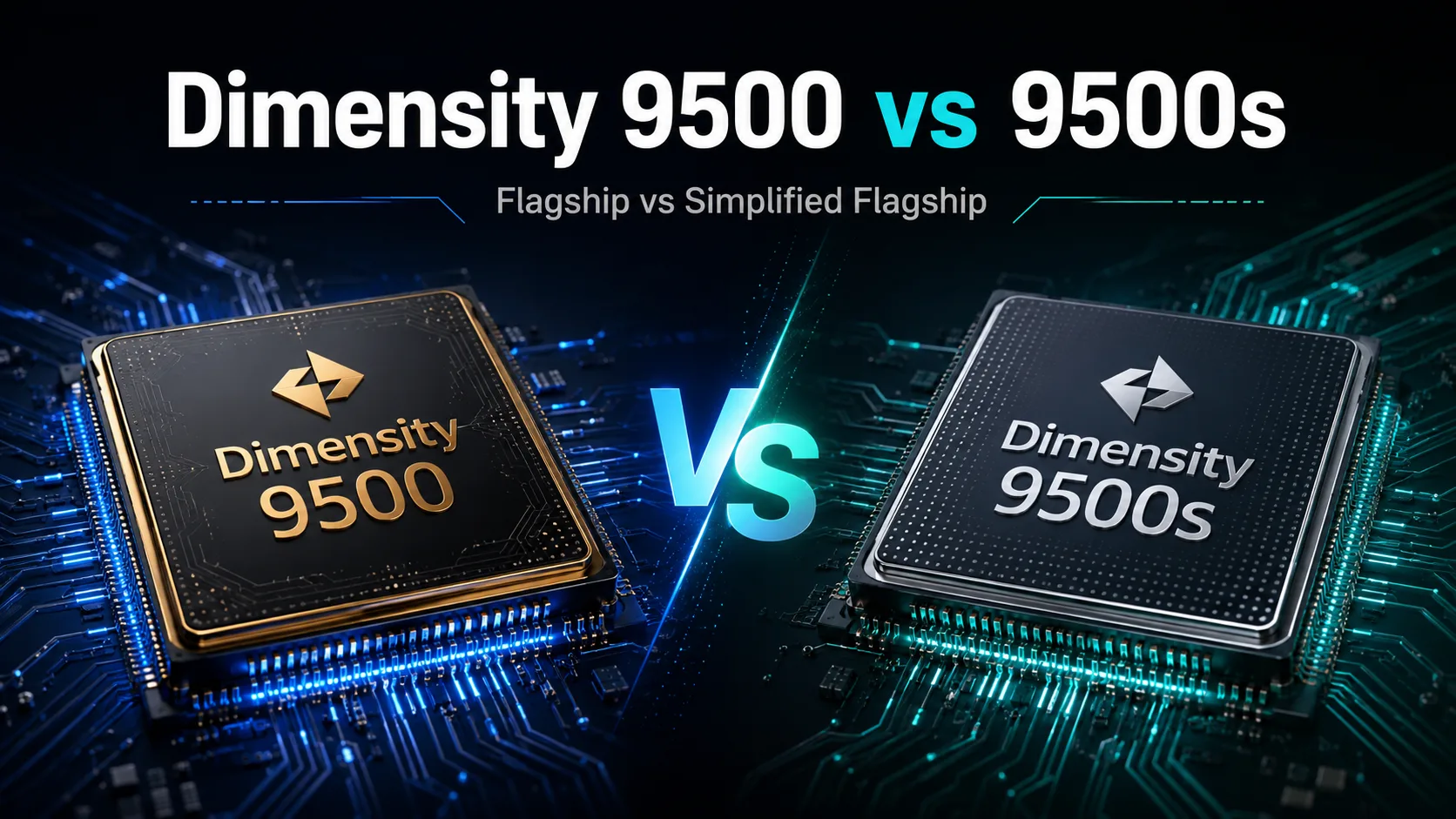
MediaTek Dimensity 9500 vs Dimensity 9500s: Why the 9500s Isn’t Faster than the Regular 9500
The names Dimensity 9500 and Dimensity 9500s can be misleading. At first glance, the Dimensity 9500s appears to be a faster version. Technically, the opposite is true: Dimensity 9500 is a full-fledged next-generation flagship, while Dimensity 9500s is a platform for more affordable flagship smartphones, built on an older CPU architecture.
The main difference does not boil down to CPU frequency. The Dimensity 9500 utilizes new Arm C1 cores: 1× C1-Ultra up to 4.21 GHz, 3× C1-Premium up to 3.5 GHz, and 4× C1-Pro up to 2.7 GHz. The Dimensity 9500s has a different scheme: 1× Cortex-X925 up to 3.73 GHz, 3× Cortex-X4, and 4× Cortex-A720. Both chips are aimed at premium smartphones, but the senior solution remains the Dimensity 9500.
Positioning: Flagship vs Simplified Flagship
The Dimensity 9500 is MediaTek's top chip for expensive Android smartphones. It features a new CPU architecture, more powerful graphics, an NPU 990, UFS 4.1 with four lanes, Wi-Fi 7 with higher speeds, and Bluetooth 6.0. This is a platform to compete with the leading solutions from Qualcomm and Apple.
The Dimensity 9500s occupies a step below. It is also designed for high-end smartphones, but in terms of architecture, it is closer to the previous generation of MediaTek flagships. It includes Cortex-X925, Cortex-X4, and Cortex-A720 cores, a large cache, LPDDR5X, and support for 8K video, but in terms of CPU, GPU, storage, Wi-Fi, and Bluetooth, it falls short of the regular Dimensity 9500.
The Dimensity 9500s is not an upgraded version of the 9500. It is a simpler alternative for smartphones that need high performance without new CPU architecture, Mali-G1 Ultra, UFS 4.1 with a four-lane configuration, and Bluetooth 6.0.
Key Differences
| Characteristic | Dimensity 9500 | Dimensity 9500s |
|---|---|---|
| CPU | 1× C1-Ultra + 3× C1-Premium + 4× C1-Pro | 1× Cortex-X925 + 3× Cortex-X4 + 4× Cortex-A720 |
| Max Frequency | up to 4.21 GHz | up to 3.73 GHz |
| L3 Cache | 16 MB | 12 MB |
| GPU | Mali-G1 Ultra, 12 cores | Immortalis-G925, 11/12 cores |
| Storage | UFS 4.1, 4-lane | UFS 4 + MCQ |
| AI | NPU 990 | Simpler MediaTek NPU without index 990 |
| Wi-Fi | Wi-Fi 7, up to 7.3 Gbps | Wi-Fi 7, up to 6.5 Gbps |
| Bluetooth | 6.0 | 5.4 |
| Video | 4K120 with EIS, 4K60 cinematic, 8K | 8K60, 8K30 encode, 8K60 decode |
CPU: Dimensity 9500's Advantage Starts with Architecture
In terms of processing power, the Dimensity 9500 has the advantage. It features a higher maximum frequency, a new line of Arm C1 cores, and more L3 cache. This helps the 9500 execute shorter loads more quickly, where maximum frequency is crucial: launching games, processing photos, video editing, and tasks tied to the speed of a single powerful core.
The Dimensity 9500s remains a fast chip. Cortex-X925, Cortex-X4, and Cortex-A720 are sufficient for flagship-level CPU performance. However, this is not a new architectural step but a configuration based on the cores of the previous flagship line. In terms of CPU, the Dimensity 9500 remains the superior solution, despite the 9500s index.
Graphics: The Gap in Gaming May Be More Noticeable
In gaming, the difference may be more pronounced than in CPU tasks. The Dimensity 9500 received Mali-G1 Ultra with 12 cores. This GPU is from a newer generation with improved peak performance, ray tracing, and better handling of demanding graphics.
The Dimensity 9500s uses Immortalis-G925. It is flagship-level graphics but belongs to the previous generation. Additionally, the 9500s may come in 11-core and 12-core variants depending on the specific smartphone. Therefore, when comparing actual devices, it’s essential to look not only at the chip name but also at the phone model.
For gaming, the Dimensity 9500 is more interesting not just due to higher FPS in benchmarks. It has a newer GPU and better allowance for future game engines, heavy 3D scenes, and ray tracing. In long-duration loads, smartphone cooling plays a role: a thin flagship may throttle frequencies faster, while a more affordable smartphone with good cooling can maintain frequencies for longer.
AI, Memory, and Storage
The Dimensity 9500 is superior in terms of the AI block, storage, and overall platform. Its NPU 990 accelerates local AI functions: generation, image processing, object recognition, and running large models on the device. UFS 4.1 with 4-lane configuration speeds up loading large games, copying large files, and launching heavy applications.
The Dimensity 9500s supports LPDDR5X up to 10667 Mbps and UFS 4 + MCQ. For interfaces, gaming, cameras, and video recording, this is sufficient, but when it comes to future-proofing, the 9500 remains stronger. For a smartphone over the next few years, this is a significant advantage.
Cameras, Video, and Connectivity
Both chips are positioned in the premium segment regarding cameras. The Dimensity 9500s supports cameras up to 320 MP, recording up to 8K60, 8K30 encode, and 8K60 decode. For photos, 4K video, and most user scenarios, the capabilities of the 9500s are adequate.
The Dimensity 9500 has a stronger video block. MediaTek highlights Imagiq 1190, 4K60 cinematic portrait video, and 4K120 video recording with image stabilization. The final camera quality depends on the sensor, optics, and processing of the specific smartphone, but in terms of platform capabilities, the advantage lies with the 9500.
In terms of connectivity, the gap also favors the Dimensity 9500. The 9500s has 5G Release 17, Wi-Fi 7 up to 6.5 Gbps, and Bluetooth 5.4. The 9500 features Wi-Fi 7 up to 7.3 Gbps and Bluetooth 6.0. In everyday tasks, the difference may go unnoticed, but for an expensive smartphone with a long lifespan, this is a plus.
Benchmarks: How Much Faster Is the Dimensity 9500?
In benchmarks, the Dimensity 9500 is consistently faster. The exact figures depend on the smartphone, firmware, temperature, and performance mode. Therefore, it’s more accurate to use ranges.
| Test | Dimensity 9500 | Dimensity 9500s |
|---|---|---|
| AnTuTu 11 | ~3.3-3.5 million | ~2.7-3.0 million |
| Geekbench 6 Single-Core | ~3200-3300 | ~2650-2700 |
| Geekbench 6 Multi-Core | ~9500-9900 | ~8300-8400 |
| 3DMark Solar Bay | ~14400 | ~10900 |
The gap is particularly noticeable in graphics and peak CPU loads. The Dimensity 9500 is faster as a new flagship chip, while the Dimensity 9500s remains a more affordable high-end platform.
Regarding stability, there is a separate nuance. In specific stress tests, the Dimensity 9500s may maintain frequencies more stably. This does not change the lead of the 9500 at peak performance but explains why the gap may narrow during extended gaming sessions. Therefore, comparisons should be made not only between chips but also specific smartphones.
What to Choose
With similar pricing, it makes more sense to choose the Dimensity 9500. It is faster, newer in architecture, stronger in graphics, AI, storage, video, and wireless capabilities. This is the senior option with a better platform longevity.
Dimensity 9500s should only be considered when a smartphone based on it is significantly cheaper or stronger as a ready-made device: with a better screen, battery, cooling, cameras, or memory capacity. The Dimensity 9500s remains a fast chip in the premium segment, but it cannot be considered an improved version of the Dimensity 9500.
The main conclusion is simple: Dimensity 9500 is the senior, more tech-forward chip. Dimensity 9500s is not "9500 Super," but a more affordable flagship platform that should only be chosen when there's a noticeable price difference.
Advantages
- Higher Frequency: 4210 (4210 vs 3730 MHz)
- Newer Launch Date: January 2026 (September 2025 vs January 2026)
Basic
3x 3.3 GHz – Cortex-X4
4x 2.4 GHz – Cortex-A720
GPU Specifications
Connectivity
Memory Specifications
Miscellaneous
- FLAC
- HE-AACv1
- HE-AACv2
- MP3
- FLAC
- HE-AACv1
- HE-AACv2
- MP3
- H.265
- AV1
- VP9
- H.265
- AV1
- VP9
Benchmarks
Comparison of Devices
Related SoC Comparisons


Share in social media
Or Link To Us
<a href="https://cputronic.com/soc/compare/mediatek-dimensity-9500-vs-mediatek-dimensity-9500s" target="_blank">MediaTek Dimensity 9500 vs MediaTek Dimensity 9500s</a>