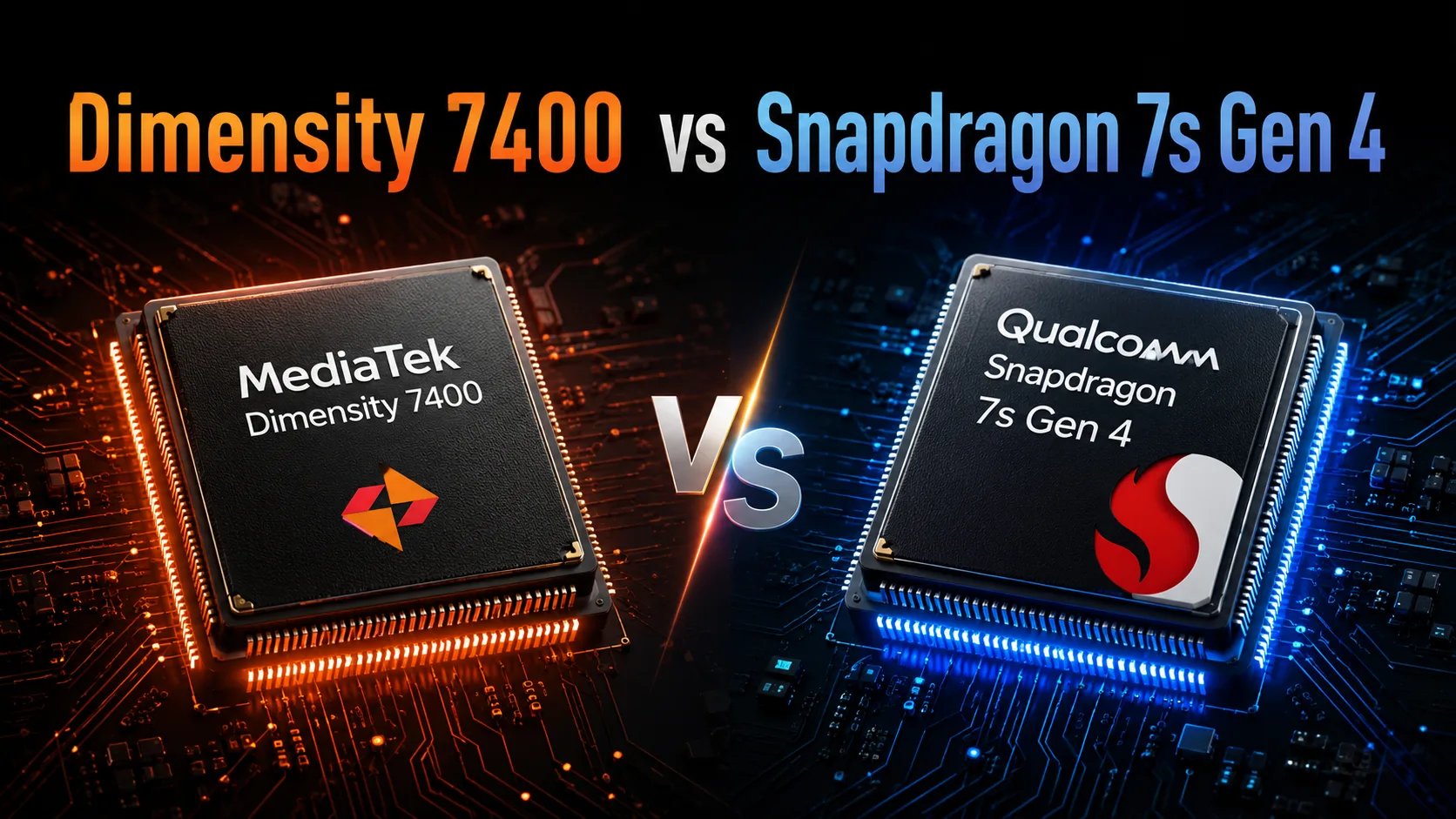
MediaTek Dimensity 7400
vs
Qualcomm Snapdragon 7s Gen 4
SoC Comparison Result
MediaTek Dimensity 7400 vs Snapdragon 7s Gen 4: Is it worth paying extra for Qualcomm?
The MediaTek Dimensity 7400 and Qualcomm Snapdragon 7s Gen 4 are both manufactured using a 4nm process and are aimed at mid-range smartphones. They share many features: support for LPDDR5, UFS 3.1, Wi-Fi 6E, Bluetooth 5.4, cameras up to 200 MP, and 4K HDR video recording capabilities. However, despite having similar base capabilities, the platforms vary significantly in CPU configuration and additional features.
MediaTek retained the tried-and-true combination of Cortex-A78 and Cortex-A55, while Qualcomm used a tri-cluster scheme with a separate Prime core. Snapdragon also offers more advanced tools for gaming, image processing, and local artificial intelligence. At the same price point, it looks more attractive, but the Dimensity 7400 makes sense in a significantly cheaper smartphone.
Key Differences
| Scenario | Preferred | Reason |
|---|---|---|
| CPU Potential | Snapdragon 7s Gen 4 | Prime core and 1+3+4 architecture |
| Gaming Technologies | Snapdragon 7s Gen 4 | Vulkan 1.3, upscaling, and heat management |
| Camera Capabilities | Snapdragon 7s Gen 4 | Triple ISP and more processing modes |
| Peak 5G Sub-6 Speed | Dimensity 7400 | 3.27 vs 2.9 Gbps |
| Battery Life | Depends on smartphone | Display and firmware are more important than chip process |
| Purchase Value | Depends on price | Dimensity is more common in affordable models |
CPU: Proven Architecture vs More Flexible Scheme
The Dimensity 7400 features four high-performance Cortex-A78 cores clocked up to 2.6 GHz and four power-efficient Cortex-A55 cores. This configuration is sufficient for browsing, social media, navigation, camera use, and most applications, although both architectures have been used in mobile processors for a long time.
The Snapdragon 7s Gen 4 includes one Prime core up to 2.7 GHz, three performance cores up to 2.4 GHz, and four efficiency cores up to 1.8 GHz. Qualcomm does not disclose the architecture names, so attributing specific Cortex versions to these cores without further confirmation is not possible.
The separate fast core gives Snapdragon a potential advantage in launching applications, processing web pages, and other short workloads. However, real-world performance should be confirmed by tests of finished smartphones, as results depend on cooling, memory speed, and firmware limitations.
Qualcomm claims a seven percent CPU increase compared to the Snapdragon 7s Gen 3, but this is not a direct comparison with the Dimensity 7400. Therefore, it's more accurate to describe Snapdragon's higher potential, rather than a guaranteed advantage in all tasks.
Graphics: Qualcomm's Advantage Primarily in Features
The Dimensity 7400 is equipped with Mali-G615 MC2 graphics. MediaTek claims a ten percent performance increase over the previous generation and uses the HyperEngine suite with Adaptive Gaming Technology 3.0 to manage performance and network connectivity.
The Snapdragon 7s Gen 4 includes Adreno graphics, which Qualcomm states is seven percent faster than its predecessor, the Snapdragon 7s Gen 3. These percentages cannot be directly compared: the companies use different base platforms and methodologies.
Snapdragon's strength lies in its gaming technology suite. The platform supports Vulkan 1.3, Snapdragon Game Super Resolution, and Adaptive Performance Engine 3.0. Upscaling enhances image clarity without the need for full rendering in higher resolution, while the performance management system adjusts heat and power usage under sustained load.
Both platforms should have sufficient power for casual online gaming. In demanding projects, frame rate stability will depend on the smartphone's cooling, but Qualcomm's toolset gives manufacturers more optimization possibilities.
Cameras: Same 200 MP, Different ISP Capabilities
Both processors support cameras with resolutions up to 200 MP and 4K HDR video recording at 30 frames per second. These numbers only set an upper limit: the quality of photos is still determined by the sensor, optics, and algorithm settings.
The Dimensity 7400 incorporates a 12-bit ISP, Imagiq 950. MediaTek claims support for Google Ultra HDR, hardware face recognition, and noise reduction. This setup is suitable for a typical mid-range smartphone with one main camera and an additional wide-angle module.
The Snapdragon 7s Gen 4 features a triple 12-bit ISP, Spectra. It can process data from three cameras simultaneously, supports 10-bit HEIF photos, Full HD slow motion at 120 FPS, multi-frame HDR, AI Remosaic, and Video Super Resolution.
In terms of image processing capabilities, Snapdragon is superior. This advantage can be especially pronounced in smartphones with three full-featured cameras and smooth transitions between them. However, a high-quality sensor on the Dimensity 7400 can still outperform a cheap module on Snapdragon.
Artificial Intelligence: Snapdragon Looks Beyond Cameras
MediaTek utilizes an NPU 655, focusing primarily on image processing. The company claims a 15 percent acceleration in camera AI functions and significant improvements in the UNet test compared to the previous generation. These figures relate to specific workloads and do not describe NPU performance across all scenarios.
Qualcomm claims support for INT4, INT8, and INT16 computing, as well as small local models Llama 1B and Qwen 1B. Possible scenarios include translation and transcription without cloud access.
Both platforms have sufficient capabilities for camera functions. Snapdragon offers a broader array of claimed scenarios for local generative AI, but their practical utility depends on the software of a specific smartphone.
Display, Memory, and Storage
Both platforms support LPDDR5 and LPDDR4X. Snapdragon 7s Gen 4 supports UFS 3.1, while the Dimensity 7400 also allows the use of slower UFS 2.2. Therefore, in budget smartphones using MediaTek, it's important to verify the type of storage, as it significantly affects app installation and file transfer speeds.
The Dimensity 7400 supports WFHD+ displays with refresh rates up to 120 Hz, and at lower resolutions, the refresh rate can reach 144 Hz. The Snapdragon can output WFHD+ at 144 Hz and supports HDR10+.
Qualcomm's advantage appears convincing on paper, but the quality of the panel, brightness, and calibration are more important than the difference between 120 and 144 Hz.
Connectivity: Speed with MediaTek, Extra Features with Qualcomm
The Dimensity 7400 supports Wi-Fi 6E, Bluetooth 5.4, and 5G with download speeds up to 3.27 Gbps. The modem operates with three-carrier aggregation, while UltraSave 3.0+ technology aims to reduce energy consumption in mobile networks.
For Snapdragon, the maximum 5G speed is 2.9 Gbps. The platform supports sub-6 GHz, mmWave, Dual SIM Dual Active, Wi-Fi 6E with channels up to 160 MHz, Snapdragon Sound, aptX Adaptive, and aptX Lossless. A smartphone manufacturer may use only part of these capabilities.
The difference between 2.9 and 3.27 Gbps in an ordinary network is nearly imperceptible. Far more crucial is the support for the required bands and the quality of the antennas in the specific model.
Battery Life Cannot Be Determined by the Chip Name
Both processors are manufactured using a 4nm process. MediaTek claims a 25% higher energy efficiency of the Dimensity 7400 in popular applications, but this comparison is made against unnamed competing solutions. This figure cannot be viewed as a guaranteed advantage over the Snapdragon 7s Gen 4.
Battery life is influenced more by the display, battery capacity, modem, and firmware settings. Two smartphones with the same processor can have significant differences in battery life and heat management.
What to Choose
At the same price, the Snapdragon 7s Gen 4 appears preferable. It offers a more flexible CPU configuration, advanced gaming technologies, a triple ISP, and broader capabilities for local AI.
The Dimensity 7400 makes sense in a more affordable smartphone. Its performance is adequate for everyday tasks, popular gaming, 4K video recording, and working with modern wireless interfaces.
The optimal choice scheme is simple:
- at the same price - Snapdragon 7s Gen 4;
- for gaming, complex camera needs, and local AI functions - Snapdragon;
- for significantly cheaper devices with the Dimensity 7400 - compare display, storage, battery, and update longevity.
The Dimensity 7400 remains sufficiently fast for the mid-range but offers fewer additional features. Paying extra for Snapdragon is reasonable only when the smartphone manufacturer truly leverages its advantages.
Advantages
- Higher Frequency: 2700 MHz (2600 MHz vs 2700 MHz)
- Newer Launch Date: August 2025 (February 2025 vs August 2025)
Basic
GPU Specifications
Connectivity
Memory Specifications
Miscellaneous
- AIFF
- CAF
- MP3
- MP4
- WAV
- H.265
- VP9
Benchmarks
Comparison of Devices
Related SoC Comparisons




Share in social media
Or Link To Us
<a href="https://cputronic.com/soc/compare/mediatek-dimensity-7400-vs-qualcomm-snapdragon-7s-gen-4" target="_blank">MediaTek Dimensity 7400 vs Qualcomm Snapdragon 7s Gen 4</a>