Google Tensor G3
vs
Google Tensor G6

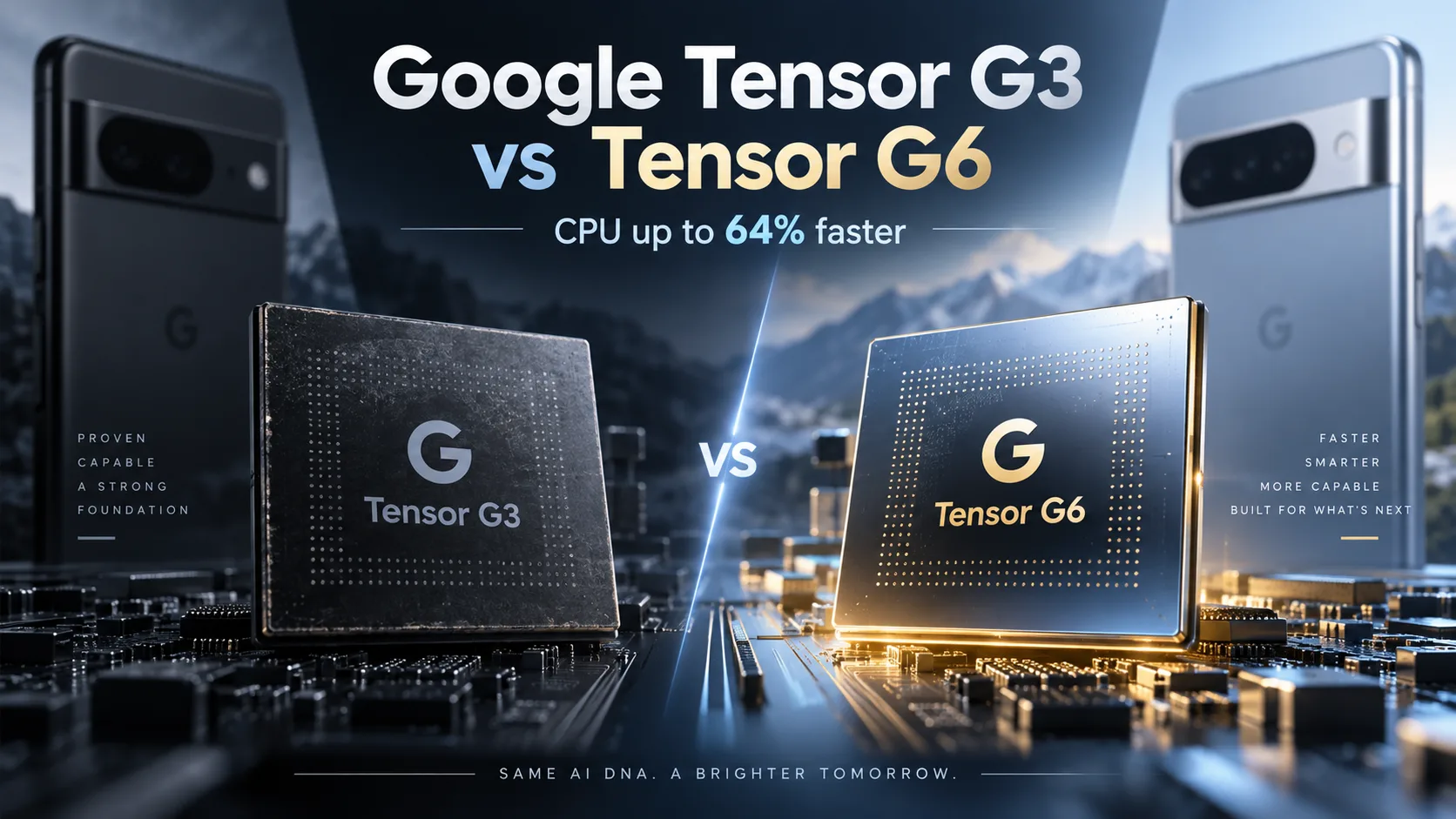
SoC Comparison Result
Google Tensor G3 vs. Tensor G6: up to 64% faster in CPU tests, graphics only 15-18% faster
Tensor G3 debuted in the Pixel 8 series, while Tensor G6 is used in the Pixel 11. Over three generations, the architecture has changed dramatically. Tensor G6 is manufactured by TSMC on a 3 nm process, uses Arm C1 cores, and has seven CPU cores instead of the nine found in the G3.
In Geekbench 6, Tensor G6 outperforms the G3 by approximately 51% in Single-Core and 64% in Multi-Core. In 3DMark Steel Nomad Light, the advantage is considerably smaller-15-18%.
Key differences between Tensor G3 and Tensor G6
| Specification | Google Tensor G3 | Google Tensor G6 |
|---|---|---|
| Release year | 2023 | 2026 |
| Process node | 4 nm | 3 nm |
| Manufacturing | Samsung | TSMC |
| CPU | 1x Cortex-X3 at 2.91 GHz + 4x Cortex-A715 at 2.37 GHz + 4x Cortex-A510 at 1.70 GHz | 1x Arm C1-Ultra at 4.11 GHz + 4x C1-Pro at 3.38 GHz + 2x C1-Pro at 2.65 GHz |
| CPU cores | 9 | 7 |
| Maximum frequency | 2.91 GHz | 4.11 GHz |
| GPU | Mali-G715 MP7 | PowerVR CXTP-48-1536 |
| GPU frequency | 890 MHz | 1286 MHz |
| Memory | LPDDR5X | LPDDR5X |
| Instruction set | ARMv9-A | ARMv9.3-A |
G6 features cores from the new Arm C1 family and reaches frequencies of up to 4.11 GHz, compared with 2.91 GHz for the G3.
Geekbench 6
| Test | Tensor G3 | Tensor G6 | Difference |
|---|---|---|---|
| Geekbench 6 Single-Core | 1767 | 2677 | +51% |
| Geekbench 6 Multi-Core | 4477 | 7321 | +64% |
In Single-Core, the G6 scores 2677 points versus 1767 for the G3, giving it a 51% advantage.
In Multi-Core, the gap reaches 64%: 7321 points versus 4477, even though the G6 has seven CPU cores instead of nine.
Results in specific smartphones
Cooling, firmware, and power limits affect performance, so let’s compare results from specific Pixel models.
| Smartphone | Processor | Geekbench 6 Single | Geekbench 6 Multi | AnTuTu 11 | 3DMark Steel Nomad Light | Launch price |
|---|---|---|---|---|---|---|
| Google Pixel 8a | Tensor G3 | 1631 | 4018 | 1,433,693 | 990 | $499 |
| Google Pixel 8 Pro | Tensor G3 | 1759 | 4413 | 1,367,231 | 982 | $999 |
| Google Pixel 11 Pro | Tensor G6 | 2681 | 7292 | 1,925,523 | 1137 | $1099 |
| Google Pixel 11 Pro XL | Tensor G6 | 2688 | 7388 | 1,933,536 | 1158 | $1299 |
In AnTuTu 11, the difference between the generations is already clearly visible and does not require comparing different benchmark versions. The Pixel 8a scores about 1.43 million points, while the Pixel 11 Pro scores 1.93 million-approximately 34% more.
If we compare the larger Pro models, the Pixel 8 Pro scores about 1.37 million points, while the Pixel 11 Pro XL scores 1.93 million. The difference reaches approximately 41%.
The picture is similar in Geekbench. The Pixel 8 Pro scores 1759/4413 points, while the Pixel 11 Pro XL scores 2688/7388.
AnTuTu 11
The average results for the chips themselves make it possible to compare them using the same benchmark version.
| Test | Tensor G3 | Tensor G6 | Difference |
|---|---|---|---|
| AnTuTu 11 | 1,409,016 | 1,933,536 | +37% |
Tensor G6 scores about 1.93 million points versus 1.41 million for Tensor G3. The advantage is approximately 37%.
This is a smaller gap than in Geekbench 6 because the overall AnTuTu score includes not only the CPU, but also the GPU, memory, and UX.
How much faster is the graphics?
The Pixel 8 Pro scores 982 points in 3DMark Steel Nomad Light, while the Pixel 11 Pro XL scores 1158. The G6’s advantage is approximately 18%.
For the Pixel 8a and Pixel 11, the difference is approximately 15%: 990 versus 1137 points.
The GPU gap is significantly smaller than the 51-64% advantage in CPU tests.
It is harder to justify upgrading from the Pixel 8 to the Pixel 11 for gaming performance alone: the gain in Steel Nomad Light is only 15-18%.
AI and TPU
Another significant change in the Tensor G6 is its new TPU for local AI tasks.
The TPU is used by Gemini Nano, Live Translate, photo processing, and other local AI features on the Pixel 11.
Google primarily compares it with Tensor G5, so the performance gains claimed by the company cannot be directly applied to a comparison between the G3 and G6.
Is it worth upgrading from the Pixel 8 to the Pixel 11?
The CPU difference between the generations is substantial. A 51% advantage in Single-Core and 64% in Multi-Core is large enough to be noticeable beyond benchmarks-primarily in demanding applications and content processing.
AnTuTu 11 shows a more moderate, but still significant, gap of approximately 37% between the average results of the G3 and G6.
The 15-18% GPU gain is considerably more modest and, on its own, does not justify replacing a Pixel 8 for gaming.
If the Pixel 8 or Pixel 8 Pro is fast enough, there is no need to replace the smartphone solely for a faster GPU. The difference is more noticeable in CPU performance and the new AI features of the Pixel 11.
If you are buying a Pixel from scratch and the prices are close, choosing a model with Tensor G6 makes more sense.
Conclusion
Tensor G6 is significantly faster than Tensor G3 in CPU and overall performance, but the graphics gap is much smaller. In Geekbench 6, the advantage reaches 51% in Single-Core and 64% in Multi-Core, while in AnTuTu 11 it is approximately 37%.
In Steel Nomad Light, the difference is only 15-18%. Therefore, for Pixel 8 owners, the main reasons to upgrade are the faster CPU and the new features of the Pixel 11-not gaming performance.
Advantages
- Higher Technology: 3 nm (4 nm vs 3 nm)
- Higher Frequency: 4110 MHz (2910 MHz vs 4110 MHz)
- Newer Launch Date: August 2026 (October 2023 vs August 2026)
Basic
4x 2.37 GHz – Cortex-A715
4x 1.7 GHz – Cortex-A510
GPU Specifications
Connectivity
Memory Specifications
Miscellaneous
Benchmarks
Comparison of Devices
Related SoC Comparisons




Share in social media
Or Link To Us
<a href="https://cputronic.com/soc/compare/google-tensor-g3-vs-google-tensor-g6" target="_blank">Google Tensor G3 vs Google Tensor G6</a>