MediaTek Helio G92
MediaTek Helio G92: Performance, Benchmarks, and Capabilities in 2026
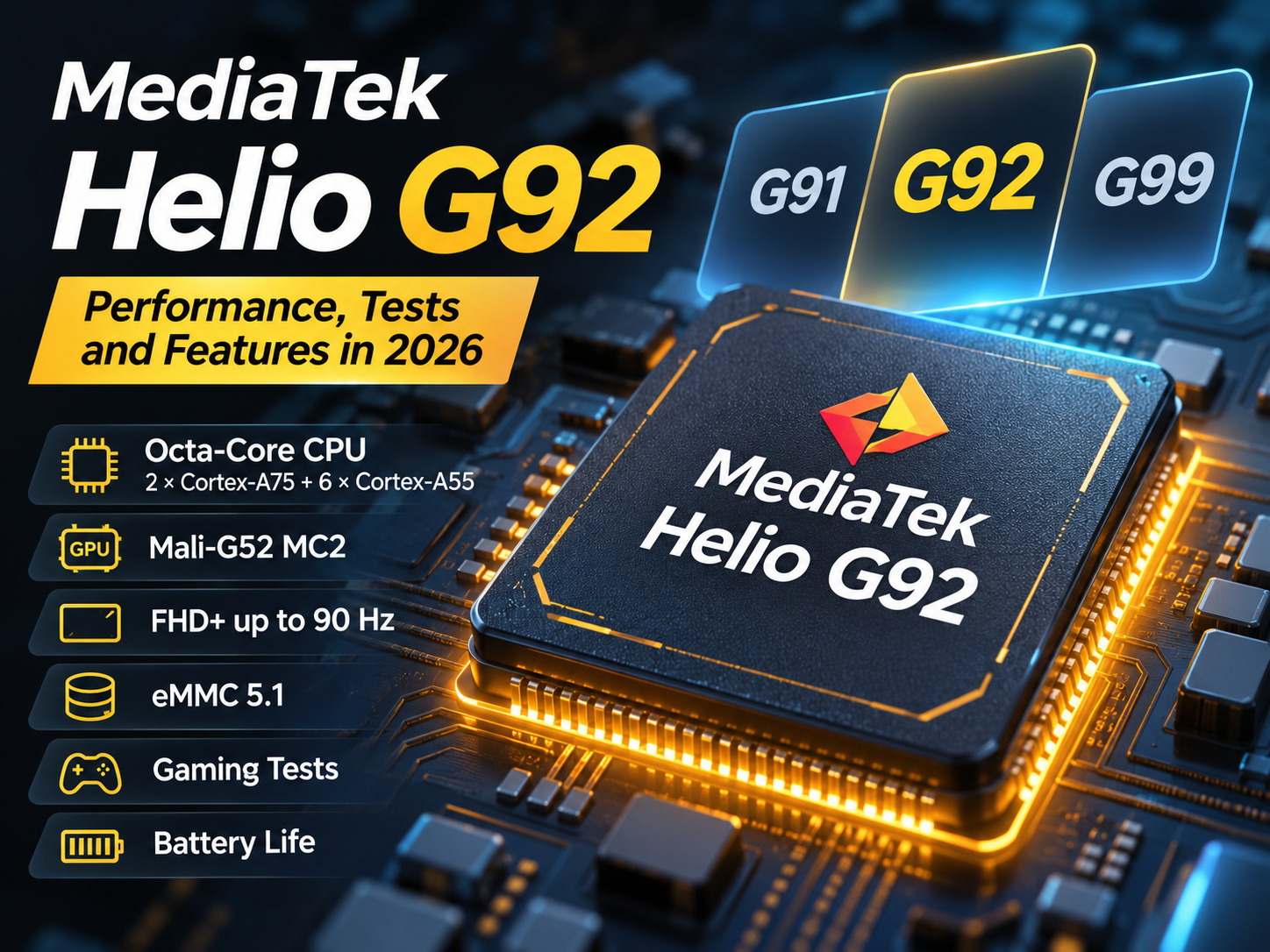
MediaTek Helio G92 is an octa-core processor for budget 4G smartphones, introduced in late 2024. It uses two Cortex-A75 cores, six Cortex-A55 cores, and Mali-G52 MC2 graphics. In terms of architecture, the chip is similar to the Helio G91 and is noticeably behind the more modern Helio G99.
In 2026, the Helio G92 is suitable for messaging, video playback, navigation, and other everyday tasks. However, its outdated CPU cores, 12 nm process, and support for eMMC 5.1 storage only limit the platform's capabilities, especially in games and when running demanding applications.
Helio G92 Architecture and Features
The processor includes two Cortex-A75 cores clocked at up to 2.0 GHz and six power-efficient Cortex-A55 cores. The Mali-G52 MC2 graphics accelerator operates at up to 1 GHz.
The platform's main features include:
- Support for FHD+ displays at up to 90 Hz and HD+ displays at up to 120 Hz.
- HyperEngine technology for managing workloads during gaming.
- Support for LPDDR4X and eMMC 5.1 storage.
- A 4G LTE modem with Dual 4G VoLTE, Wi-Fi 5, and Bluetooth 5.0.
- Hardware encoding for H.264 and H.265, and VP9 playback.
In terms of CPU and GPU configuration, the Helio G92 is practically identical to the G91, so a significant performance increase over the previous model should not be expected.
Geekbench 6 and AnTuTu: Smartphone Results
The Helio G92's performance can be assessed using the TCL 60 NXTPAPER 4G, as well as the realme C75 and C100 smartphones. The latter two use the Helio G92 Max designation.
These versions have similar CPU and GPU specifications, although there is no separate official comparison of the G92 and G92 Max. Therefore, the results from the realme models are used as an additional reference rather than as direct measurements of the standard G92.
| Smartphone | Processor | Geekbench 6 Single / Multi | AnTuTu 10 |
|---|---|---|---|
| TCL 60 NXTPAPER 4G | Helio G92 | 441 / 1407 | ≈285 000 |
| realme C75 | Helio G92 Max | 441 / 1376 | 280 632 |
| realme C100 4G | Helio G92 Max | 439 / 1416 | - |
| Infinix Note 30 | Helio G99 | 726 / 1974 | 414 288 |
Reference results from catalogs were used for the TCL, while the results for the realme C75 and C100 come from measurements in reviews. The realme C100 also scored 402 479 points in AnTuTu 11, but this result cannot be compared directly with AnTuTu 10.
The published Geekbench 6 results for devices with the G92 and G92 Max are similar: around 440 points in the single-core test and 1400 points in the multi-core test. These results indicate similar performance but do not confirm that the G92 and G92 Max are completely identical.
When the realme C75 is compared with the Infinix Note 30, the Helio G99's advantage is:
- 65% in Geekbench 6 Single-Core.
- 43% in Geekbench 6 Multi-Core.
- 48% in AnTuTu 10.
These are results from specific smartphones, not a universal difference between the processors. The Helio G99's higher computing performance is primarily due to its use of modern Cortex-A76 cores and higher CPU frequencies. System settings, memory, and cooling also affect the final results.
Gaming Performance
The Mali-G52 MC2 is suitable for simple mobile games, but its capabilities are insufficient for stable performance in modern demanding titles.
In testing of the realme C100 with the Helio G92 Max, the 3DMark Wild Life graphics test produced a score of 778 and an average frame rate of 4.66 FPS.
The following results were obtained in actual games:
| Game | Settings | FPS |
|---|---|---|
| Mobile Legends: Bang Bang | Highest available | 48-51 |
| League of Legends: Wild Rift | Highest available | 33-53 |
| Call of Duty: Mobile | Low, Max Frame Rate | 18-30 |
| Asphalt Legends | Standard, 60 FPS target | 44-53 |
| Zenless Zone Zero | Low, 60 FPS target | 4-14 |
The results were obtained on the realme C100 with the Helio G92 Max. The listed FPS figures are the observed ranges, not average values.
Mobile Legends remains a relatively accessible game for this platform, although stable 60 FPS was not achieved. In Call of Duty: Mobile, noticeable frame-rate drops occur even at low settings. In Zenless Zone Zero, the frame rate falls to 4-14 FPS, making the game uncomfortable to play.
Power Efficiency and Everyday Use
The Helio G92 is manufactured on a 12 nm process, while the Helio G99 uses 6 nm technology. The more modern process gives the G99 an advantage in terms of energy-efficiency potential, although actual power consumption depends on the workload and the settings of the specific device.
A smartphone's battery life is determined by more than just its processor. For example, the realme C100 is equipped with an 8000 mAh battery. In the PCMark Work 3.0 Battery Life test, the device lasted 26 hours and 9 minutes, while continuous video playback lasted more than 34 hours.
The Helio G92 provides sufficient performance for everyday use, although app loading and switching between demanding tasks may be accompanied by delays.
eMMC 5.1 is an additional limitation. This type of storage is slower than UFS 2.2 in terms of data transfer speeds, which can slow down app installation, game loading, and operations involving large files.
Comparison with the Helio G91 and G99
| Feature | Helio G92 | Helio G91 | Helio G99 |
|---|---|---|---|
| Process | 12 nm | 12 nm | 6 nm |
| Performance cores | 2 × Cortex-A75, 2.0 GHz | 2 × Cortex-A75, 2.0 GHz | 2 × Cortex-A76, 2.2 GHz |
| GPU | Mali-G52 MC2 | Mali-G52 MC2 | Mali-G57 MC2 |
| Storage | eMMC 5.1 | eMMC 5.1 | UFS 2.2 |
| FHD+ display | Up to 90 Hz | Up to 90 Hz | Up to 120 Hz |
In addition to more powerful CPU cores, the Helio G99 features updated graphics, support for faster UFS 2.2 storage, and a more modern manufacturing process.
Is It Worth Buying a Smartphone with the Helio G92 in 2026?
Buying a Helio G92 device makes sense if the price is low or the smartphone offers additional advantages, such as a large battery, a reinforced body, or a specialized display.
For comparison, approximate price points are:
| Smartphone | Configuration | Processor | Price |
|---|---|---|---|
| realme C75 | 8/256 GB | Helio G92 Max | $200-240 |
| Redmi Note 14 4G | 6/128 GB | Helio G99-Ultra | $150-200 |
The Redmi Note 14 4G uses the more powerful Helio G99-Ultra, features a 120 Hz AMOLED display, and supports UFS 2.2. At a comparable price, it offers a faster and more capable computing platform.
At the same time, the TCL 60 NXTPAPER 4G stands out with its specialized NXTPAPER display, while the realme C75 offers enhanced body protection and a 6000 mAh battery. These features may be more important than processor speed.
Conclusion
The MediaTek Helio G92 is a budget 4G processor designed primarily for everyday use. It provides acceptable performance in regular applications but falls noticeably behind the Helio G99 in computing and graphics performance.
In 2026, a smartphone with the Helio G92 is worth considering for its low price, battery life, or additional features. If speed and gaming performance are the main criteria, a device based on the Helio G99, G99-Ultra, or G100 is preferable.
SOC Comparison
Compare Helio G92 with other SOCs
Basic
GPU Specifications
Connectivity
Memory Specifications
Miscellaneous
Related SoC Comparisons


Share in social media
Or Link To Us
<a href="https://cputronic.com/index.php/soc/mediatek-helio-g92" target="_blank">MediaTek Helio G92</a>