Samsung Exynos 2400
vs
Samsung Exynos 1680

SoC Comparison Result
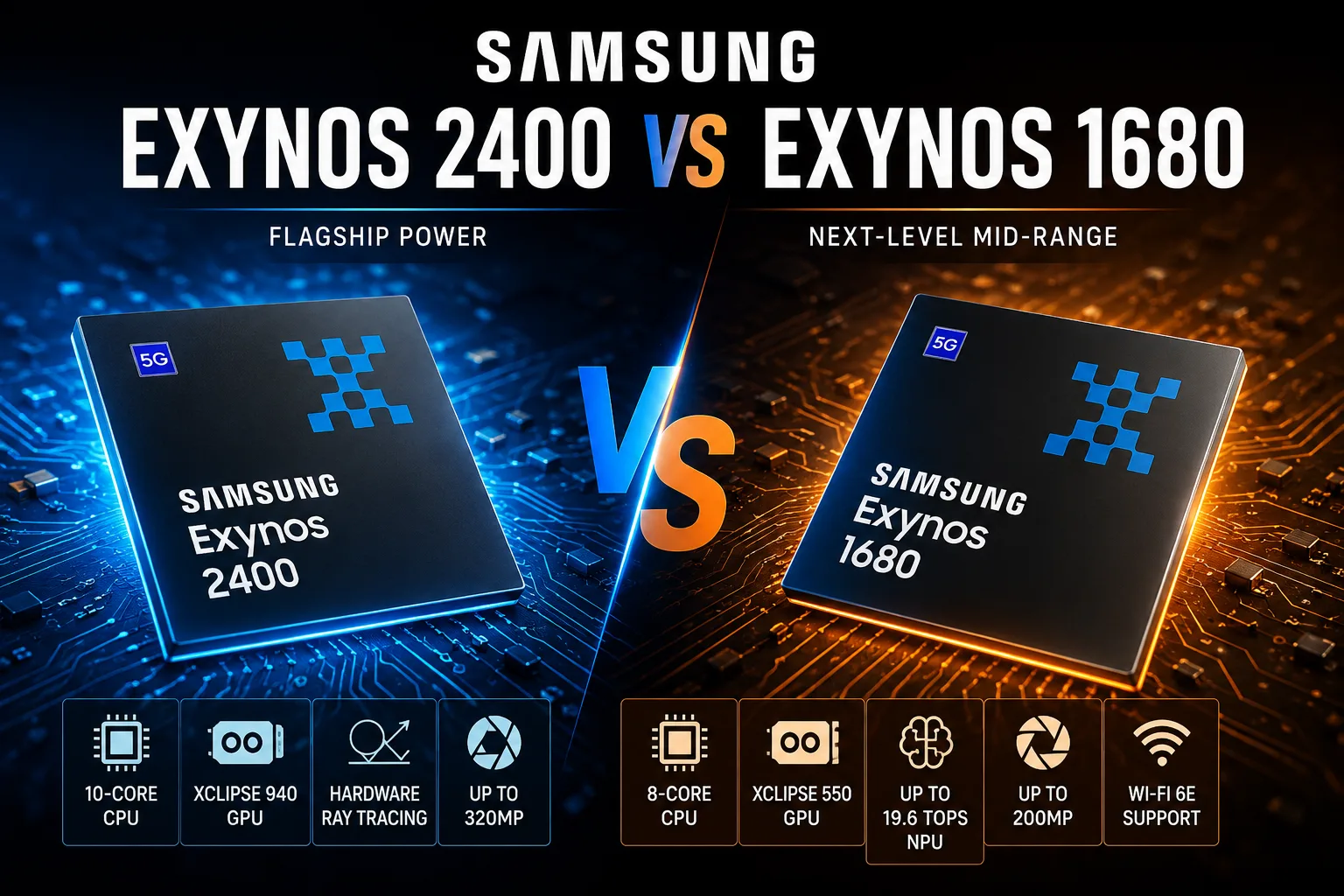
Samsung Exynos 2400 vs Samsung Exynos 1680 - flagship vs new mid-range
Samsung Exynos 2400 and Exynos 1680 are not direct competitors, although both chips belong to modern mobile platforms from Samsung. The Exynos 2400 is designed for flagship smartphones and focuses on maximum CPU and GPU performance. The Exynos 1680 is a newer mid-range chip that aims to provide a noticeable boost for the Galaxy A series compared to previous generations, but without the ambition to reach the level of top models.
The main difference between them is not age, but class. The Exynos 1680 looks modern: it features a 4nm process, CPU with Cortex-A720 and Cortex-A520 cores, Xclipse 550 graphics based on AMD RDNA 3 architecture, an NPU with up to 19.6 TOPS, and camera support of up to 200 MP. However, the Exynos 2400 exceeds it in almost all key parameters: it has a 10-core CPU with a powerful Cortex-X4, Xclipse 940 graphics, wider camera capabilities, and significantly greater capacity for heavy tasks.
Specifications
| Parameter | Samsung Exynos 2400 | Samsung Exynos 1680 |
|---|---|---|
| Class | Flagship | Mid-range / upper mid-range |
| Process | 4 nm Samsung | 4 nm Samsung |
| CPU | 10 cores | 8 cores |
| Prime Core | Cortex-X4 | Cortex-A720 |
| GPU | Xclipse 940 | Xclipse 550 |
| GPU Architecture | AMD RDNA 3 | AMD RDNA 3 |
| Cameras | up to 320 MP | up to 200 MP |
| Positioning | Galaxy S / flagship segment | Galaxy A / mid-range |
The table clearly illustrates the essence of the comparison. The Exynos 1680 does not appear outdated or weak: it has a modern process, current CPU cores, and RDNA 3 graphics. However, the Exynos 2400 is designed for a different level of workload from the outset. The Cortex-X4, larger GPU, and 10-core layout provide it with an advantage where smartphones operate under prolonged high loads rather than short bursts.
CPU: where the difference will be noticeable
The Exynos 2400 uses a more complex 10-core configuration: one powerful Cortex-X4, performance-oriented Cortex-A720 cores, and energy-efficient Cortex-A520 cores. The presence of the Cortex-X4 is particularly important for short heavy tasks: launching applications, processing snapshots, running the interface under load, unpacking data, and dealing with complex web pages.
The Exynos 1680 is built more simply. Its prime core is Cortex-A720, not a Cortex-X series core. However, the 1+4+3 configuration works well for the mid-range: one fast core, four performance cores, and three energy-efficient cores. For browsing, messaging, camera, social media, and ordinary multitasking, this setup is more than adequate. But in tasks where peak single-thread performance or prolonged multi-thread loads are crucial, the Exynos 2400 will remain noticeably faster.
Benchmarking Performance
| Test | Exynos 2400 | Exynos 1680 |
|---|---|---|
| Geekbench 6 Single-Core | approximately 1900-2100 | approximately 1350-1450 |
| Geekbench 6 Multi-Core | approximately 6200-7000 | approximately 4300-4600 |
| AnTuTu | around 1.8-2.0 million | around 1.1-1.4 million |
| GPU Compute / graphics tests | noticeably higher | solid mid-range level |
The numbers should be seen as guidelines: results depend on the specific smartphone, cooling, firmware, and version of the test. But the overall picture is clear: the Exynos 2400 is faster both in single-thread and multi-thread tasks. The difference may not always be obvious during regular use, but it becomes significant in heavy tasks.
The Exynos 1680, meanwhile, does not appear weak. For the mid-range, it offers a good performance buffer: interface, camera, browser, navigation, video, everyday applications, and most games should not be a problem. However, the Exynos 2400 operates with more headroom and is better suited for scenarios where the smartphone acts as a versatile flagship, rather than an ordinary device for everyday use.
Graphics and Gaming
The biggest difference between the chips lies in graphics. Both use Xclipse GPU family based on AMD RDNA 3, but the actual blocks vary in class. The Xclipse 940 in Exynos 2400 represents flagship graphics with hardware ray tracing, designed for high settings, complex effects, and more stable frame rates in intensive games.
The Xclipse 550 in Exynos 1680 is not budget graphics, but it still does not compete with the Xclipse 940. Its purpose differs: to provide the Galaxy A series with a more modern GPU, improve performance compared to previous mid-range Exynos chips, and ensure comfortable gaming at Full HD. In popular titles like PUBG Mobile, Call of Duty Mobile, Genshin Impact, or Honkai: Star Rail, much will depend on settings, but the headroom of Exynos 2400 is clearly higher.
If gaming is one of the primary scenarios, the Exynos 2400 is preferable. The Exynos 1680 is suitable for most popular games at Full HD, but in heavy projects, it will sooner require lowering graphics settings.
Camera, AI, and Multimedia
The Exynos 1680 has a strong feature set for its class: NPU up to 19.6 TOPS, camera support up to 200 MP, modern image processing algorithms, and Wi-Fi 6E. This is important for a mid-range smartphone not only because of individual AI features. The performance of the NPU and ISP affects photo processing, noise reduction, portrait modes, scene recognition, and camera performance in challenging conditions.
The Exynos 2400, nonetheless, has broader capabilities. It supports cameras up to 320 MP, more demanding video recording scenarios, and a more powerful ISP. In reality, photo quality depends not only on the processor but also on the sensor, optics, and algorithms of the specific smartphone. However, comparing the platforms directly, the Exynos 2400 is better suited for flagship cameras and complex video processing.
Battery Life and Heating
Both chips are manufactured using Samsung's 4nm process, but that does not mean they will behave the same way. The Exynos 2400 is more powerful, so under high load, it may consume more energy and be more dependent on the device's cooling. However, it has greater performance headroom: even after lowering frequencies, it can still remain faster.
The Exynos 1680 is simpler in terms of CPU and GPU, making it a more logical fit for smartphones where balance, battery life, and moderate heating are important. In everyday tasks, it can be a more stable option, but the ultimate outcome in gaming and heavy applications will still depend on the specific model of the smartphone.
Conclusion
The Exynos 2400 is significantly stronger than the Exynos 1680 in almost every aspect: processing power, graphics, camera, video, and heavy scenarios. It is a flagship chip, and in the comparison with Exynos 1680, it wins without much reservation. If high settings gaming, active video recording, heavy multitasking, and maximum performance capacity within the Samsung ecosystem are needed, the Exynos 2400 is the right choice.
The Exynos 1680 appeals to a different audience. It is not a replacement for the Exynos 2400 but a modern mid-range platform: current CPU cores, RDNA 3 graphics, NPU up to 19.6 TOPS, support for 200 MP cameras, and solid headroom for everyday tasks. If maximum performance is required - Exynos 2400. If a more affordable Samsung smartphone without overspending on flagship platforms is needed - the Exynos 1680 looks more practical.
Advantages
- Higher Frequency: 3210 MHz (3210 MHz vs 2900 MHz)
- Newer Launch Date: March 2026 (January 2024 vs March 2026)
Basic
2x 2.9 GHz – Cortex-A720
3x 2.6 GHz – Cortex-A720
4x 1.8 GHz – Cortex-A520
4x 2.6 GHz – Cortex-A720
3x 1.95 GHz – Cortex-A520
GPU Specifications
Connectivity
Memory Specifications
Miscellaneous
- AIFF
- CAF
- MP3
- MP4
- WAV
- H.265
- VP8
- VP9
Benchmarks
Comparison of Devices
Related SoC Comparisons




Share in social media
Or Link To Us
<a href="https://cputronic.com/index.php/soc/compare/samsung-exynos-2400-vs-samsung-exynos-1680" target="_blank">Samsung Exynos 2400 vs Samsung Exynos 1680</a>