Qualcomm Snapdragon 7s Gen 2
vs
Qualcomm Snapdragon 6s Gen 4

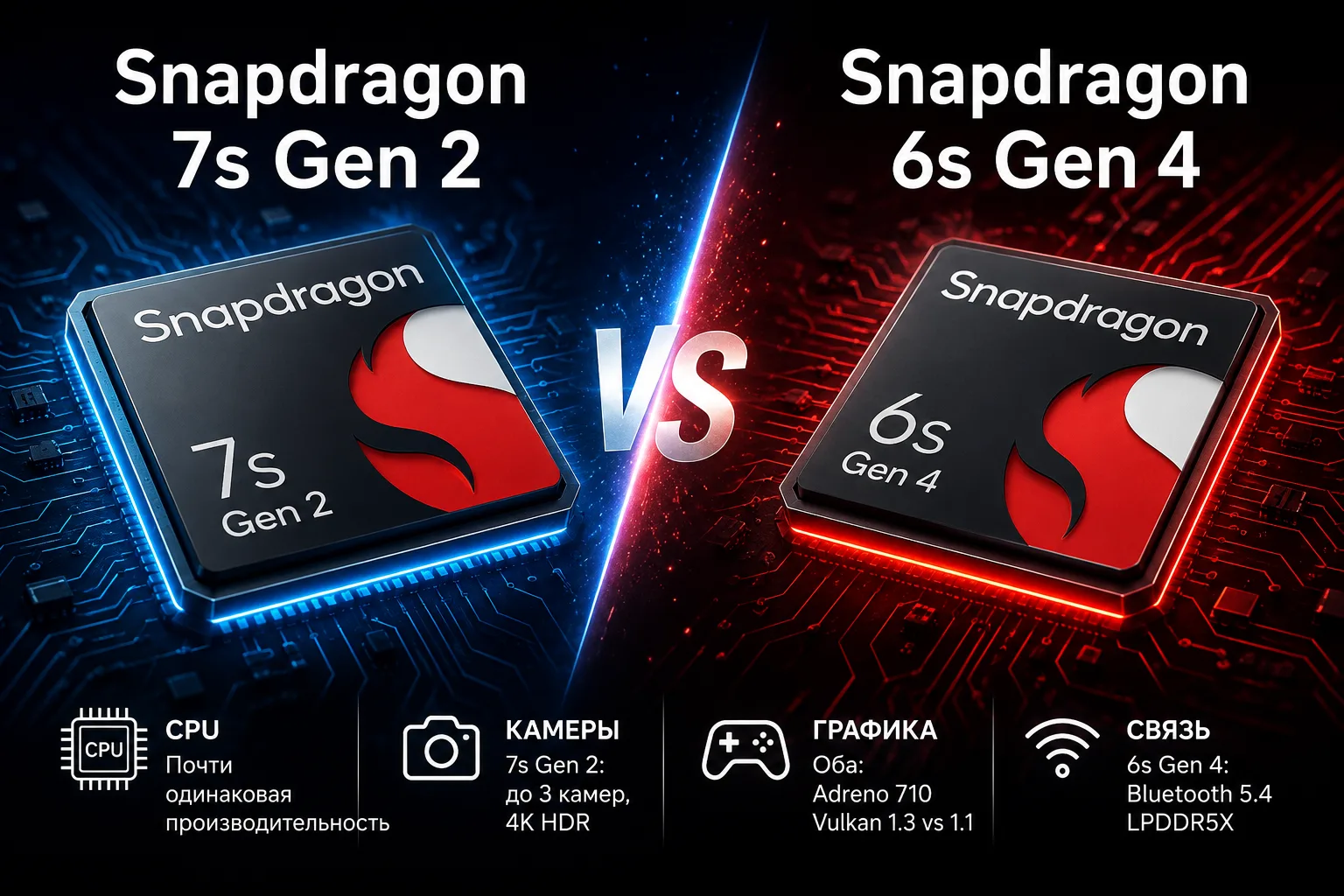
SoC Comparison Result
Snapdragon 7s Gen 2 vs Snapdragon 6s Gen 4: Almost Equal Speed, but Different Camera Capabilities
The Snapdragon 7s Gen 2 occupies a higher spot in Qualcomm's lineup, but it hardly outperforms the Snapdragon 6s Gen 4 in CPU performance. Both chips have the same configuration of cores, similar frequencies, and are manufactured using the same process, leading to comparable results in Geekbench on devices utilizing them.
The main advantage of the Snapdragon 7s Gen 2 is its more advanced camera and video capabilities. It supports 4K HDR video recording and simultaneous operation of three cameras, while its graphics unit is compatible with Vulkan 1.3. The Snapdragon 6s Gen 4 can record video at a maximum of 2K HDR and works with two cameras, but it does support Bluetooth 5.4 and LPDDR5X memory.
Key Differences
| Feature | Snapdragon 7s Gen 2 | Snapdragon 6s Gen 4 |
|---|---|---|
| Performance Cores | 4 × Cortex-A78, up to 2.4 GHz | 4 × Cortex-A78, up to 2.4 GHz |
| Efficiency Cores | 4 × Cortex-A55, up to 1.95 GHz | 4 × Cortex-A55, up to 1.8 GHz |
| Graphics | Adreno 710 | Adreno 710 |
| Vulkan | 1.3 | 1.1 |
| ISP | Triple 12-bit | Dual 12-bit |
| Maximum Video Recording | 4K HDR, 30 fps | 2K HDR, 30 fps |
| Simultaneous Camera Operation | Up to three | Up to two |
| RAM Support | LPDDR5 or LPDDR4X | LPDDR5X or LPDDR4X |
| Maximum RAM Volume | 12 GB | 12 GB |
| Bluetooth | 5.2 | 5.4 |
| External Display | Up to 4K at 60 Hz | Not specified |
For display, storage, and wireless connectivity, the differences are minimal: both chips support FHD+ at 144 Hz, UFS 3.1, Wi-Fi 6E, and 5G.
CPU Performance: Minimal Difference
The only difference is in the frequency of the smaller cores: up to 1.95 GHz for the Snapdragon 7s Gen 2 and up to 1.8 GHz for the Snapdragon 6s Gen 4. The four high-performance Cortex-A78 cores in both instances operate at up to 2.4 GHz.
In selected Geekbench 6.7.1 runs, the differences between chips turned out to be smaller than those between individual smartphones:
| Processor and Device | RAM | Single Core | Multi Core |
|---|---|---|---|
| Snapdragon 7s Gen 2 - Redmi Note 13 Pro 5G | 8 GB | 1016 | 2871 |
| Snapdragon 7s Gen 2 - POCO X6 | 8 GB | 939 | 2740 |
| Snapdragon 6s Gen 4 - Moto G57 Power | 12 GB | 1004 | 2871 |
| Snapdragon 6s Gen 4 - Moto G57 | 4 GB | 1002 | 2470 |
These results are specific and not averages across all devices. Nevertheless, the range is clear: both chips score around 1000 points in single-core tests, and the best multi-core results approach 2900 points.
The closeness is particularly evident in the case of the Redmi Note 13 Pro 5G and Moto G57 Power: in selected runs, both smartphones achieved 2871 points in multi-core performance.
The Moto G57 lagged significantly only in multi-core performance, while its single-core result remained in line with other devices. This once again indicates that the performance of a specific smartphone cannot be automatically transferred to all models with the same processor.
The responsiveness of the interface and application launch speed will be influenced more by the storage, the amount of RAM, and system settings than by the small difference between these chips.
Graphics and Gaming
Both processors use Adreno 710, placing them in the same gaming class. In demanding games, settings may need to be lowered or rendering resolution decreased, particularly under prolonged load.
The identical GPU name does not guarantee the same frequencies, power limits, and driver versions. Therefore, two smartphones on these platforms may differ significantly in frame rate stability.
The Snapdragon 7s Gen 2 supports Vulkan 1.3, whereas the Snapdragon 6s Gen 4 is limited to Vulkan 1.1. While a newer API alone doesn’t boost FPS, it provides compatibility with modern graphics features.
Specifications show a slight edge to the Snapdragon 7s Gen 2, but without comparable gaming tests of specific smartphones, it's hard to assess the gap.
Cameras and Video: Advantage of Snapdragon 7s Gen 2
The chips differ the most in camera and video recording capabilities.
The Snapdragon 7s Gen 2 features a triple 12-bit ISP. It can concurrently capture images from three cameras and record 4K HDR video at 30 frames per second. It also supports HDR10, HLG, and 1080p slow-motion video at 120 frames per second.
The Snapdragon 6s Gen 4 is equipped with a dual 12-bit ISP. It works simultaneously with two cameras and records video at a maximum of 2K HDR at 30 frames per second. Slow-motion recording is available in 720p at 240 frames per second.
Both chips support cameras up to 200 MP, but this figure says little about photo quality. The end result more heavily depends on the sensor, optics, stabilization, and processing algorithms.
The advantage of the Snapdragon 7s Gen 2 is significant in smartphones with 4K recording, strong ultra-wide cameras, or multiple useful modules. In a budget model with just one main camera, the capabilities of the triple ISP yield almost no advantage.
Memory, Storage, and Connectivity
The Snapdragon 7s Gen 2 supports LPDDR5 at speeds up to 3200 MHz and LPDDR4X up to 2133 MHz. The Snapdragon 6s Gen 4 works with LPDDR5X up to 3200 MHz and LPDDR4X up to 2100 MHz. The maximum memory volume for both chips is 12 GB.
Both platforms also support UFS 3.1. However, this does not imply that such a storage type is used in every smartphone. Manufacturers can opt for slower memory, which will impact application launches and file handling more than the processor itself.
In terms of mobile connectivity, the chips are nearly identical. Both support 5G sub-6 GHz and mmWave, Wi-Fi 6E, and download speeds of up to 2.9 Gbps.
The Snapdragon 6s Gen 4 features Bluetooth 5.4, while the Snapdragon 7s Gen 2 has Bluetooth 5.2. Conversely, the Snapdragon 7s Gen 2 supports aptX Lossless, aptX Adaptive, and Snapdragon Sound. The available codecs depend on the specific smartphone's implementation.
In Which Smartphones Are These Processors Used
The Snapdragon 7s Gen 2 is used in the following serial models:
- Xiaomi Redmi Note 13 Pro 5G;
- POCO X6;
- Motorola Edge 50 Fusion;
- HMD Skyline.
These smartphones vary in memory size, storage type, design, and cooling configurations. Therefore, results from one model cannot be automatically applied to all devices featuring the Snapdragon 7s Gen 2.
The Snapdragon 6s Gen 4 was released later and is currently used in only a few smartphones:
- Motorola Moto G57;
- Motorola Moto G57 Power.
The Moto G57 was the first commercial smartphone to use the Snapdragon 6s Gen 4. The Power version uses the same processor but has a 7000 mAh battery and configurations with larger RAM.
The Snapdragon 7s Gen 2 currently has a wider selection of devices for which detailed performance, heat, and battery tests are already available.
Which Smartphone to Choose
Choose a model with Snapdragon 7s Gen 2 if you value:
- 4K HDR video recording;
- Simultaneous operation of three cameras;
- Support for Vulkan 1.3;
- External display output;
- A broad selection of tested devices.
Choose a model with Snapdragon 6s Gen 4 if it offers:
- A lower price;
- A larger battery;
- More RAM;
- A longer update period;
- Better configurations.
It is not justified to overpay for Snapdragon 7s Gen 2 solely for CPU performance. Its advantages lie in more advanced image processing, 4K HDR recording, and support for Vulkan 1.3.
Conclusion
In processor tests, the Snapdragon 6s Gen 4 operates approximately at the level of Snapdragon 7s Gen 2. The main advantages of the higher-end platform are three ISPs, 4K HDR recording, and Vulkan 1.3.
At the same price, the Snapdragon 7s Gen 2 smartphone is preferable. However, a larger battery, a fast storage solution, additional memory, or prolonged support easily outweigh the differences between the chips.
Advantages
- Newer Launch Date: October 2025 (September 2023 vs October 2025)
Basic
4x 1.95 GHz – Cortex-A55
GPU Specifications
Connectivity
Memory Specifications
Miscellaneous
- AIFF
- CAF
- MP3
- MP4
- WAV
- H.265
- VP9
Benchmarks
Comparison of Devices
Related SoC Comparisons



Share in social media
Or Link To Us
<a href="https://cputronic.com/index.php/soc/compare/qualcomm-snapdragon-7s-gen-2-vs-qualcomm-snapdragon-6s-gen-4" target="_blank">Qualcomm Snapdragon 7s Gen 2 vs Qualcomm Snapdragon 6s Gen 4</a>