Qualcomm Snapdragon 685
vs
MediaTek Dimensity 7100

SoC Comparison Result
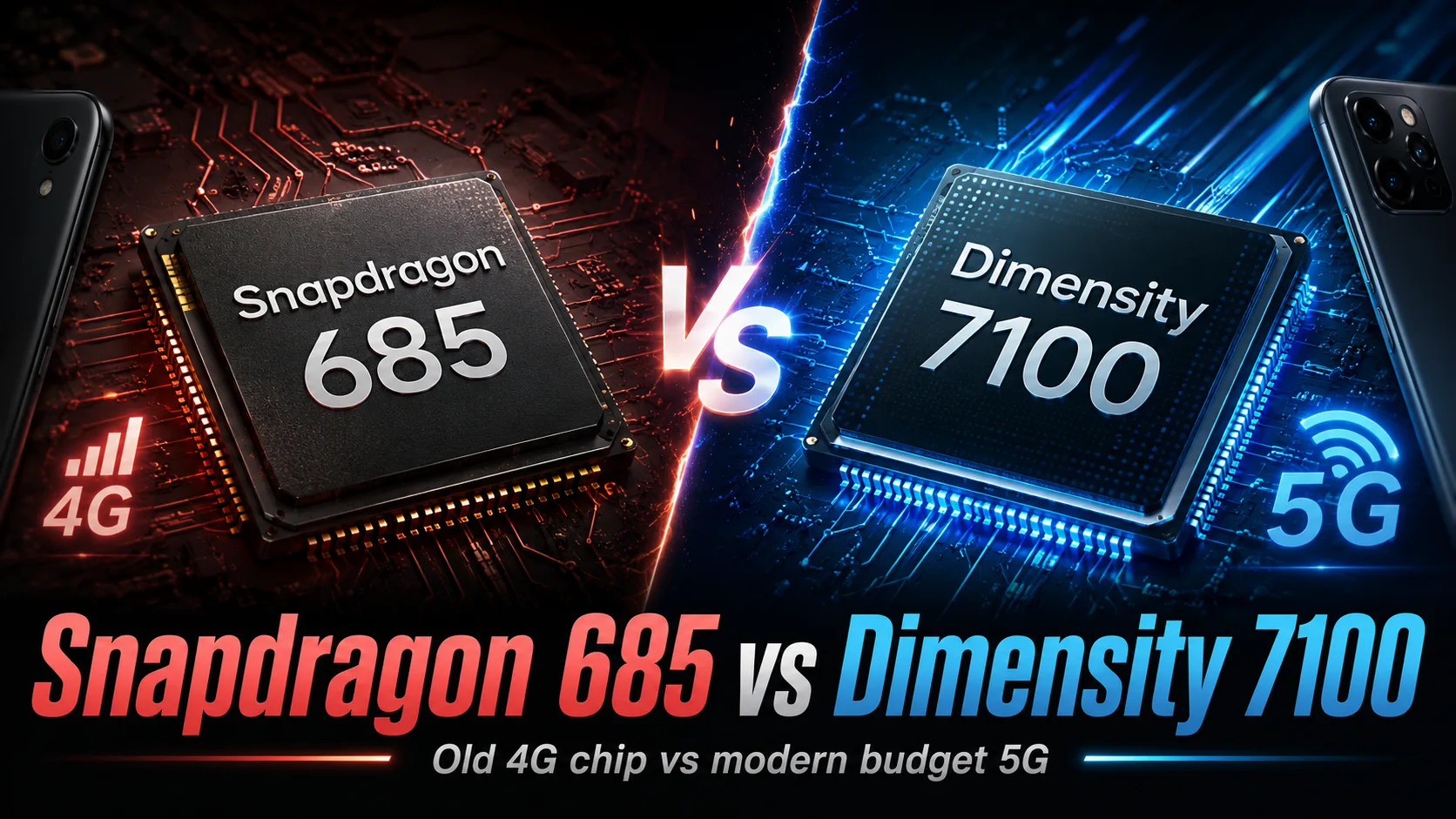
Snapdragon 685 vs Dimensity 7100: Old 4G Chip vs Modern Budget 5G
Qualcomm Snapdragon 685 and MediaTek Dimensity 7100 are separated by just three years, but technically they are chips from different generations. The Snapdragon 685 was released in 2023 and retains the old Cortex-A73 and Cortex-A53 combination. The Dimensity 7100 debuted in 2026 with four Cortex-A78 cores, more modern graphics, 5G support, LPDDR5, and UFS 3.1. Therefore, the winner here is obvious, and the main question is how significant the lead of the Dimensity 7100 is.
Main Difference
Both chips are manufactured using TSMC's 6nm process and have eight cores.
| Specification | Snapdragon 685 | Dimensity 7100 |
|---|---|---|
| Performance Cores | 4 x Cortex-A73 up to 2.8 GHz | 4 x Cortex-A78 up to 2.4 GHz |
| Efficiency Cores | 4 x Cortex-A53 up to 1.9 GHz | 4 x Cortex-A55 up to 2.0 GHz |
| GPU | Adreno 610 | Mali-G610 MC2 |
| Manufacturing Process | 6nm TSMC | 6nm TSMC |
| RAM | LPDDR4X | LPDDR5 / LPDDR4X |
| Storage | UFS 2.2 | up to UFS 3.1 |
| Mobile Network | 4G LTE | 5G |
| Wi-Fi | Wi-Fi 5 | Wi-Fi 6 |
| Bluetooth | 5.2 | 5.4 |
The main reason for such a gap is the four Cortex-A78 cores instead of the older Cortex-A73. Even the higher clock speed of the Snapdragon 685 does not compensate for the difference between these architectures.
CPU Performance
| Benchmark | Snapdragon 685 | Dimensity 7100 | Difference |
|---|---|---|---|
| Geekbench 6 Single-Core | 475 | 996 | +110% |
| Geekbench 6 Multi-Core | 1,517 | 2,950 | +94% |
| AnTuTu 10 | 354,293 | 595,824 | +68% |
In single-core Geekbench 6, the Dimensity 7100 is more than twice as fast. In multi-core performance, the gap is slightly less at 94%.
With such a disparity, the advantage is not limited to the numbers in Geekbench. The Dimensity 7100 is noticeably faster in everyday CPU tasks. This is not a 20-30% difference that can be attributed to cooling, firmware, or specific smartphone settings.
Testing on Specific Smartphones
The results are the same in specific smartphones.
| Smartphone | Processor | Geekbench 6 Single | Geekbench 6 Multi | AnTuTu 11 |
|---|---|---|---|---|
| Infinix Note Edge | Dimensity 7100 | 995 | 2,925 | 774,911 |
| Tecno Pova 8 5G | Dimensity 7100 | 996 | 2,944 | 757,391 |
| Infinix Hot 70 Pro | Dimensity 7100 | 970 | 2,882 | 782,313 |
| Xiaomi Redmi Note 12 4G | Snapdragon 685 | 469 | 1,484 | 496,286 |
| Honor X7c | Snapdragon 685 | 463 | 1,463 | 483,206 |
| Realme C67 4G | Snapdragon 685 | 465 | 1,412 | 437,619 |
Smartphones with the Dimensity 7100 score around 970-1000 points in Geekbench 6 Single-Core and 2880-2950 in Multi-Core. The models with Snapdragon 685 have scores about half as low - 460-470 and 1400-1500 points.
The variation within each group is small, so the results cannot be explained by an especially successful implementation of a single smartphone. AnTuTu 11 cannot be directly compared with AnTuTu 10 from the main table; however, within the same version of the test, MediaTek's advantage remains: models with Dimensity 7100 score around 750-780 thousand points, while smartphones with Snapdragon 685 typically stay in the range of 440-500 thousand.
Graphics and Gaming
The Snapdragon 685 uses the Adreno 610, which is regarded as entry-level by today's standards. It is sufficient for simple games, but performance is lacking in modern demanding titles.
The Dimensity 7100 utilizes the Mali-G610 MC2. This is also not a powerful gaming GPU: the MC2 configuration significantly limits its capabilities. One should not expect to run heavy games at maximum settings.
The Dimensity 7100 is better suited for PUBG Mobile, Call of Duty Mobile, and other popular titles, where it can maintain an acceptable frame rate at lower settings in heavier games. The Snapdragon 685 is already noticeably weak in modern demanding games.
Memory and Storage
The Snapdragon 685 is limited to LPDDR4X and UFS 2.2. The Dimensity 7100 supports LPDDR5 and UFS 3.1. A specific smartphone may come with slower memory or storage, but the chip itself allows for notably faster components. Therefore, the Snapdragon 685 is weaker not only in terms of CPU - its memory and storage capabilities are also significantly more modest.
5G vs 4G
The Snapdragon 685 does not support 5G at all. For a budget chip from 2023, the lack of 5G seemed tolerable, but by 2026, purchasing a new device without 5G already requires a significant discount.
The Dimensity 7100 supports 5G, Wi-Fi 6, and Bluetooth 5.4, while the Snapdragon 685 remains with LTE, Wi-Fi 5, and Bluetooth 5.2. For a new smartphone in 2026, such a set already seems outdated.
Energy Efficiency
The identical 6nm manufacturing process alone does not give the Snapdragon 685 an advantage in efficiency. Based on specifications, it is difficult to reliably determine a winner here: real-life battery life is more strongly dependent on the battery, display, cooling, and settings of the specific smartphone.
What to Choose
If smartphones are priced similarly, there is practically no reason to choose the Snapdragon 685 over the Dimensity 7100. MediaTek is about twice as fast in CPU performance, stronger in graphics, and additionally supports LPDDR5, UFS 3.1, and 5G.
For basic tasks, the Snapdragon 685 is still sufficient, but for a new smartphone in 2026, this is already too low a standard.
Buying a model with Snapdragon 685 is only worth considering if there is a significant price difference. At similar prices, the Dimensity 7100 outperforms in almost every aspect - from CPU and graphics to memory and connectivity. Compared to it, the Snapdragon 685 looks outright outdated.
Advantages
- Higher Frequency: 2800 MHz (2800 MHz vs 2400 MHz)
- Newer Launch Date: January 2026 (March 2023 vs January 2026)
Basic
4x 2 GHz – Cortex-A55
GPU Specifications
Connectivity
Memory Specifications
Miscellaneous
- FLAC
- HE-AACv1
- HE-AACv2
- MP3
- H.265
- VP9
Benchmarks
Related SoC Comparisons



Share in social media
Or Link To Us
<a href="https://cputronic.com/index.php/soc/compare/qualcomm-snapdragon-685-vs-mediatek-dimensity-7100" target="_blank">Qualcomm Snapdragon 685 vs MediaTek Dimensity 7100</a>