Qualcomm Snapdragon 6 Gen 3
vs
Samsung Exynos 1480


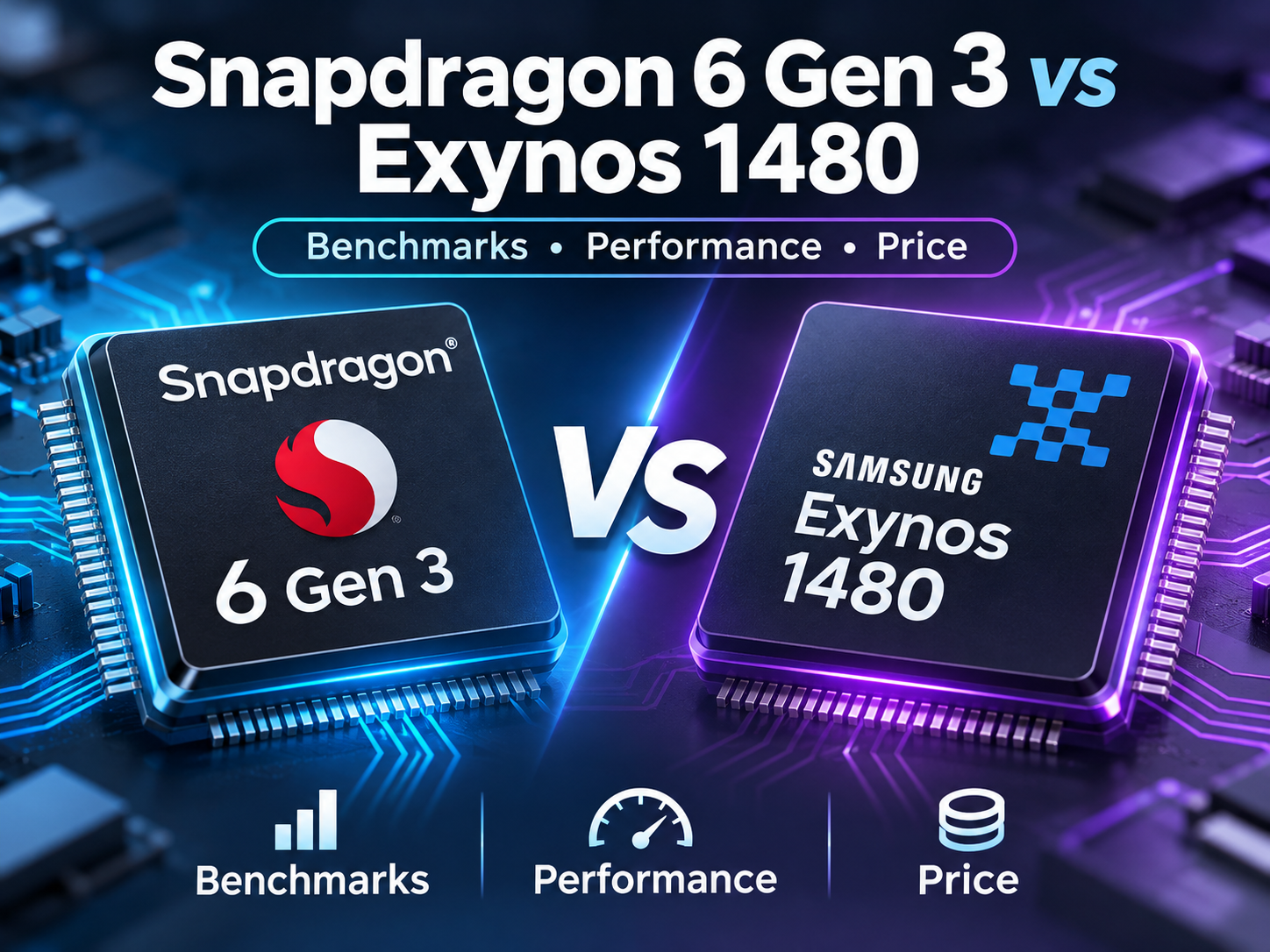
SoC Comparison Result
Snapdragon 6 Gen 3 vs. Exynos 1480: Performance Tests and Smartphone Prices
Snapdragon 6 Gen 3 and Exynos 1480 are octa-core mobile chips manufactured using Samsung’s 4nm process. Both use Cortex-A78 and Cortex-A55 cores, but the Exynos cores run at higher clock speeds. In tests of the Galaxy A55 and Galaxy A36, the Exynos 1480’s advantage is 13-18% in Geekbench 6 and 46% in 3DMark Steel Nomad Light. At the same time, the difference in smartphone prices is approximately $45.
Key Differences
| Feature | Snapdragon 6 Gen 3 | Exynos 1480 |
|---|---|---|
| Release date | September 2024 | March 2024 |
| Performance cores | 4 × Cortex-A78, 2.4 GHz | 4 × Cortex-A78, 2.75 GHz |
| Efficiency cores | 4 × Cortex-A55, 1.8 GHz | 4 × Cortex-A55, 2.0 GHz |
| Graphics | Adreno 710 | Xclipse 530 |
| GPU architecture | Qualcomm Adreno | AMD RDNA |
| Bluetooth | 5.2 | 5.3 |
| 5G download speed | Up to 2.9 Gb/s | Up to 5.1 Gb/s |
| Video recording | Up to 4K, 30 FPS | Up to 4K, 60 FPS |
The Exynos 1480 runs at higher clock speeds: its Cortex-A78 performance cores are 350 MHz faster, while its Cortex-A55 efficiency cores are 200 MHz faster. This helps explain its advantage in Geekbench 6, although the final results also depend on the smartphone’s power-management settings and cooling.
Using the same process node does not guarantee equal battery life. Power consumption is affected by clock speeds, voltage, the display, and other device components.
Performance in Geekbench 6 and AnTuTu 11
Four smartphones were selected for comparison: the Samsung Galaxy A36 and Motorola Moto G Stylus 5G (2025) with the Snapdragon 6 Gen 3, as well as the Galaxy A55 and Galaxy A37 with the Exynos 1480.
| Smartphone and processor | Geekbench 6 Single / Multi | AnTuTu 11 | 3DMark Steel Nomad Light | Price |
|---|---|---|---|---|
| Galaxy A36 5G - Snapdragon 6 Gen 3 | 1,004 / 2,919 | 844,447 | 315 | ~$255 |
| Moto G Stylus 5G (2025) - Snapdragon 6 Gen 3 | 1,006 / 2,837 | 831,447 | 301 | ~$300 |
| Galaxy A55 5G - Exynos 1480 | 1,137 / 3,437 | 1,021,736 | 459 | ~$300 |
| Galaxy A37 5G - Exynos 1480 | 1,153 / 3,457 | 1,064,079 | 481 | ~$390 |
Prices are approximate reference points for the U.S. market as of November 2026. Configurations: Galaxy A36 6/128 GB, Moto G Stylus 8/256 GB, Galaxy A55 8/128 GB, and Galaxy A37 6/128 GB. Benchmark results apply to the specific models tested and may vary depending on the firmware and memory configuration.
In a comparison of the Galaxy A55 and Galaxy A36, the Exynos 1480’s advantage is:
- 13% in Geekbench 6 Single-Core.
- 18% in Geekbench 6 Multi-Core.
- 21% in AnTuTu 11.
- 46% in 3DMark Steel Nomad Light.
In the Geekbench 6 single-core test, the Galaxy A55 scores 1,137 points versus 1,004 for the Galaxy A36. In the multi-core test, the advantage increases to 18%.
The Galaxy A37 slightly outperforms the A55 in the listed tests, although both use the Exynos 1480. For example, the difference in Geekbench 6 Multi-Core is just 20 points - 3,457 versus 3,437. This result does not justify considering the A37 noticeably faster.
In AnTuTu 11, the Galaxy A37 scores 1.06 million points, the Galaxy A55 scores 1.02 million, while devices with the Snapdragon 6 Gen 3 remain in the 830,000-845,000 range. This benchmark evaluates the CPU, GPU, memory subsystem, and UX, so the final scores depend on more than just the CPU cores.
Graphics: Adreno 710 vs. Xclipse 530
The Snapdragon 6 Gen 3 is equipped with the Adreno 710 graphics processor. The Exynos 1480 uses the Xclipse 530, based on AMD’s RDNA architecture.
In 3DMark Steel Nomad Light, the Galaxy A55 scores 459 points versus 315 for the Galaxy A36. The advantage is 46%.
The difference between the Galaxy A37 and Moto G Stylus 5G (2025) is even larger: 481 versus 301 points, or approximately 60%. Both comparisons show the advantage of the Xclipse 530, although the results are also affected by the settings and cooling of the specific smartphones.
The Steel Nomad Light results suggest that the Exynos 1480 can be expected to deliver higher performance in demanding games. However, the frame rate depends on drivers, graphics settings, game optimization, and cooling. The exact FPS in a specific game cannot be determined from 3DMark results.
Memory, Connectivity, and Video Recording
Both processors support LPDDR5 memory, UFS 3.1 storage, and Wi-Fi 6E. The actual memory speed and available wireless features depend on the specific smartphone model.
The Exynos 1480’s integrated modem supports 5G data downloads at speeds of up to 5.1 Gb/s, while the Snapdragon 6 Gen 3 is rated for up to 2.9 Gb/s. These are maximum theoretical speeds, not results measured on mobile networks.
Video-recording capabilities also differ. The Exynos 1480 hardware supports 4K recording at 60 FPS, while the Snapdragon 6 Gen 3 supports 4K at 30 FPS. However, the Galaxy A55 and Galaxy A37 are limited to 4K at 30 FPS. Therefore, the Exynos advantage at the processor level does not provide these smartphones with additional video-recording modes.
Which Smartphone Offers the Better Buy?
Samsung Galaxy A36 5G - approximately $255. The Snapdragon 6 Gen 3 model with 6 GB of RAM and 128 GB of storage is suitable for everyday tasks. The smartphone was released in 2025 and received support for up to six generations of Android and six years of security updates.
Samsung Galaxy A55 5G - approximately $300. For a difference of around $45 compared with the Galaxy A36, buyers get a faster CPU, significantly more powerful graphics, and 8 GB of RAM in the configuration considered. In terms of price-to-performance ratio, the A55 is more attractive, especially for gaming. However, the smartphone was released in 2024, and its stated support is limited to four generations of Android and five years of security updates.
Motorola Moto G Stylus 5G (2025) - approximately $300. Based on the CPU and graphics test results, it trails the Galaxy A55, but it offers 256 GB of storage, an integrated stylus, and fast charging. The Moto G Stylus should primarily be considered for these features rather than for the speed of the Snapdragon 6 Gen 3.
Samsung Galaxy A37 5G - approximately $390. The smartphone uses the same Exynos 1480 as the Galaxy A55. There is no substantial performance gain between them, but the A37 was released in 2026 and received support for up to six generations of Android and six years of security updates. It is preferable for long-term use, but it offers worse performance per dollar than the A55.
Conclusion
The Samsung Exynos 1480 outperforms the Qualcomm Snapdragon 6 Gen 3 in CPU and graphics tests. In the Galaxy A55 and Galaxy A36 comparison, the difference is 13-18% in Geekbench 6 and 46% in 3DMark Steel Nomad Light.
Both chips provide sufficient performance for everyday tasks. The Exynos 1480 is more appealing under heavy CPU and GPU loads, especially when the smartphones are priced about the same.
At around $300, the Galaxy A55 offers higher performance than the $255 Galaxy A36. The Galaxy A37 does not provide a significant speed increase over the A55 because it uses the same processor. Its main advantage is longer software support.
Advantages
- Newer Launch Date: September 2024 (September 2024 vs March 2024)
- Higher Frequency: 2750 MHz (2400 MHz vs 2750 MHz)
Basic
4x 1.8 GHz – Cortex-A55
4x 2 GHz – Cortex-A55
GPU Specifications
Connectivity
Memory Specifications
Miscellaneous
Benchmarks
Comparison of Devices
Related SoC Comparisons



Share in social media
Or Link To Us
<a href="https://cputronic.com/index.php/soc/compare/qualcomm-snapdragon-6-gen-3-vs-samsung-exynos-1480" target="_blank">Qualcomm Snapdragon 6 Gen 3 vs Samsung Exynos 1480</a>