MediaTek Helio G200
vs
MediaTek Dimensity 8500
SoC Comparison Result
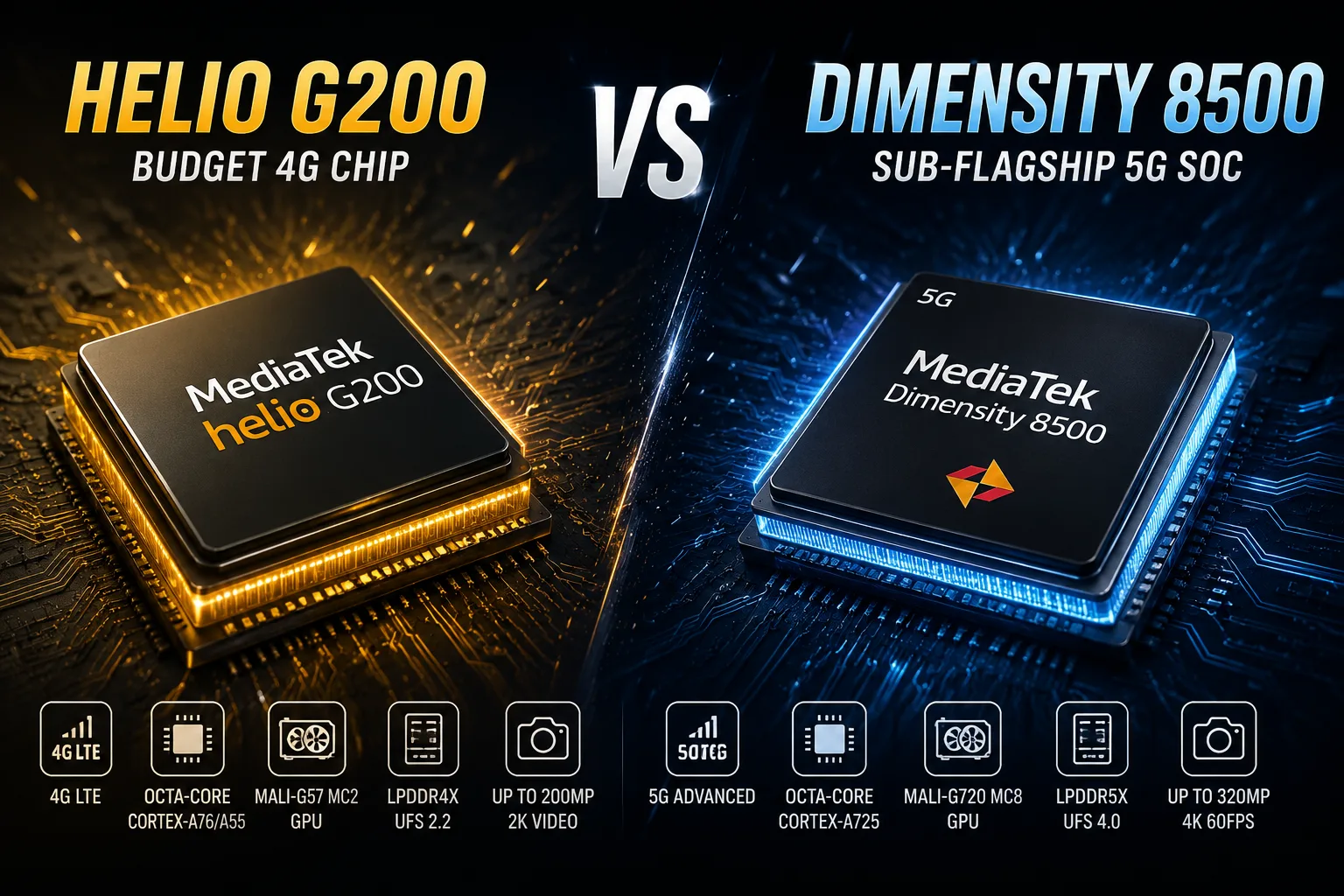
Helio G200 vs. Dimensity 8500: Budget 4G Chip vs. Sub-Flagship SoC
Helio G200 and Dimensity 8500 are not direct competitors. The former is designed for affordable 4G smartphones, while the latter targets high-performance upper mid-range models with fast memory, powerful graphics, and 5G capabilities. Unsurprisingly, the Dimensity 8500 is faster, so the key question is how noticeable this difference is in real-world use and whether it justifies the extra cost.
Comparison in Brief
| Scenario | Helio G200 | Dimensity 8500 |
|---|---|---|
| Everyday Apps | Sufficient for basic tasks; possible delays under load | Quick response even with multitasking |
| Heavy Gaming | Low to medium settings | High settings and high frame rates |
| Multitasking | Highly dependent on memory and interface | Better at retaining apps in memory |
| Camera and Video | Up to 200 MP, video up to 2K | Up to 320 MP, 4K recording at 60 FPS |
| Mobile Connectivity | Only 4G | 5G-Advanced |
| Local AI Functions | Primarily camera processing | Dedicated NPU for language and visual models |
| Smartphone Class | Budget | Upper mid-range |
Processor: Old Cortex-A76 vs. Eight Cortex-A725
The Helio G200 features two high-performance Cortex-A76 cores clocked at up to 2.2 GHz and six energy-efficient Cortex-A55 cores at up to 2.0 GHz. This same configuration was used in the Helio G99 and G100. For messengers, browsing, navigation, and video playback, this is adequate, but limitations will increasingly become evident in demanding applications and newer versions of Android.
The Dimensity 8500 is designed differently: all eight cores belong to the Cortex-A725 architecture. One runs at up to 3.4 GHz, three at up to 3.2 GHz, and the remaining four at up to 2.2 GHz. It is complemented by 6 MB of L3 cache and 5 MB of system cache. This configuration launches apps faster and handles prolonged loads better.
In real-world use, the Helio G200 often experiences delays when installing apps, processing photos, and switching between demanding applications. The Dimensity 8500 performs these same tasks faster, and its advantage will become even more noticeable after several major system updates.
Gaming: Basic GPU vs. Upper Mid-Range Graphics
The main limitation of the Helio G200 remains the Mali-G57 MC2 graphics. Compared to the Helio G100, the company increased the GPU frequency to 1.1 GHz, but the number of compute units and the architecture itself have not changed. The increase will be minimal: this is an enhancement of the previous accelerator rather than a new graphics system.
The Mali-G57 MC2 handles undemanding games and popular competitive projects. In heavy games, settings and rendering resolution will have to be lowered, often resulting in 30 frames per second. A 120 Hz display does not guarantee 120 FPS: on Helio G200, the high refresh rate is mainly beneficial for the interface.
The Dimensity 8500 utilizes the Mali-G720 MC8-a GPU with eight compute units and hardware ray tracing. MediaTek claims a 25% increase in peak performance and a 20% reduction in power consumption compared to the previous generation. This GPU allows for high settings and longer retention of frame rates in demanding games.
On the Helio G200, modern heavy games run under compromises. The Dimensity 8500 often allows the selection of high settings without significant drops in frame rates.
Memory and Storage: Another Advantage for Dimensity 8500
The Helio G200 supports LPDDR4X with speeds of up to 4266 Mbps and UFS 2.2 storage. For a budget smartphone, this is sufficient, but LPDDR4X and UFS 2.2 further constrain the processor and graphics.
The Dimensity 8500 works with quad-channel LPDDR5X up to 9600 Mbps and UFS 4 with MCQ technology. High bandwidth speeds up game loading, frame processing from the camera, and the operation of local AI models.
With all else being equal, apps launch faster, the gallery loads photos more quickly, and games are less likely to be unloaded from memory. However, the result also depends on the amount of RAM, storage, and settings of the interface.
Cameras: Helio G200 Limited to 2K Video, Dimensity 8500 Supports 4K/60
Both chips support high-resolution cameras. The Helio G200 can handle sensors up to 200 MP, two cameras, and 12-bit DCG for HDR video. Video is limited to 2K resolution at 30 FPS or Full HD at 60 FPS.
The Dimensity 8500 supports sensors up to 320 MP, simultaneous operation of three 32-megapixel cameras, and 4K video recording at 60 FPS. The ISP Imagiq 1080 supports HDR when using zoom, faster autofocus, and AI-assisted frame processing.
The quality of shooting still depends on the sensor, optics, and algorithms of individual manufacturers. However, the Dimensity 8500 offers developers more opportunities for night shooting, electronic stabilization, and 4K video processing.
Connectivity and Wireless Interfaces
The Helio G200 is equipped with a Cat-13 LTE modem, supports frequency aggregation, 4×4 MIMO, dual SIM cards with 4G, Wi-Fi 5, and Bluetooth 5.2. For a low-cost smartphone, this set is sufficient, but Wi-Fi 5 and the lack of 5G already indicate the budget nature of the chip.
The Dimensity 8500 features a 5G-Advanced modem with download speeds of up to 5.17 Gbps, three carrier aggregation, Dual SIM Dual Active mode, Wi-Fi 6E, and Bluetooth 5.4.
If 5G is nearly nonexistent in the region, the advantages of the Dimensity 8500's modem are currently minimal. However, for a smartphone expected to last several years, support for 5G, Wi-Fi 6E, and Bluetooth 5.4 appears much more promising.
AI: Helio G200 for Camera Processing, Dimensity 8500 with Dedicated NPU
AI capabilities in the Helio G200 are mainly related to photo and video processing, such as face recognition, noise reduction, and other camera algorithms. There is no dedicated NPU for running large language and generative models.
The Dimensity 8500 is equipped with an NPU 880. It supports running language and visual models on the smartphone itself, image generation, and calculations in INT4 format. The specific set of functions depends on the device manufacturer, but the Dimensity 8500 has a significantly more powerful AI accelerator.
Who Should Consider Helio G200
A smartphone with the Helio G200 makes sense if it is needed for calls, messengers, video, navigation, and undemanding games. Under moderate loads, the chip does not require high cooling demands, simplifying the design of the low-cost device.
However, the name G200 does not indicate that this is a fundamentally new or particularly powerful chip. In terms of core processor features, memory, and storage, it nearly replicates the Helio G100. The main changes revolve around the increased GPU frequency, support for 12-bit DCG, and refinements in 4G connectivity.
Conclusion
A smartphone with the Helio G200 makes sense only when there is a significant price difference. For messengers, video, navigation, and simple games, it is adequate, but the Gaming label does not make such a device a full-fledged gaming model.
The Dimensity 8500 belongs to a different class: it is much faster, supports 5G, 4K recording at 60 FPS, and local AI models. The extra cost here goes toward a smartphone that handles demanding tasks better and has a longer lifespan.
Advantages
- Higher Technology: 4 nm (6 nm vs 4 nm)
- Higher Frequency: 3400 MHz (2200 MHz vs 3400 MHz)
- Newer Launch Date: January 2026 (May 2025 vs January 2026)
Basic
GPU Specifications
Connectivity
Memory Specifications
Miscellaneous
- AIFF
- CAF
- MP3
- MP4
- WAV
- H.265
- VP9
Benchmarks
Comparison of Devices
Related SoC Comparisons





Share in social media
Or Link To Us
<a href="https://cputronic.com/index.php/soc/compare/mediatek-helio-g200-vs-mediatek-dimensity-8500" target="_blank">MediaTek Helio G200 vs MediaTek Dimensity 8500</a>