MediaTek Helio G200
vs
MediaTek Dimensity 6300
SoC Comparison Result
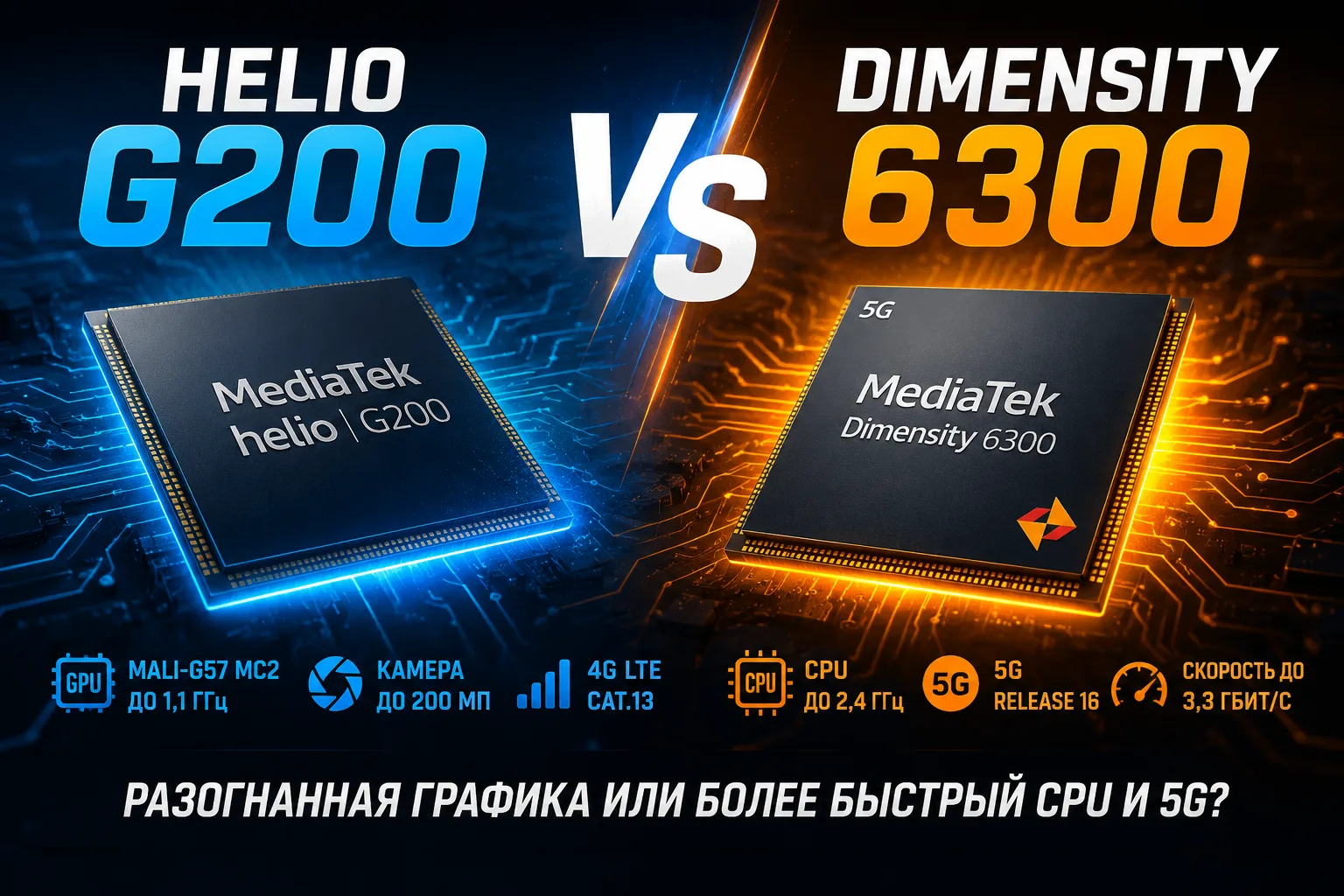
MediaTek Helio G200 vs Dimensity 6300: Overclocked Graphics or Faster CPU and 5G
MediaTek Helio G200 was released later than Dimensity 6300 but has not become unequivocally the more powerful chip. Both platforms are manufactured using a 6nm process and utilize two Cortex-A76 cores, six Cortex-A55 cores, and Mali-G57 MC2 graphics.
The Helio G200 features an increased GPU frequency and supports cameras with resolutions up to 200 MP. The Dimensity 6300 offers higher clock speeds for its CPU cores and an integrated 5G modem. However, the performance of actual smartphones depends on the specific implementation: a device with Helio G200 may score higher on AnTuTu, but in certain CPU and GPU tests, Dimensity 6300 often holds the advantage.
Key Differences
| Characteristic | MediaTek Helio G200 | MediaTek Dimensity 6300 |
|---|---|---|
| Performance cores | 2 × Cortex-A76, up to 2.2 GHz | 2 × Cortex-A76, up to 2.4 GHz |
| Efficiency cores | 6 × Cortex-A55, up to 2.0 GHz | 6 × Cortex-A55, up to 2.0 GHz |
| Graphics | Mali-G57 MC2, up to 1.1 GHz | Mali-G57 MC2 |
| Mobile networks | 4G LTE | 5G Release 16 |
| Maximum camera resolution | 200 MP | 108 MP |
| Main advantage | Increased GPU frequency | Faster CPU and 5G |
In other respects, the platforms are quite similar. They support LPDDR4X memory, UFS 2.2 storage, and Full HD+ displays with refresh rates up to 120 Hz. Therefore, the overall speed of a smartphone depends not only on the SoC but also on memory, storage, cooling, and manufacturer settings.
CPU Performance
The Dimensity 6300 has a higher clock speed for its two performance Cortex-A76 cores: 2.4 GHz versus 2.2 GHz for Helio G200. The configuration of six efficiency cores is the same.
In Geekbench 6, the Dimensity 6300 scores around 790 points in single-threaded tests, while Helio G200 scores approximately 755. The difference is about 5%. In multi-threaded mode, the results are nearly identical, falling in the range of 2030-2040 points.
The slight advantage for Dimensity 6300 may manifest during app launches, handling complex web pages, and other short bursts of load on one or two performance cores. However, during prolonged multi-threaded work, there is no noticeable gap between the processors.
AnTuTu and Smartphone Results
AnTuTu is particularly popular for comparing smartphones, but its overall score characterizes the entire device. The test takes into account CPU, GPU, memory, storage, and interface speed, so the result cannot be considered a pure comparison of processors.
| Test | Smartphone with Helio G200 | Result | Smartphone with Dimensity 6300 | Result |
|---|---|---|---|---|
| AnTuTu 10 | Infinix Hot 60 Pro | 465,122 | Samsung Galaxy M16 5G | 423,000 |
| 3DMark Sling Shot | Infinix Hot 60 Pro+ | 3,564 | Ulefone Armor X32 Pro | 3,873 |
| 3DMark Sling Shot Extreme | Infinix Hot 60 Pro+ | 2,760 | Ulefone Armor X31 Pro | 2,834 |
| 3DMark Steel Nomad Light | Infinix Hot 60 Pro+ | 147 | Ulefone Armor Mini 20T Pro | 153 |
| PCMark Work 3.0 | Infinix Hot 60 Pro | 10,896 | Motorola Moto G Power (2025) | 11,299 |
| PCMark Storage 2.0 | Infinix Hot 60 Pro | 28,347 | Realme 14x 5G | 36,102 |
In AnTuTu 10, the Infinix Hot 60 Pro outperforms the Samsung Galaxy M16 5G by about 10%. This is an important result for buyers of ready-made smartphones, but it does not mean that the CPU Helio G200 is faster. The overall score also depends on the increased GPU frequency, memory size, storage speed, and device firmware.
In some graphic tests, the picture changes. Smartphones with Dimensity 6300 outpace the Infinix Hot 60 Pro+ by about 3-9%. Thus, the increased frequency of the Mali-G57 MC2 in Helio G200 does not provide a stable gaming advantage across all devices.
In PCMark Work, the gap is less than 4%, making it difficult to notice the difference between the processors in daily applications.
PCMark Storage depends more on the specific storage device than on the SoC. Both platforms support UFS 2.2, but the Realme 14x 5G turned out to be about 27% faster than the Infinix Hot 60 Pro. This clearly demonstrates how much the performance of the finished smartphone depends on the memory chip selection and software optimization made by the manufacturer.
The main limitation of both chips remains the Mali-G57 MC2 graphics. It can handle less demanding games and popular network projects, but in heavy games, you will need to reduce the graphics quality and frame rate.
4G vs 5G
The support for mobile networks is the most significant difference between the processors.
Helio G200 works only with 4G LTE. Dimensity 6300 supports 5G Release 16, aggregation of two carriers, and download speeds of up to 3.3 Gbps.
The advantage of Dimensity 6300 lies not only in its maximum speed. A smartphone with 5G will gain access to new bands and network capabilities as the infrastructure develops.
Helio G200 makes sense in two cases:
- 5G is hardly used in the region;
- a smartphone with Helio G200 is significantly cheaper than a comparable model with Dimensity 6300.
At equal prices, it makes no sense to give up 5G for the sake of an increased GPU frequency.
Cameras and Displays
Helio G200 supports cameras with resolutions up to 200 MP, while Dimensity 6300 supports up to 108 MP. However, the maximum sensor resolution says little about the quality of the photos. The result is more influenced by the sensor size, optics, stabilization, and processing algorithms.
For example, the TECNO Spark 40 Pro+ using Helio G200 has a 50 MP main camera. The smartphone stands out not for the camera resolution, but for its combination of a 144 Hz AMOLED display, a slim body, and wireless charging.
Both processors officially support Full HD+ displays with refresh rates up to 120 Hz. A higher refresh rate or resolution of the panel in a specific model characterizes the smartphone's equipment, not the performance of the processor itself.
Where the Processors are Found
Helio G200 is mainly used in thin 4G models from TECNO and Infinix, where the focus is on the display, design, and charging:
- TECNO Spark 40 Pro+;
- Infinix Hot 60 Pro;
- Infinix Hot 60 Pro+.
Dimensity 6300 is found in a wider range of budget 5G smartphones - from mass models by Samsung and Realme to rugged devices from Ulefone:
- Samsung Galaxy M16 5G;
- TECNO Spark 30 5G;
- Realme 14x 5G;
- Motorola Moto G Power (2025);
- Ulefone Armor X31 Pro;
- Ulefone Armor X32 Pro;
- Ulefone Armor Mini 20T Pro.
A broader choice of devices is another practical advantage of Dimensity 6300. It is easier to find a smartphone with the desired combination of display, battery, chassis, and price using this chip.
Which Processor is Better
MediaTek Dimensity 6300 wins the comparison based on overall capabilities. It is approximately 5% faster in single-threaded loads, matches in multi-threaded mode, and supports 5G.
Helio G200 can achieve a higher total AnTuTu score in a well-optimized smartphone. The Infinix Hot 60 Pro is such an example. However, individual GPU tests do not confirm a consistent gaming superiority, and the higher AnTuTu score partially depends on memory, storage, and device firmware.
At similar prices, it is better to choose a smartphone with Dimensity 6300. A model with Helio G200 is justified if it offers significant savings or more robust specifications. For instance, the TECNO Spark 40 Pro+ offers a 144 Hz AMOLED display, a thickness of 6.49 mm, 45W wired charging, and 30W wireless charging - in this case, the advantages of the smartphone itself may outweigh the lack of 5G.
Advantages
- Newer Launch Date: May 2025 (May 2025 vs April 2024)
- Higher Frequency: 2400 MHz (2200 MHz vs 2400 MHz)
Basic
GPU Specifications
Connectivity
Memory Specifications
Miscellaneous
- AIFF
- CAF
- MP3
- MP4
- WAV
- H.265
- VP9
Benchmarks
Comparison of Devices
Related SoC Comparisons


Share in social media
Or Link To Us
<a href="https://cputronic.com/index.php/soc/compare/mediatek-helio-g200-vs-mediatek-dimensity-6300" target="_blank">MediaTek Helio G200 vs MediaTek Dimensity 6300</a>