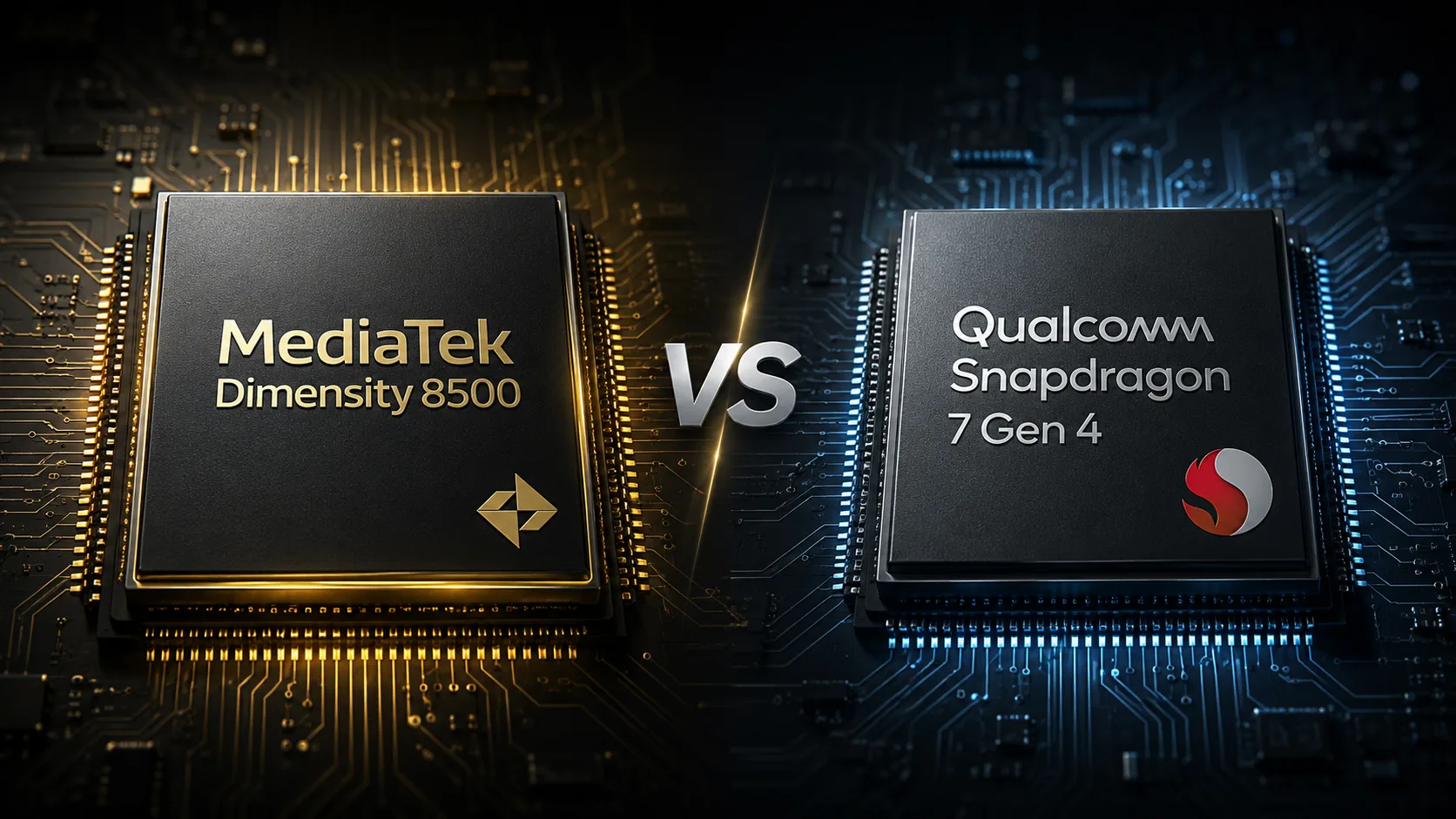
MediaTek Dimensity 8500
vs
Qualcomm Snapdragon 7 Gen 4

SoC Comparison Result
MediaTek Dimensity 8500 vs Snapdragon 7 Gen 4: almost a sub-flagship vs a solid mid-range
MediaTek Dimensity 8500 and Qualcomm Snapdragon 7 Gen 4 can be compared directly, but it’s important to understand the context. These are not two equivalent chips. The Dimensity 8500 clearly occupies a higher class and is designed for smartphones with a serious performance reserve. The Snapdragon 7 Gen 4 is a more conservative platform in the upper mid-range segment, where benchmarks are important, but so are connectivity, camera, sound, battery life, and price.
The main difference between them lies not in a single parameter, but in their approach. MediaTek bets on powerful hardware: a fully capable CPU with Cortex-A725 cores, fast LPDDR5X 9600 Mbps memory, and Mali-G720 MC8 graphics. Qualcomm focuses not on records, but on a balanced platform with Wi-Fi 7, Bluetooth 6.0, a good ISP, and proprietary multimedia technologies.
Key Differences
| Parameter | MediaTek Dimensity 8500 | Qualcomm Snapdragon 7 Gen 4 | Meaning of Differences |
|---|---|---|---|
| Class | Sub-flagship / premium | Upper mid-range | Dimensity is positioned higher |
| CPU | 8 Cortex-A725 cores, up to 3.4 GHz | 1+4+3 cores, up to 2.8 GHz | MediaTek has all high-performance cores |
| GPU | Mali-G720 MC8 | Adreno 722 | Dimensity is stronger in raw graphics |
| Memory | LPDDR5X 9600 Mbps | LPDDR5X | Dimensity has higher bandwidth |
| Storage | UFS 4 + MCQ | UFS 4.0 / 3.1 / 2.x | Depends on the specific smartphone |
| Cameras | Up to 320 MP, 4K60 | Up to 200 MP, Triple 12-bit ISP, 4K60 HDR | Megapixels don’t solve everything |
| Connectivity | 5G up to 5.17 Gbps, Wi-Fi 6E, Bluetooth 5.4 | 5G up to 4.2 Gbps, Wi-Fi 7, Bluetooth 6.0 | Qualcomm is stronger in Wi-Fi/Bluetooth |
| Display | WQHD+ up to 144 Hz | WQHD+ up to 144 Hz | Almost parity here |
The main difference lies in the CPU. The Dimensity 8500 uses eight Cortex-A725 cores with different clock speeds: one core up to 3.4 GHz, three cores up to 3.2 GHz, and four cores up to 2.2 GHz. This is not a classical big.LITTLE scheme but an all-big-core design. Therefore, in multi-core tasks, the Dimensity 8500 should be significantly stronger: heavy browsing, photo processing, rendering, games with background activity, and multitasking reveal this architecture’s advantages.
The Snapdragon 7 Gen 4 is structured more conservatively. It has a fast core up to 2.8 GHz, a mid-range performance cluster, and energy-efficient cores. For an ordinary smartphone, this is sufficient: interface usage, social media, camera tasks, video, navigation, and most games won’t be an issue. However, in heavy tasks, the Snapdragon 7 Gen 4 cannot compete with the Dimensity 8500 on an equal footing.
Performance: differences are noticeable beyond AnTuTu
In aggregated benchmarks, the Dimensity 8500 is faster in almost all key scenarios. The gap is especially wide in multi-core and graphic tests.
| Benchmark | MediaTek Dimensity 8500 | Snapdragon 7 Gen 4 | Approximate Difference |
|---|---|---|---|
| AnTuTu 11 | 2,153,969 | 1,261,959 | about +71% |
| Geekbench 6 Single-Core | 1,721 | around 1,200-1,250 | about +35-40% |
| Geekbench 6 Multi-Core | 6,716 | around 3,500 | almost 2 times |
| Geekbench GPU Compute | 13,461 | around 6,700 | almost 2 times |
These figures should not be viewed as absolute for any smartphone. Results depend on cooling, memory, firmware, and power limits. However, the overall conclusion remains unchanged: Dimensity 8500 operates at a higher class. The Snapdragon 7 Gen 4 is significantly faster than its predecessor, but it doesn’t reach the performance level of the Dimensity 8500 in CPU and GPU.
Gaming: MediaTek has the advantage, but with nuances
In gaming, the Dimensity 8500 appears stronger primarily due to its GPU. The Mali-G720 MC8 benchmarks significantly ahead of the Adreno 722, so in demanding projects, high settings, and extended gaming sessions, the advantage should lie with MediaTek-provided the smartphone manufacturer didn’t cut corners on cooling.
However, the Snapdragon 7 Gen 4 shouldn’t be completely discounted. Qualcomm excels in terms of drivers, compatibility, and optimization in certain games and emulators. Therefore, on average, the Dimensity 8500 is faster, but the specific gaming experience still depends on the smartphone: the chassis, throttling, memory, firmware, and manufacturer settings.
In summary: for maximum graphical power, the Dimensity 8500 is better. For stable compatibility in certain games and emulators, the Snapdragon can still be more convenient.
Camera and AI: 320 MP vs 200 MP - not the main argument
On paper, the Dimensity 8500 appears more solid: it supports cameras up to 320 MP, records at 4K60, and has a powerful NPU 880. But photo quality isn't determined solely by the maximum sensor resolution. The actual camera module, optics, HDR algorithms, night mode, and processing by the manufacturer are much more important.
The Snapdragon 7 Gen 4 offers a different set of features: Triple 12-bit ISP, 4K60 HDR video, hardware electronic stabilization, Video Super Resolution, AI autofocus, auto-exposure, and automatic white balance. Qualcomm also emphasizes local AI features, Snapdragon Sound, and XPAN.
Thus, conclusions about the camera should be cautious. The Dimensity 8500 is stronger as a hardware platform, but a smartphone with Snapdragon 7 Gen 4 can take better photos if the manufacturer uses a more favorable sensor and better adjusts the processing.
Connectivity, memory, and everyday use
The Dimensity 8500 wins in memory and peak 5G speeds: LPDDR5X 9600 Mbps and advertised speeds of up to 5.17 Gbps look impressive. This is a plus for heavy tasks, gaming, multitasking, and overall system bandwidth.
The Snapdragon 7 Gen 4 has a stronger wireless component: Wi-Fi 7 and Bluetooth 6.0 compared to Wi-Fi 6E and Bluetooth 5.4 on the Dimensity 8500. For some users, this might be more critical than differences in synthetic tests: stable headphones, fast Wi-Fi, modern audio features, and reliable network performance are noticeable every day.
In ordinary tasks, both chips will be fast. The difference reveals itself not in messaging or YouTube, but in prolonged loads: gaming, rendering, photo processing, emulators, AI functions, and multitasking. Here, the Dimensity 8500 has significantly more headroom.
What to Choose
Choose the MediaTek Dimensity 8500 if you need a smartphone with maximum performance for your money. It’s better suited for gaming, heavy applications, active multitasking, and purchasing with a reserve for several years. If the prices of two smartphones are close, the Dimensity 8500 almost always looks more logical.
The Snapdragon 7 Gen 4 makes sense if the smartphone is significantly cheaper or better as a device: camera, screen, battery, build quality, sound, firmware. The chip itself is modern and balanced, but it shouldn’t cost the same as the Dimensity 8500 model. At equal prices, the comparison will not favor Qualcomm.
Conclusion
The MediaTek Dimensity 8500 is stronger than the Snapdragon 7 Gen 4 in key areas like CPU, multi-core performance, graphics, and memory. It’s a chip for smartphones aiming to be closer to sub-flagships without the full flagship price tag.
The Snapdragon 7 Gen 4 is not a weak processor but a competent platform in the upper mid-range. It has good connectivity, Wi-Fi 7, Bluetooth 6.0, an adequate camera framework, and a strong Qualcomm ecosystem. However, in direct comparison with the Dimensity 8500, it falls short in performance.
If the price is close, the Dimensity 8500 is better. If a smartphone with Snapdragon 7 Gen 4 is cheaper or significantly better in display, camera, and battery life, it can also be a reasonable purchase.
Advantages
- Higher Frequency: 3400 MHz (3400 MHz vs 2800 MHz)
- Newer Launch Date: January 2026 (January 2026 vs May 2025)
Basic
GPU Specifications
Connectivity
Memory Specifications
Miscellaneous
Benchmarks
Comparison of Devices
Related SoC Comparisons


Share in social media
Or Link To Us
<a href="https://cputronic.com/index.php/soc/compare/mediatek-dimensity-8500-vs-qualcomm-snapdragon-7-gen-4" target="_blank">MediaTek Dimensity 8500 vs Qualcomm Snapdragon 7 Gen 4</a>