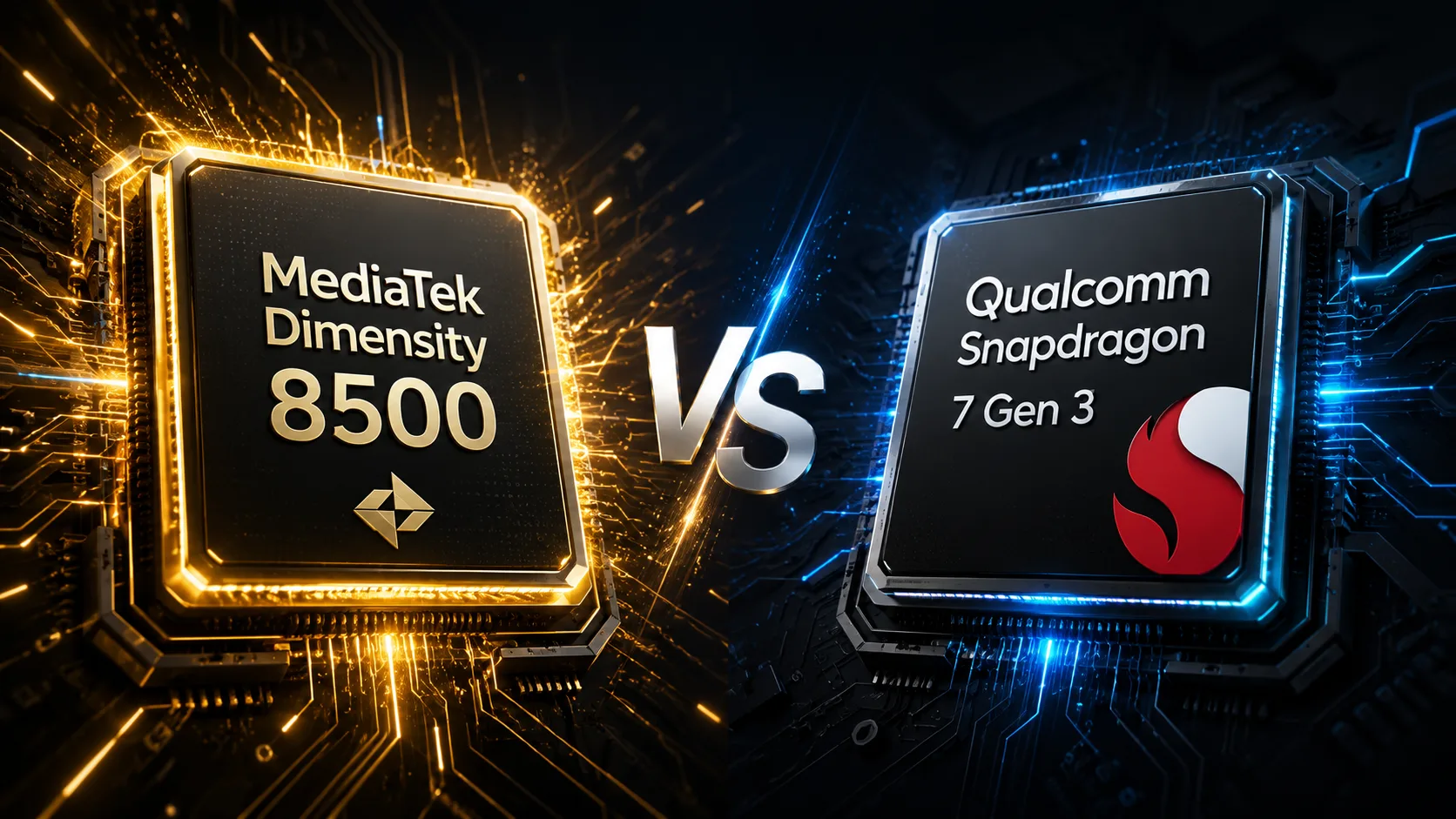
MediaTek Dimensity 8500
vs
Qualcomm Snapdragon 7 Gen 3

SoC Comparison Result
MediaTek Dimensity 8500 vs Snapdragon 7 Gen 3: The new mid-range is already faster than the old
MediaTek Dimensity 8500 and Qualcomm Snapdragon 7 Gen 3 formally belong to the upper mid-range segment, but in terms of hardware, they are from different generations. Snapdragon 7 Gen 3 is a 2023 platform with Cortex-A715, Adreno 720, LPDDR5, and UFS 3.1. Dimensity 8500 uses eight Cortex-A725 cores, a more powerful Mali-G720 MC8 GPU, LPDDR5X 9600, and UFS 4. Therefore, the comparison quickly shifts from a slight advantage for MediaTek to a difference in class.
CPU: both have eight cores, but the configuration is different
Formally, both chips have eight CPU cores. In reality, their CPU blocks are designed for different load levels.
Snapdragon 7 Gen 3 uses a 1+3+4 configuration: one Cortex-A715 core up to 2.63 GHz, three Cortex-A715 cores up to 2.4 GHz, and four energy-efficient Cortex-A510 cores up to 1.8 GHz. This is a typical mid-range configuration: it is sufficient for the interface, browser, camera, messengers, and regular apps, but does not provide a significant reserve for multi-threaded workloads.
Dimensity 8500 is built with a greater focus on performance. It has all eight cores as Cortex-A725: one core up to 3.4 GHz, three cores up to 3.2 GHz, and four cores up to 2.2 GHz. Energy-efficient Cortex-A510 cores are not used. Therefore, the advantage of MediaTek is more evident under prolonged and multi-threaded loads: photo and video processing, app installation, heavy multitasking, and gaming.
In single-core performance, Snapdragon 7 Gen 3 still looks confident, but under full load across multiple cores, Dimensity 8500 has a clear advantage. This is not just a higher frequency, but a newer and more capable CPU configuration.
| What differs | Dimensity 8500 | Snapdragon 7 Gen 3 |
|---|---|---|
| CPU Architecture | all Cortex-A725 | Cortex-A715 + Cortex-A510 |
| Peak Frequency | up to 3.4 GHz | up to 2.63 GHz |
| Graphics | Mali-G720 MC8 | Adreno 720 |
| Memory | LPDDR5X 9600 | LPDDR5 |
| Storage | UFS 4 + MCQ | UFS 3.1 |
| Overall Level | closer to sub-flagships | mid-range 2023 |
GPU: the main gap between platforms
Adreno 720 in Snapdragon 7 Gen 3 is sufficient for popular games like PUBG Mobile, Mobile Legends, Asphalt, and Call of Duty Mobile. Qualcomm also has a practical advantage: Adreno graphics are often well-supported by games and emulators.
But this is not enough to compete with Mali-G720 MC8. Dimensity 8500 is significantly stronger in graphics and better suited for heavy games, high-resolution rendering, and stable FPS. With smartphones featuring Snapdragon 7 Gen 3, users will often have to reduce graphics settings or rendering resolution, especially in projects like Genshin Impact, Wuthering Waves, and Honkai: Star Rail.
Synthetic benchmarks should not be directly transferred to all smartphones: the results depend on the enclosure, cooling, power limits, and firmware. However, with normal implementation, Dimensity 8500 will be noticeably faster in graphical tasks.
Memory and storage: the difference lies not only in the cores
The difference between LPDDR5 and LPDDR5X, as well as between UFS 3.1 and UFS 4, is not always noticeable at the first boot of the smartphone. But these parameters influence the device's reserves and stability under load.
Dimensity 8500 supports LPDDR5X 9600 and UFS 4 + MCQ. This provides an advantage when launching heavy applications, loading games, working with cache, and simultaneous loads on the CPU, GPU, and memory.
Snapdragon 7 Gen 3 is limited to a simpler platform. For a regular smartphone, this is sufficient, but in a direct comparison, MediaTek is faster not only in CPU and GPU. Dimensity 8500 has more modern memory, storage, and data exchange between the key blocks of the platform.
Benchmarks: the gap is greater than it seems by class
Approximate results in popular tests show a large gap between the platforms. Dimensity 8500 scores approximately double in AnTuTu, is noticeably stronger in Geekbench Multi-Core, and pulls particularly far ahead in GPU loads.
| Test | Dimensity 8500 | Snapdragon 7 Gen 3 | Difference |
|---|---|---|---|
| AnTuTu 11 | about 2.1 million | about 1.0 million | approximately 2 times |
| Geekbench 6 Single-Core | about 1550 | about 1130 | +35-40% |
| Geekbench 6 Multi-Core | about 6400 | about 3000 | more than 2 times |
| GPU Compute | about 13,400 | about 4,000 | more than 3 times |
These figures depend on the specific smartphone: cooling, memory, power limits, and firmware version. But the overall conclusion remains the same: Snapdragon 7 Gen 3 is in the regular mid-range, while Dimensity 8500 performs better.
Connectivity and Cameras: here MediaTek's advantage is not as pronounced
In modems and wireless interfaces, the gap is smaller. Dimensity 8500 supports 5G-Advanced, Wi-Fi 6E, and Bluetooth 5.4. Snapdragon 7 Gen 3 uses the Snapdragon X63 modem, supporting Sub-6, mmWave, Wi-Fi 6/6E, and Bluetooth 5.4.
In practice, connection quality depends not only on the SoC. Antennas, frequencies of the specific smartphone version, firmware, and region are also essential. Therefore, one chip cannot be automatically declared the winner in all devices.
The situation with cameras is similar. Dimensity 8500 supports sensors up to 320 MP and 4K60 recording. Snapdragon 7 Gen 3 supports up to 200 MP and also 4K60. On paper, MediaTek looks more powerful, but photo quality is determined by the sensor, optics, HDR algorithms, and manufacturer processing, not just the maximum number of megapixels in the specification.
When Snapdragon 7 Gen 3 still makes sense
Snapdragon 7 Gen 3 remains sensible for budget devices. For the interface, browser, video, social media, camera, navigation, and casual gaming, its performance is sufficient.
However, choosing a smartphone with Snapdragon 7 Gen 3 over a model with Dimensity 8500 is only worth it for a clear reason. For example, if the device is significantly cheaper, better in screen quality, camera, battery life, build, or firmware. Another argument could be specific games and applications where Adreno works more stably or is better optimized.
If the prices are close and the other characteristics of the smartphones are similar, Snapdragon 7 Gen 3 looks weaker on key parameters: CPU, GPU, memory, and storage.
What to choose
Dimensity 8500 is better suited for heavy gaming, multitasking, photo and video processing, and longer usage without a performance drop. It has a stronger CPU, significantly more powerful GPU, faster memory, and more modern storage.
Snapdragon 7 Gen 3 remains sufficient for an average mid-range smartphone, but in this pair, it is at a lower level. Its strengths are Qualcomm's predictability, Adreno graphics, and possible optimization for specific devices. However, at a similar price point, a model with Dimensity 8500 looks stronger. Snapdragon 7 Gen 3 should only be chosen when the smartphone itself is cheaper or better in screen, camera, battery life, or firmware.
Advantages
- Higher Frequency: 3400 MHz (3400 MHz vs 2630 MHz)
- Newer Launch Date: January 2026 (January 2026 vs November 2023)
Basic
3x 2.4 GHz – Cortex-A715
4x 1.8 GHz – Cortex-A510
GPU Specifications
Connectivity
Memory Specifications
Miscellaneous
Benchmarks
Comparison of Devices
Related SoC Comparisons


Share in social media
Or Link To Us
<a href="https://cputronic.com/index.php/soc/compare/mediatek-dimensity-8500-vs-qualcomm-snapdragon-7-gen-3" target="_blank">MediaTek Dimensity 8500 vs Qualcomm Snapdragon 7 Gen 3</a>