MediaTek Dimensity 8500
vs
Qualcomm Snapdragon 6 Gen 5
SoC Comparison Result
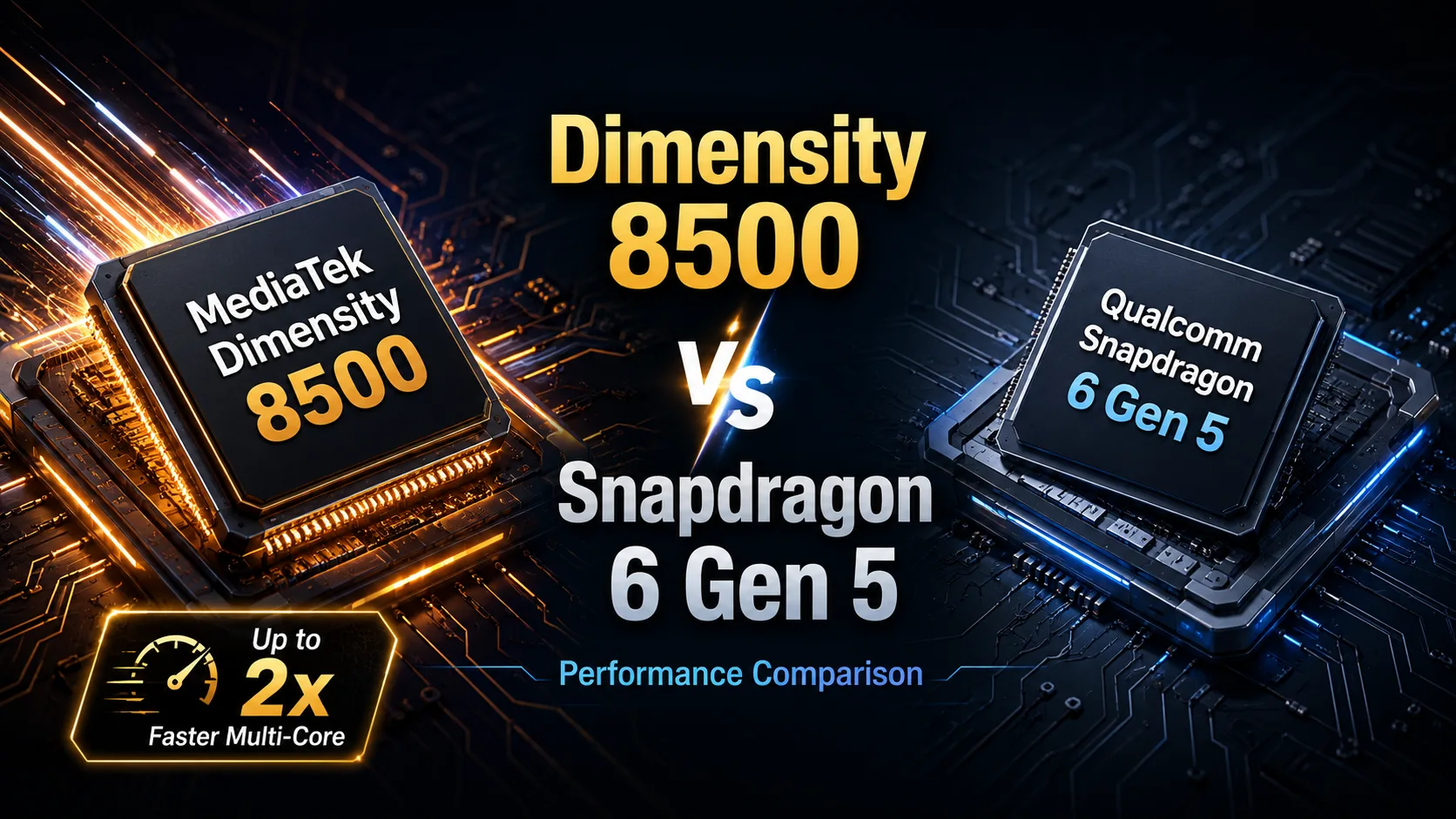
MediaTek Dimensity 8500 vs Snapdragon 6 Gen 5: the new Snapdragon is almost twice slower in multi-threading
The Snapdragon 6 Gen 5 is newer than the Dimensity 8500, but in Geekbench 6 Multi, it scores almost half as many points. Qualcomm has retained four Cortex-A78 and four Cortex-A55 cores, while MediaTek uses Cortex-A725 across all eight cores. In AnTuTu 11, the difference is even greater: about 1 million points compared to 2.1-2.4 million.
Key Differences
| Characteristic | MediaTek Dimensity 8500 | Snapdragon 6 Gen 5 |
|---|---|---|
| CPU | 1x Cortex-A725 3.4 GHz + 3x Cortex-A725 3.2 GHz + 4x Cortex-A725 2.2 GHz | 4x Cortex-A78 2.6 GHz + 4x Cortex-A55 2.0 GHz |
| CPU Architecture | 8x Cortex-A725 | Cortex-A78 + Cortex-A55 |
| GPU | Mali-G720 MP8 | Adreno 812 |
| Process Node | 4 nm | 4 nm |
| Memory | LPDDR5X up to 9600 Mbps | LPDDR5 / LPDDR4X |
| Storage | UFS 4.x | up to UFS 3.1 |
| Video Recording | up to 4K 60 FPS | up to 4K 30 FPS |
| Wi-Fi | Wi-Fi 6E | Wi-Fi 7 |
| Bluetooth | 5.4 | 6.0 |
Snapdragon supports newer Wi-Fi 7 and Bluetooth 6.0. The Dimensity 8500 is much stronger in CPU and GPU, as well as supporting faster memory and storage.
In terms of performance, the Snapdragon 6 Gen 5 is significantly closer to the budget segment than to the Dimensity 8500.
Benchmarks in Real Smartphones
The table includes the base Dimensity 8500 and its variants 8500 Ultra and 8500 Elite. The CPU and GPU configurations are similar, so the results allow assessing the performance of the family in marketed smartphones.
| Smartphone | Processor | Geekbench 6 Single | Geekbench 6 Multi | AnTuTu 11 |
|---|---|---|---|---|
| Honor Power 2 | Dimensity 8500 Elite | 1728 | 6762 | 2 407 614 |
| Redmi Turbo 5 | Dimensity 8500 | 1729 | 6949 | 2 112 047 |
| Poco X8 Pro | Dimensity 8500 Ultra | 1707 | 6611 | 2 085 754 |
| Honor X80 Pro Max | Snapdragon 6 Gen 5 | 1177 | 3498 | 1 012 134 |
| Redmi Note 17 Pro Max | Snapdragon 6 Gen 5 | 1099 | 3481 | 1 010 104 |
Dimensity 8500 scores around 1700 points in Geekbench 6 Single and 6600-7000 in Multi. The Snapdragon 6 Gen 5 scores around 1100-1200 and 3500 points.
In these smartphones, MediaTek is approximately 50% faster in single-thread tests and almost twice as fast in multi-threading.
In AnTuTu, devices with the Dimensity 8500 score 2.1-2.4 million points compared to about 1 million for the Snapdragon 6 Gen 5.
AnTuTu is influenced by memory, storage, cooling, and firmware, so it does not represent a pure CPU test. However, the specific configuration of the smartphone does not explain the twofold difference in results between the two chip families.
CPU: Cortex-A78 vs. Eight Cortex-A725
The weak point of the Snapdragon 6 Gen 5 is its older CPU cores.
Qualcomm uses four Cortex-A78 and four Cortex-A55. The Cortex-A78 debuted in 2020, while the Cortex-A55 predates it. Such cores are still found in the budget segment, but compared to Cortex-A725, they significantly lag in speed.
MediaTek uses Cortex-A725 for all eight cores. The high-performance core runs at up to 3.4 GHz, three others at up to 3.2 GHz, and four lower cores at up to 2.2 GHz.
The result is evident in Geekbench 6 Multi: around 3500 points for Snapdragon compared to 6600-7000 for Dimensity.
This difference will be noticeable in photo processing, emulation, archiving, and heavy multitasking. For browsing, video, messaging, and general apps, the Snapdragon 6 Gen 5 has sufficient power.
GPU: Dimensity 8500 is more than three times faster in 3DMark
In graphics performance, the Snapdragon 6 Gen 5 lags even further behind. Moreover, several different benchmarks show roughly the same difference.
| Benchmark | Dimensity 8500 | Snapdragon 6 Gen 5 | Difference |
|---|---|---|---|
| Geekbench 6 GPU Compute | ~13,500 | ~4250 | ~3.2x |
| 3DMark Wild Life Extreme | 4058 | 1214 | 3.3x |
| 3DMark Steel Nomad Light | 1442 (10.69 FPS) | 433 (3.21 FPS) | 3.3x |
| AnTuTu 11 GPU | ~650,000-760,000 | ~215,000 | ~3.0-3.5x |
3DMark provides a particularly clear result. In Wild Life Extreme, the Dimensity 8500 scores 4058 points against 1214 for the Snapdragon 6 Gen 5. In Steel Nomad Light, the ratio is nearly the same: 1442 vs. 433 points, or 10.69 vs. 3.21 FPS.
Geekbench GPU and AnTuTu confirm the same order of magnitude of difference: the Mali-G720 MP8 is around 3-3.5 times faster than the Adreno 812.
The Adreno 812 can handle less demanding games, but the Dimensity 8500 allows for higher settings and better frame rate maintenance in heavy projects.
Snapdragon is newer, but the architecture is older
The Dimensity 8500 was introduced in January 2026, while the Snapdragon 6 Gen 5 came out in May.
Compared to the Snapdragon 6 Gen 4, the new model is faster, especially in graphics. However, set against the Dimensity 8500, the update seems rather modest.
The Gen 5 index doesn’t change anything: the CPU is still built on Cortex-A78 and Cortex-A55. For a processor released in 2026, such a core set already looks outdated.
Snapdragon 6 Gen 5 should be cheaper
For a budget smartphone, the Snapdragon 6 Gen 5 is quite sufficient. However, such a processor is hard to justify if the smartphone costs as much or more than the Dimensity 8500 model.
The Poco X8 Pro with Dimensity 8500 Ultra launched at a starting price of around $329. The Redmi Note 17 Pro Max with Snapdragon 6 Gen 5 started at about $499.
The difference is about $170, and the more expensive Redmi features almost twice slower multi-threaded CPU and approximately three times weaker graphics.
Redmi may justify its price with battery, display, cameras, or features, but not with processor speed.
If a phone with the Snapdragon 6 Gen 5 is significantly cheaper, the compromise is understandable. However, at a comparable price with the Dimensity 8500, there is no reason to choose Qualcomm for performance.
Conclusion
The Dimensity 8500 is a class above the Snapdragon 6 Gen 5 in performance. In real smartphones, it is about 50% faster in Geekbench 6 Single, nearly twice as fast in Multi, and more than twice as fast in overall AnTuTu scores.
In graphics, the advantage is even larger. In 3DMark Wild Life Extreme, the results are 4058 versus 1214 points, and in Steel Nomad Light, 1442 versus 433. Geekbench GPU and AnTuTu GPU also show roughly a threefold superiority of the Mali-G720 MP8.
Snapdragon supports Wi-Fi 7 and Bluetooth 6.0, and its power is adequate for a budget smartphone. However, at a comparable price, they are no longer equal competitors: the Dimensity 8500 is much faster in both CPU and GPU.
Advantages
- Higher Frequency: 3400 MHz (3400 MHz vs 2.6 GHz)
- Newer Launch Date: May 2026 (January 2026 vs May 2026)
Basic
GPU Specifications
Connectivity
Memory Specifications
Miscellaneous
Benchmarks
Comparison of Devices
Related SoC Comparisons


Share in social media
Or Link To Us
<a href="https://cputronic.com/index.php/soc/compare/mediatek-dimensity-8500-vs-qualcomm-snapdragon-6-gen-5" target="_blank">MediaTek Dimensity 8500 vs Qualcomm Snapdragon 6 Gen 5</a>