MediaTek Dimensity 7100
vs
Qualcomm Snapdragon 6s 4G Gen 2

SoC Comparison Result
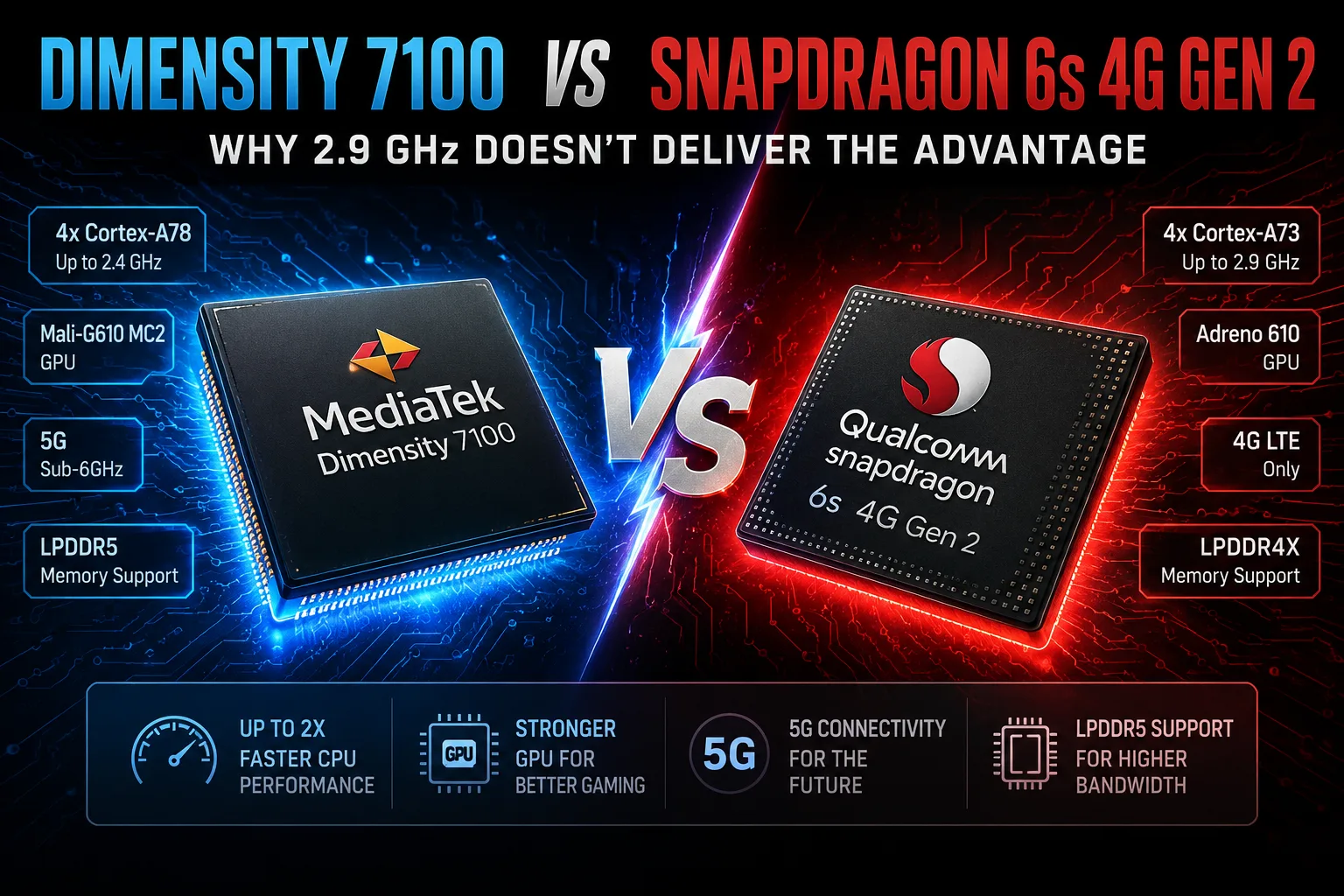
MediaTek Dimensity 7100 vs Snapdragon 6s 4G Gen 2: Why 2.9 GHz Doesn't Provide an Advantage
MediaTek Dimensity 7100 and Qualcomm Snapdragon 6s 4G Gen 2 appeared almost simultaneously and are manufactured using a 6nm process, but there is a significant performance gap between them. The Dimensity 7100 uses more modern Cortex-A78 cores, features more powerful graphics, and supports 5G. The Snapdragon 6s 4G Gen 2 is aimed at low-cost 4G devices and is built on older Cortex-A73 and Cortex-A53 cores. Therefore, the 2.9 GHz of the Snapdragon is more impressive in specifications than in actual tests.
Key Differences Between Dimensity 7100 and Snapdragon 6s 4G Gen 2
| MediaTek Dimensity 7100 | Snapdragon 6s 4G Gen 2 | |
|---|---|---|
| Positioning | Mid-range | Budget segment |
| CPU | 4× Cortex-A78 + 4× Cortex-A55 | 4× Cortex-A73 + 4× Cortex-A53 |
| Maximum Frequency | 2.4 GHz | 2.9 GHz |
| GPU | Mali-G610 MC2 | Adreno 610 |
| Process Technology | 6nm | 6nm |
| Mobile Network | 5G | 4G |
| Memory | LPDDR5 / LPDDR4X | LPDDR4X |
Cortex-A78 is significantly more modern than Cortex-A73, so the four cores of the Dimensity 7100 at 2.4 GHz end up being faster than the four Cortex-A73 cores of the Snapdragon even at 2.9 GHz.
The Dimensity 7100 also supports LPDDR5, although the type of memory depends on the specific device.
Dimensity 7100 is Nearly Twice as Fast in Geekbench 6
The Dimensity 7100 scores around 1000 points in single-core tests and 2900-3000 in multi-core tests. The Snapdragon 6s 4G Gen 2 scores about 490 and 1400-1500 points, respectively.
In both scenarios, MediaTek's advantage approaches twofold.
Geekbench 6 in Real Devices
| Device | Processor | Single-Core | Multi-Core |
|---|---|---|---|
| Infinix Note Edge | Dimensity 7100 | 995 | 2925 |
| Tecno Pova 8 5G | Dimensity 7100 | 999 | 2979 |
| Tecno Pova Curve 2 | Dimensity 7100 | 975 | 2859 |
| Honor X8d | Snapdragon 6s 4G Gen 2 | 489 | 1532 |
| POCO Pad C1 | Snapdragon 6s 4G Gen 2 | 490 | 1512 |
| Redmi Pad 2 9.7 | Snapdragon 6s 4G Gen 2 | 483 | 1348 |
Three devices with Dimensity 7100 show single-core scores between 975-999 and multi-core scores between 2859-2979. The Snapdragon 6s 4G Gen 2 ranges from 483-490 in single-core and 1348-1532 in multi-core.
The Snapdragon is represented by both smartphones and tablets, so cooling and power limits of the devices vary. However, even the upper limits of Qualcomm's results remain significantly below the lower limits of the Dimensity 7100.
In real-world usage, Dimensity 7100 handles heavy web pages, photo processing, app installation, and multitasking more efficiently. The Snapdragon 6s 4G Gen 2 is primarily aimed at messaging apps, video streaming, and less demanding applications.
Dimensity 7100 is Noticeably Stronger in Graphics and Gaming
Dimensity 7100 utilizes Mali-G610 MC2, while Snapdragon 6s 4G Gen 2 uses the noticeably older Adreno 610.
In gaming, the advantage of Dimensity 7100 allows for higher settings more frequently and provides more stable FPS. The Snapdragon 6s 4G Gen 2 quickly hits graphical limitations, especially in modern demanding projects.
However, the Dimensity 7100 is still not part of flagship gaming platforms. In the most demanding games, performance will depend on settings, screen resolution, cooling, and specific smartphone optimizations.
Dimensity 7100 Supports 5G, Snapdragon Remains on LTE
Dimensity 7100 supports 5G networks, whereas Snapdragon 6s 4G Gen 2 is limited to LTE.
For a budget smartphone, the lack of 5G might be an acceptable trade-off, especially if the device is significantly cheaper than competitors. At similar price points, the Dimensity 7100 offers both 5G and significantly higher performance.
What’s Better: Dimensity 7100 or Snapdragon 6s 4G Gen 2
Despite being manufactured on the same 6nm process and released around the same time, these SoCs cannot be considered direct competitors in terms of performance. Snapdragon 6s 4G Gen 2 is a budget 4G platform, while Dimensity 7100 is much closer to modern mid-range standards.
The Dimensity 7100 is nearly twice as fast in Geekbench 6, stronger in graphics, and additionally offers 5G and LPDDR5 support.
The Snapdragon 6s 4G Gen 2 makes sense primarily in significantly cheaper devices. At similar price points, the Dimensity 7100 is undoubtedly the stronger choice.
Advantages
- Newer Launch Date: January 2026 (January 2026 vs December 2025)
- Higher Frequency: 2900 MHz (2400 MHz vs 2900 MHz)
Basic
4x 2 GHz – Cortex-A55
GPU Specifications
Connectivity
Memory Specifications
Miscellaneous
- FLAC
- HE-AACv1
- HE-AACv2
- MP3
- H.265
- VP9
Benchmarks
Related SoC Comparisons




Share in social media
Or Link To Us
<a href="https://cputronic.com/index.php/soc/compare/mediatek-dimensity-7100-vs-qualcomm-snapdragon-6s-4g-gen-2" target="_blank">MediaTek Dimensity 7100 vs Qualcomm Snapdragon 6s 4G Gen 2</a>