Google Tensor G4
vs
Google Tensor G6

SoC Comparison Result
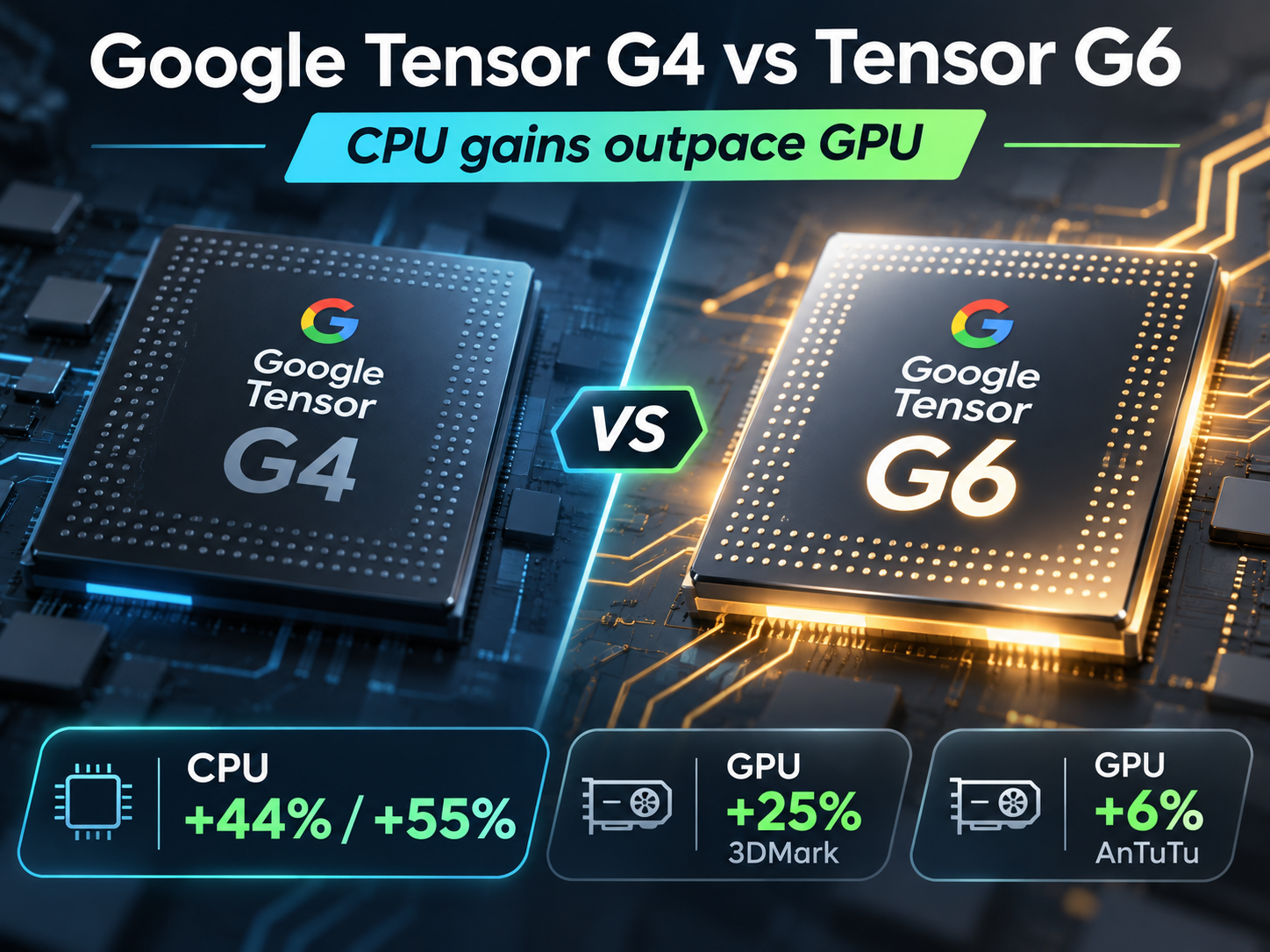
Google Tensor G4 vs. Tensor G6: CPU Improved More Than GPU
The Google Tensor G6 in the Pixel 11 smartphones noticeably outperforms the Tensor G4 used in the Pixel 9 series in CPU performance. In the selected Geekbench 6 results, the new chip leads by 44% in the single-threaded test and 55% in the multi-threaded test. The graphics performance increase is more modest: about 25% in 3DMark Wild Life Extreme and 6% in the AnTuTu 11 graphics subtest. Over two generations, Google updated the CPU architecture, switched to TSMC manufacturing, and replaced Mali graphics with PowerVR.
Key Differences
| Feature | Tensor G4 | Tensor G6 |
|---|---|---|
| Release year | 2024 | 2026 |
| Process node | Samsung 4 nm | TSMC 3 nm |
| CPU | 1× Cortex-X4 + 3× Cortex-A720 + 4× Cortex-A520 | 1× C1-Ultra + 6× C1-Pro |
| Core count | 8 | 7 |
| Maximum clock speed | 3.10 GHz | 4.11 GHz |
| GPU | Mali-G715 MP7 | PowerVR CXTP-48-1536 |
| Modem | Samsung Exynos 5400 | MediaTek |
| Secure coprocessor | Titan M2 | Titan M3 |
Both processors support LPDDR5X and 5G networks. The switch from Samsung to TSMC took place back in 2025 with the release of the Tensor G5. The Tensor G6 continues the development of this platform with new CPU cores and a new graphics accelerator.
CPU: Seven New Cores vs. Eight Older Ones
The Tensor G4 uses three CPU clusters: one Cortex-X4 clocked at up to 3.10 GHz, three Cortex-A720 cores clocked at up to 2.60 GHz, and four Cortex-A520 cores clocked at up to 1.92 GHz.
The Tensor G6 has a different configuration:
- 1× C1-Ultra clocked at up to 4.11 GHz;
- 4× C1-Pro clocked at up to 3.38 GHz;
- 2× C1-Pro clocked at up to 2.65 GHz.
The maximum clock speed increased by 33%. Google also used new Arm C1 cores. Despite reducing the core count from eight to seven, multi-threaded performance increased.
Geekbench 6: Comparing Specific Smartphones
| Smartphone | Chip | Single-Core | Multi-Core |
|---|---|---|---|
| Google Pixel 9 Pro XL | Tensor G4 | 2001 | 4932 |
| Google Pixel 11 Pro XL | Tensor G6 | 2888 | 7641 |
| Difference | +44% | +55% |
The table shows the results of individual Geekbench 6 runs rather than average device scores. Scores may vary when the test is repeated depending on temperature, background load, and software version.
The Tensor G6’s advantage is especially noticeable in the multi-threaded test. It may become apparent when processing photos, unpacking archives, and performing calculations. However, a 55% Geekbench increase does not mean that all applications will run 55% faster.
Google claims that the Tensor G6 provides a 25% browser performance increase and launches apps 15% faster than the Tensor G5. These figures compare it with the previous generation, not directly with the G4.
GPU: The Increase Depends on the Test
The Tensor G4 is equipped with the Mali-G715 MP7, while the Tensor G6 uses the PowerVR CXTP-48-1536. The switch to PowerVR graphics architecture began with the Tensor G5.
Unlike the CPU, the GPU performance increase was less pronounced.
3DMark Wild Life Extreme
| Smartphone | Processor | Score |
|---|---|---|
| Google Pixel 9 | Tensor G4 | 2598 |
| Google Pixel 9 Pro | Tensor G4 | 2603 |
| Google Pixel 9 Pro XL | Tensor G4 | 2652 |
| Google Pixel 11 | Tensor G6 | 3312 |
| Google Pixel 11 Pro | Tensor G6 | 3191 |
| Google Pixel 11 Pro XL | Tensor G6 | 3326 |
The table shows the median device results in the 3DMark database.
Comparing the Pixel 9 Pro XL with the Pixel 11 Pro XL, the new generation leads by 25%. However, in the newer 3DMark Steel Nomad Light, the difference is noticeably smaller:
- Pixel 9 Pro XL - 1085 points;
- Pixel 11 Pro XL - 1179 points.
That is an increase of just 9%. The difference between the tests shows that the new GPU handles some graphics workloads better than others.
At the same time, the Tensor G6’s PowerVR falls behind the graphics accelerators in many competing flagship processors. Google significantly increased CPU performance, but the Pixel 11 still does not rank among the most powerful gaming smartphones.
AnTuTu 11: Graphics Increased by Just 6%
The AnTuTu 11 results also show that the computational and graphics parts of the Tensor platform are developing at different rates.
| AnTuTu 11 | Pixel 9 Pro XL | Pixel 11 Pro XL | Difference |
|---|---|---|---|
| GPU | 410 009 | 434 034 | +6% |
| Overall score | 1 672 795 | 1 990 568 | +19% |
The figures come from published measurements of real smartphones. These are individual tests, so they do not represent the average performance of all devices.
In the graphics subtest, the Tensor G6 leads by just 6%, although the overall score increased by 19%.
Taken together, AnTuTu 11 and 3DMark show a moderate GPU increase whose size depends on the test. To assess gaming capabilities, the results in specific games are more important, including FPS and performance stability under sustained load.
Power Efficiency and Heat
Samsung manufactures the Tensor G4 using a 4 nm process. The Tensor G6 uses TSMC’s more advanced 3 nm process, which Google adopted back in the G5 generation.
The company claims that the Tensor G6 improves CPU power efficiency by up to 20% compared with the G5. This does not mean a comparable increase in Pixel 11 battery life: a smartphone’s runtime also depends on its display, battery, modem, and software.
The new CPU’s higher clock speeds do not necessarily mean higher power consumption in everyday tasks. However, chip efficiency cannot be assessed based solely on the process node and clock speeds.
Sustained performance is also important for gaming. A high result in a single 3DMark run does not guarantee that the same speed will be maintained after prolonged load.
Artificial Intelligence, Camera, and Connectivity
Alongside the CPU and GPU, Google updated the Tensor G6’s specialized blocks.
The chip features a fifth-generation TPU. According to the company, its computational performance increased by 50% compared with the Tensor G5. For certain local artificial intelligence tasks, Google also claims a speedup of up to 3.5 times. These figures do not represent a direct comparison with the Tensor G4.
The updates cover several areas:
- Local processing of Gemini Nano requests.
- Image processing using an updated ISP.
- Computational photography and digital zoom capabilities.
- Hardware-based protection using Titan M3.
Specific camera and artificial intelligence features also depend on the smartphone model and software.
The modem has also changed. The Tensor G4 uses the Samsung Exynos 5400, while the Tensor G6 has switched to a MediaTek solution. The new chip’s specifications list the MediaTek M90, with a claimed peak download speed of up to 12 Gb/s.
Actual mobile internet speeds depend on the carrier’s network, coverage, and signal reception conditions.
Should You Upgrade from the Pixel 9 to the Pixel 11?
The Tensor G6 significantly outperforms the G4 in computational performance. The new Arm C1 cores deliver a substantial Geekbench 6 increase even with fewer CPU cores.
However, the difference will be less noticeable when browsing, using messaging apps, navigating, and watching videos. The Tensor G4 remains powerful enough for these tasks.
Gaming is more complicated. The Tensor G6 is about 25% faster in Wild Life Extreme, but its advantage in Steel Nomad Light and AnTuTu 11 is below 10%. Therefore, upgrading to the Pixel 11 solely for a higher FPS without checking specific games is not advisable.
Bottom line: The Tensor G6 significantly outperforms the Tensor G4 in CPU performance and features a more powerful TPU, along with updated image-processing and connectivity blocks. Graphics performance also increased, but by a much smaller margin. For Pixel 9 owners, the main reasons to upgrade will be the faster CPU and the new capabilities of Pixel 11 smartphones-not a major FPS increase in every game.
Advantages
- Higher Technology: 3 nm (4 nm vs 3 nm)
- Higher Frequency: 4110 MHz (3100 MHz vs 4110 MHz)
- Newer Launch Date: August 2026 (August 2024 vs August 2026)
Basic
3x 2.6 GHz – Cortex-A720
4x 1.92 GHz – Cortex-A520
GPU Specifications
Connectivity
Memory Specifications
Miscellaneous
Benchmarks
Comparison of Devices
Related SoC Comparisons



Share in social media
Or Link To Us
<a href="https://cputronic.com/index.php/soc/compare/google-tensor-g4-vs-google-tensor-g6" target="_blank">Google Tensor G4 vs Google Tensor G6</a>