NVIDIA GeForce RTX 5070 Ti
vs
NVIDIA GeForce RTX 5070 SUPER
GPU Comparison Result
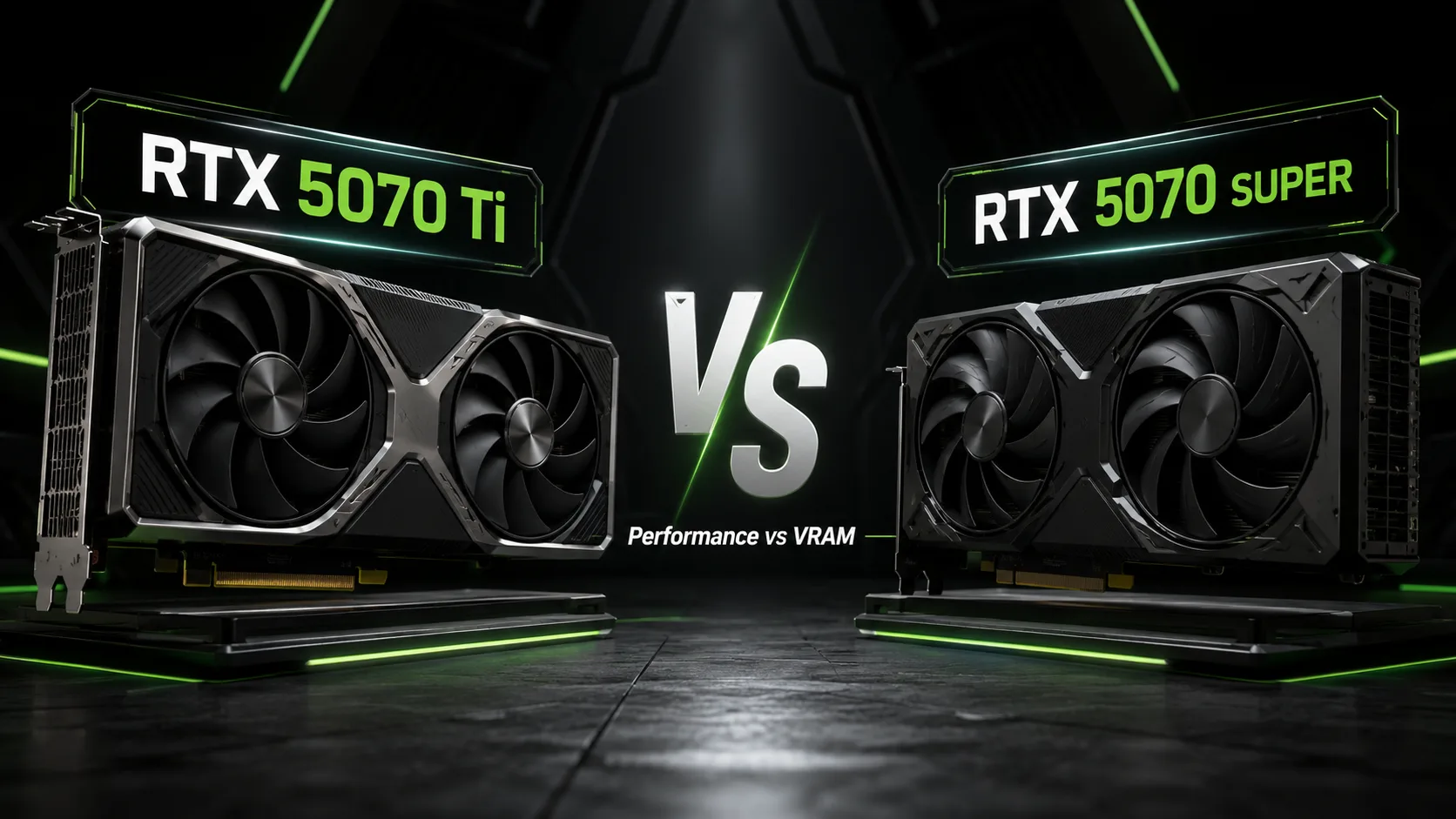
NVIDIA GeForce RTX 5070 Ti vs RTX 5070 SUPER: powerful GPU or 18 GB of memory?
On paper, the GeForce RTX 5070 SUPER looks unusual: the anticipated new model is expected to come with 18 GB of video memory-2 GB more than the more expensive RTX 5070 Ti. However, these cards belong to different tiers in terms of computational power. The RTX 5070 Ti uses a larger GPU, has nearly 40% more CUDA cores, and boasts a significantly wider memory subsystem.
Therefore, comparing only 16 and 18 GB is misleading. In most games, GPU power and memory bandwidth are more important, while additional VRAM becomes crucial only in specific workloads.
But there is an important caveat: as of July 20, 2026, NVIDIA has not officially announced the GeForce RTX 5070 SUPER. The company's lineup only includes the RTX 5070 and RTX 5070 Ti, while the specifications of the SUPER version are based on leaks. There have also been reports that its release may have been postponed due to the high cost of 3-gigabit GDDR7 chips.
Specifications Comparison
| Specification | GeForce RTX 5070 Ti | GeForce RTX 5070 SUPER* |
|---|---|---|
| Architecture | Blackwell | Blackwell |
| GPU | GB203 | GB205 |
| CUDA Cores | 8960 | 6400 |
| Video Memory | 16 GB GDDR7 | 18 GB GDDR7 |
| Memory Bus | 256 bits | 192 bits |
| Bandwidth | 896 GB/s | about 672 GB/s |
| Power Consumption | 300 W | about 275 W |
| Status | released | officially unannounced |
*Specifications for RTX 5070 SUPER are preliminary and may change before the announcement.
RTX 5070 Ti is in a higher class
The name RTX 5070 SUPER may create the impression that it is positioned alongside the RTX 5070 Ti. However, in terms of configuration, this is not the case.
According to preliminary data, the RTX 5070 SUPER will have 6400 CUDA cores-only about 4% more than the regular RTX 5070 with 6144 cores. The RTX 5070 Ti already has 8960 CUDA cores. The difference between the compared cards reaches 40%.
The number of cores cannot be directly translated into frame rate differences: performance is influenced by frequencies, power limits, memory, and specific game engines. However, the scale of the differences indicates that the SUPER version should occupy an intermediate position between the RTX 5070 and RTX 5070 Ti, rather than replace the Ti model.
The RTX 5070 Ti will be faster in tasks limited by GPU computational power:
- games at 4K;
- heavy ray tracing;
- rendering;
- video editing;
- work with high frame rates.
What do the additional 2 GB of memory provide?
The main argument for the RTX 5070 SUPER is the anticipated 18 GB of GDDR7. This represents a significant improvement over the 12 GB of the regular RTX 5070 and even 2 GB more than the RTX 5070 Ti.
However, the amount of VRAM indicates how much data the graphics card can store simultaneously, not how quickly it can process that data. The RTX 5070 Ti uses a 256-bit bus and provides a bandwidth of 896 GB/s. The RTX 5070 SUPER is expected to have a 192-bit bus and about 672 GB/s.
As long as a game or workload stays within 16 GB, the RTX 5070 Ti will remain faster due to its more powerful GPU and wider memory bus.
The additional 2 GB may come in handy in other scenarios:
- local execution of neural network models;
- large scenes in Blender;
- high-resolution video editing;
- games with heavy textures and modifications;
- projects that do not fit within 16 GB.
In such cases, a larger amount of memory can sometimes be more important than performance. If a model or scene exceeds the VRAM limit, a faster card will not be able to fully utilize its advantage.
Gaming at 1440p and 4K
The RTX 5070 SUPER is likely to be primarily aimed at 1440p gaming. The increased amount of memory will address the main drawback of the regular RTX 5070 and provide more headroom for heavy textures and future games.
At the same time, the increase in the number of cores by only about 4% indicates moderate performance gains compared to the base RTX 5070. An increased power limit may boost frequencies, but a radical leap is not expected.
The RTX 5070 Ti is better suited for 4K and high refresh rate monitors. The larger GPU provides higher baseline FPS even before frame generation is enabled. This is especially important in ray tracing, where weak baseline performance has a greater impact on latency and image stability.
Both cards belong to the Blackwell architecture and should support DLSS 4, Multi Frame Generation, and Ray Reconstruction. The set of technologies will be the same, but their performance will not.
Price will be a decisive factor
The difference in power consumption is small: 300 W for the RTX 5070 Ti versus an estimated 275 W for the RTX 5070 SUPER. A saving of 25 W is unlikely to influence the choice more than price and performance.
The RTX 5070 SUPER makes sense only with a significant price gap from the RTX 5070 Ti. If it is priced closer to the regular RTX 5070, it could become a balanced choice for 1440p: 18 GB of memory, a small speed increase, and more confidence for the years to come.
However, if its cost approaches that of the RTX 5070 Ti, the advantage will disappear. For most games, the more powerful GPU and 256-bit bus will be more beneficial than the additional 2 GB of memory.
Conclusion
GeForce RTX 5070 Ti is the better choice for most buyers. It is significantly faster, better suited for 4K, ray tracing, rendering, and any tasks that fit within 16 GB of memory.
GeForce RTX 5070 SUPER should be considered in two cases: if it turns out to be significantly cheaper than the RTX 5070 Ti or if a specific workload genuinely requires more than 16 GB of VRAM.
Until the official announcement, it is too early to draw a final conclusion, but based on current information, the RTX 5070 SUPER does not appear to be a competitor to the RTX 5070 Ti, but rather a more practical replacement for the regular RTX 5070.
Advantages
- Higher Boost Clock: 2520 MHz (2520 MHz vs 2512 MHz)
- Higher Bandwidth: 710.1GB/s (710.1GB/s vs 672.0GB/s)
- More Shading Units: 8960 (8960 vs 6400)
- Larger Memory Size: 18GB (16GB vs 18GB)
Basic
Memory Specifications
Display and Media
3x DisplayPort 2.1b
Theoretical Performance
Miscellaneous
Benchmarks
Related GPU Comparisons


Share in social media
Or Link To Us
<a href="https://cputronic.com/index.php/gpu/compare/nvidia-geforce-rtx-5070-ti-vs-nvidia-geforce-rtx-5070-super" target="_blank">NVIDIA GeForce RTX 5070 Ti vs NVIDIA GeForce RTX 5070 SUPER</a>