AMD Radeon 780M
vs
NVIDIA GeForce GTX 1650 Mobile


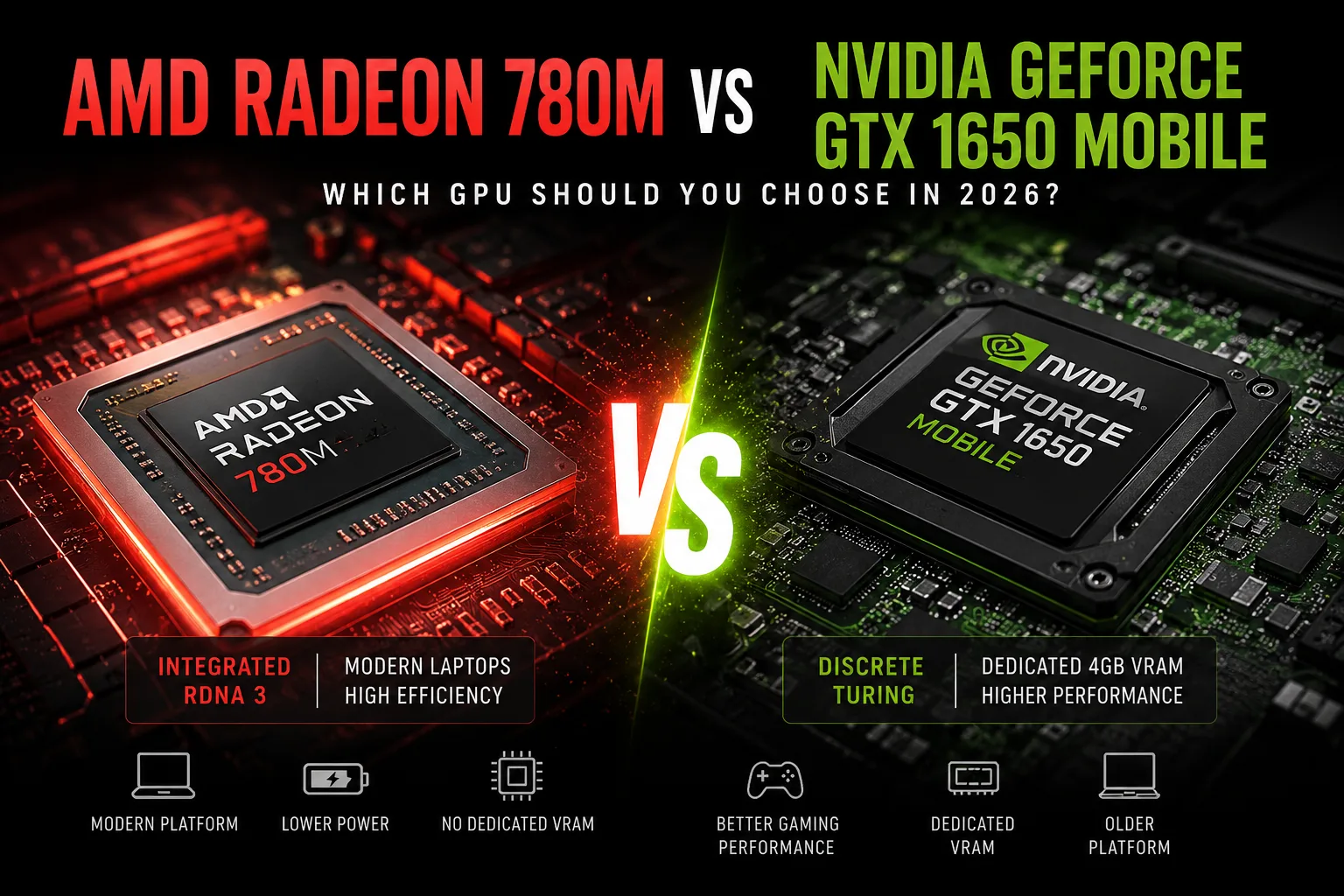
GPU Comparison Result
AMD Radeon 780M vs GeForce GTX 1650 Mobile: GTX is faster, but laptops with it are already outdated
The GeForce GTX 1650 Mobile remains about 25-30% faster than the Radeon 780M. However, by 2026, just having higher FPS is no longer enough to make a choice. The Radeon 780M is still found in modern laptops, while the GTX 1650 Mobile is primarily found in older models, on the second-hand market, and among stock leftovers.
Main Differences
| Radeon 780M | GeForce GTX 1650 Mobile | |
|---|---|---|
| Type | Integrated graphics | Discrete graphics |
| Architecture | RDNA 3 | Turing |
| Memory | System DDR5/LPDDR5X | 4 GB dedicated video memory |
| Main device class | Thin and versatile laptops | Budget gaming laptops |
| Strong point | Efficiency and compactness | Higher gaming performance |
| Major drawback | Strong dependence on memory and power limits | Age of the platform and 4 GB VRAM |
The GTX 1650 Mobile appeared in gaming laptops back in 2019. The Radeon 780M was released much later, along with the mobile Ryzen 7040, and AMD has continued to use this graphics in newer processors.
In practice, this comparison is between old budget discrete graphics and fast integrated Radeon graphics from the RDNA 3 generation.
Benchmarks in Specific Laptops
The table shows the 3DMark Time Spy Graphics result, not the overall Time Spy score.
| GPU | Laptop | Processor | Time Spy Graphics |
|---|---|---|---|
| Radeon 780M | Lenovo Yoga Slim 7 14APU G8 | Ryzen 7 7840S | 2865 |
| Radeon 780M | Lenovo Yoga Pro 7 14APH G8 | Ryzen 7 7840HS | 2808 |
| Radeon 780M | Framework Laptop 13.5 | Ryzen 7 7840U | 2575 |
| GeForce GTX 1650 Mobile | ASUS TUF FX505DT-EB73 | Ryzen 7 3750H | 3568 |
| GeForce GTX 1650 Mobile | HP Omen 15-dc1020ng | Core i5-9300H | 3565 |
| GeForce GTX 1650 Mobile | Dell G5 15 5590 | Core i5-9300H | 3488 |
In this sample, the Radeon 780M scores an average of about 2750 points, while the GTX 1650 Mobile scores about 3540. The NVIDIA's advantage is around 29%.
The performance of the Radeon 780M is particularly dependent on the specific laptop. Fast LPDDR5X or dual-channel DDR5, high power limits, and effective cooling significantly impact performance.
In a well-optimized laptop, the Radeon 780M can approach the GTX 1650 Max-Q. However, the full GTX 1650 Mobile, which usually operates at around 50W, generally remains faster.
The Difference in Games May Be Greater
In older AAA games, the GTX 1650 Mobile's lead can sometimes be larger than in Time Spy.
For example, in The Witcher 3 at high settings 1080p, laptops with the full GTX 1650 Mobile show around 60 FPS, while the Radeon 780M achieves about 40 FPS.
The 4 GB of dedicated video memory frees the GTX 1650 Mobile from dependence on the memory bandwidth. However, today, the same 4 GB VRAM has become one of the main limitations of this graphics card. In newer games, this amount is often insufficient for high textures and stable performance.
The GTX 1650 lacks RT cores and Tensor cores, so it does not support DLSS. The Radeon 780M does support hardware ray tracing, but its performance is not sufficient to use ray tracing in demanding games without a severe drop in FPS.
What to Buy in 2026
The Radeon 780M is still found in new laptops, including models with Ryzen 7 250 and Ryzen 7 260. These are already systems built on modern processors and platforms.
The GTX 1650 Mobile has virtually disappeared from current lineups. Today, it is mainly found in used gaming laptops, refurbished devices, and leftover stock.
If a Dell G3, ASUS TUF, or a similar laptop with a GTX 1650 Mobile is available on the second-hand market for around €200-300, the additional 25-30% performance may still justify the purchase for older and less demanding games.
But at a price close to that of a modern laptop with a Radeon 780M, this option is no longer cost-effective. The additional FPS comes with an old processor, outdated platform, worn-out battery, and 4 GB VRAM.
Conclusion
The GTX 1650 Mobile is on average about 25-30% faster than the Radeon 780M. In certain older games, the difference may be even more significant.
However, in 2026, this advantage mainly matters in the second-hand market. If an old gaming laptop with a GTX 1650 Mobile costs €200-300, it could still be a worthwhile purchase for older and less demanding games.
At a price close to that of a modern laptop with a Radeon 780M, there's no longer a reason to choose a seven-year-old platform just for additional graphical performance.
In pure performance, the Radeon 780M falls behind the GTX 1650 Mobile. Nonetheless, it demonstrates how close modern integrated graphics have come to budget discrete GPUs from previous years.
Advantages
- Higher Boost Clock: 2900MHz (2900MHz vs 1515MHz)
- Newer Launch Date: January 2023 (January 2023 vs April 2020)
- Larger Memory Size: 4GB (System Shared vs 4GB)
- Higher Bandwidth: 192.0 GB/s (System Dependent vs 192.0 GB/s)
- More Shading Units: 1024 (768 vs 1024)
Basic
Memory Specifications
Display and Media
Theoretical Performance
Miscellaneous
Benchmarks
Related GPU Comparisons


Share in social media
Or Link To Us
<a href="https://cputronic.com/index.php/gpu/compare/amd-radeon-780m-vs-nvidia-geforce-gtx-1650-mobile" target="_blank">AMD Radeon 780M vs NVIDIA GeForce GTX 1650 Mobile</a>