Intel Core Ultra 5 322
vs
Intel Core 5 320


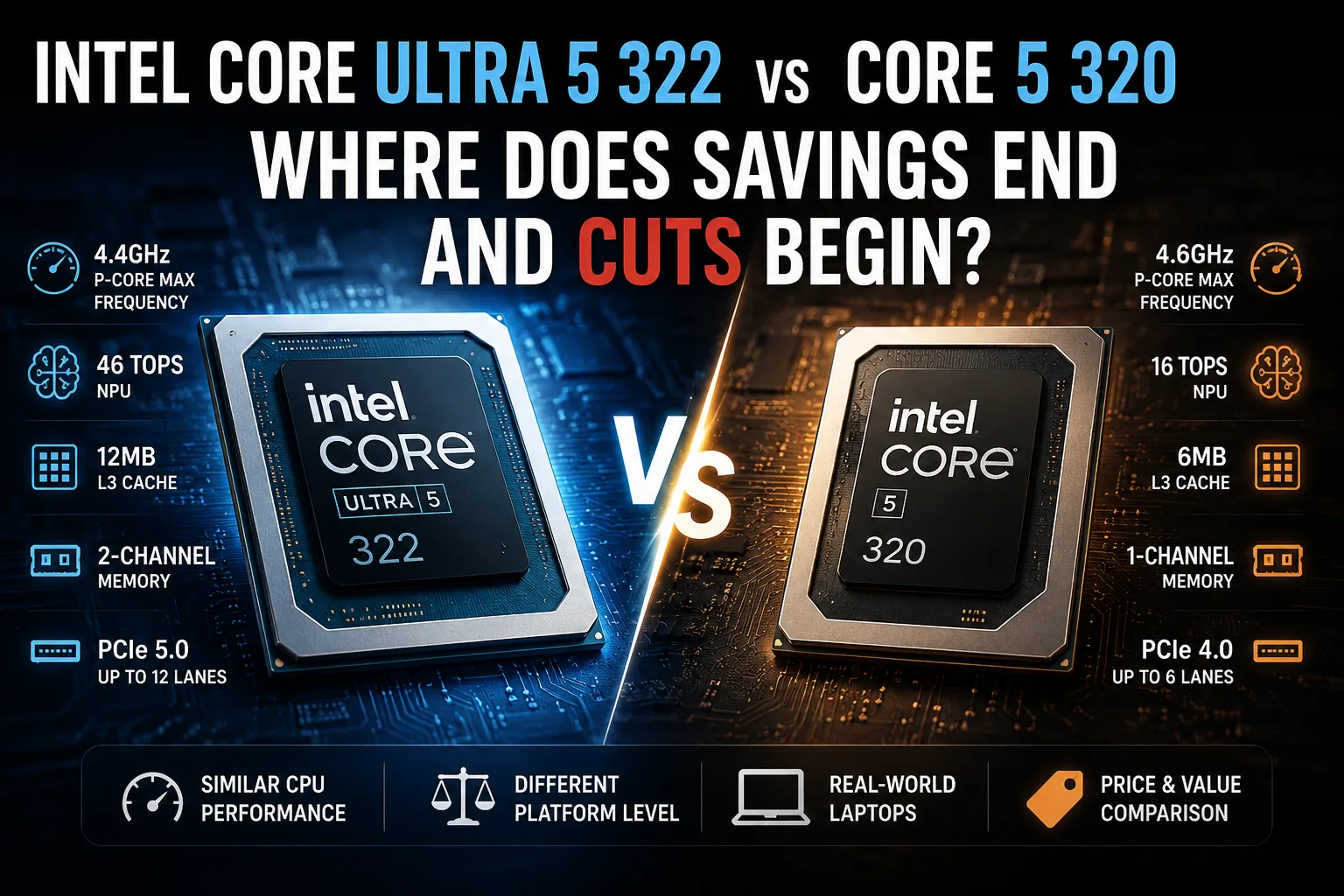
CPU Comparison Result
Intel Core Ultra 5 322 vs Core 5 320: Where Saving Ends and Cutting Begins
Intel Core Ultra 5 322 and Core 5 320 appear as two neighboring processors. In terms of CPU speed, this is indeed the case. However, when it comes to the platform, this is no longer true.
Both processors have 6 cores and 6 threads arranged in a 2P + 4 LP E scheme. In Geekbench, they often perform nearly on par, with Core 5 320 occasionally even pulling ahead due to its higher clock speed. But Intel has significantly cut back on nearly everything surrounding the CPU: half the L3 cache, one memory channel instead of two, a weaker NPU, fewer PCIe lanes, and stricter platform limits.
Thus, the question is not about how much faster the Core Ultra 5 322 is. It is hardly any faster. The real question is: how much is one willing to save to settle for the Core 5 320?
Core 5 320 Cut Back Everywhere on the Platform
| Specification | Core Ultra 5 322 | Core 5 320 |
|---|---|---|
| Architecture | Panther Lake | Wildcat Lake |
| Cores / Threads | 6 / 6 | 6 / 6 |
| Configuration | 2P + 4 LP E | 2P + 4 LP E |
| Max Turbo Frequency P-cores | 4.4 GHz | 4.6 GHz |
| L3 Cache | 12 MB | 6 MB |
| Base Power | 25 W | 15 W |
| Max Turbo Power | 55 W | 35 W |
| NPU | 46 TOPS | 16 TOPS |
| Integrated Graphics | Intel Graphics, 2 Xe-core | Intel Graphics, 2 Xe-core |
| Max GPU Frequency | 2.3 GHz | 2.5 GHz |
| Max Memory Capacity | 128 GB | 64 GB |
| Memory Channels | 2 | 1 |
| PCI Express | 5.0, up to 12 lanes | 4.0, up to 6 lanes |
Ironically, the Core 5 320 is even faster at peak P-core frequency: 4.6 GHz versus 4.4 GHz. Hence, in short single-threaded loads, it does not seem inferior at all.
But then the cuts begin.
The Core Ultra 5 322 boasts double the L3 cache, two memory channels instead of one, 46 TOPS NPU instead of 16, PCIe 5.0 instead of 4.0, and double the available PCIe lanes.
This is no minor difference. The Core 5 320 is not just cheaper. Intel has consciously downgraded the platform while keeping a decent speed for individual CPU cores.
In Geekbench, There's Almost No Difference
| Processor | Device | Geekbench 6 Single | Geekbench 6 Multi |
|---|---|---|---|
| Core Ultra 5 322 | MSI Modern 14S AI+ G3MG | 2559 | 7939 |
| Core Ultra 5 322 | Lenovo IdeaPad 5i 2-in-1 14IPH11 | 2556 | 8048 |
| Core Ultra 5 322 | Lenovo 83UR | 2515 | 8142 |
| Core 5 320 | HP OmniBook 5 14-kf0xxx | 2582 | 8069 |
| Core 5 320 | Dell XPS 13 DX13260 | 2548 | 7792 |
| Core 5 320 | Lecoo N143B | 2500 | 7377 |
| Core 5 320 | Acer Aspire AG15-I51P | 2396 | 7421 |
This is why paying extra for the Core Ultra 5 322 for barely any CPU speed gain is almost pointless.
In actual laptops, the Core 5 320 is capable of outperforming the 322 in both Single Core and Multi Core. The variances between different laptop models are sometimes larger than the differences between the processors themselves.
For browsing, Office, video calls, regular development, and everyday tasks, both will feel almost identical.
However, both are weak for heavy multi-threaded workloads. Six cores without SMT in 2026 is no longer a platform worth purchasing for rendering, compiling large projects, or for serious workloads.
46 TOPS vs 16 TOPS - There's No Contest Here
The situation with the NPU is entirely different.
The Core Ultra 5 322 provides 46 TOPS, while the Core 5 320 offers 16 TOPS.
This is almost a threefold difference.
If local AI functions matter at all, the Core 5 320 has virtually nothing to counter the higher model. It has Intel AI Boost, but 16 TOPS seem to only indicate "NPU present," rather than providing a serious capability for the next few years.
Against the backdrop of 46 TOPS in the 322, the NPU block in the Core 5 320 appears as just another area where Intel has cut back.
One Memory Channel - The Most Disappointing Limitation of the Core 5 320
Here it becomes difficult to justify.
The Core Ultra 5 322 has a dual-channel memory controller, while the Core 5 320 has a single channel.
And this is not a case where the laptop manufacturer installed one RAM stick and the user can later add a second one. The limitation is built into the processor itself.
For documents and browsing, this isn't catastrophic. For integrated graphics, however, it poses a serious drawback.
It's particularly odd that the GPU in the Core 5 320 is rated to run up to 2.5 GHz compared to the 322's 2.3 GHz. However, the benefits of the higher frequency diminish when the graphics hit the limited memory bandwidth.
In both cases, the iGPU remains basic. For Windows, video, and older or simpler games, it will suffice. Buying such a laptop for gaming is not advisable.
But a single memory channel in the Core 5 320 is not simply a cost-cutting measure on the case, screen, or battery. It is a cutback on the very foundation of the platform.
Wildcat Lake Saves Everywhere It Doesn’t Show Immediately
The Core Ultra 5 322 supports PCIe 5.0 and up to 12 lanes, while the Core 5 320 has PCIe 4.0 and six lanes.
In a cheap laptop with a single SSD, the user may not notice this at all. That's precisely why such cuts are convenient for the manufacturer.
The speed of the CPU cores remains decent. However, the cache is smaller, memory bandwidth is reduced, the NPU is weaker, and the PCIe is simpler.
On the shelf, the laptop still looks modern. The specifications state Intel Core 5 320, DDR5, AI, PCIe, Intel Graphics. Only when dissecting the platform does it become clear how much has been trimmed from it.
Price Decides Everything
And here, the Core 5 320 can be justified.
| Processor | Laptop | Configuration | Price at Time of Review |
|---|---|---|---|
| Core 5 320 | Acer Swift Air 14 | 8 GB / 512 GB, 14" IPS 120 Hz | around €799 |
| Core Ultra 5 322 | Lenovo IdeaPad Slim 5i 16 | 16 GB / 512 GB, 16" WUXGA | from €849 |
| Core Ultra 5 322 | Lenovo IdeaPad 5i 2-in-1 14 | 16 GB / 512 GB, touchscreen 14" WUXGA | from €879 |
| Ryzen AI 7 350 | Lenovo IdeaPad Slim 5 14 | 24 GB / 1 TB, 14" OLED | from €949 |
The Core 5 320 makes sense in budget machines. Approximately €500-700 is its natural territory. Up to €800 is acceptable if the laptop itself is genuinely good: lightweight chassis, decent screen, good battery life.
However, the closer the price is to €900, the harder it is to justify the purchase.
The Core Ultra 5 322 looks more appealing, but problems arise for it too. At €850-900, it’s still reasonable, particularly in a good 14-inch convertible.
Then, along comes the Lenovo IdeaPad Slim 5 14 with Ryzen AI 7 350.
And Then Ryzen AI 7 350 Appears Next to It
For about €949, one can find a 14-inch Lenovo IdeaPad Slim 5 featuring Ryzen AI 7 350, 24 GB RAM, 1 TB SSD, and OLED.
This is when Intel's pricing for its models starts to look particularly peculiar.
The Ryzen AI 7 350 boasts 8 cores and 16 threads, Radeon 860M, and an NPU up to 50 TOPS. In the 14-inch Lenovo models, it achieves around 13,900 points in Geekbench 6 Multi.
The Core Ultra 5 322 scores around 8,000.
So, for about €70 more than the IdeaPad 5i 2-in-1 with the Core Ultra 5 322, one can get:
- 8 cores and 16 threads instead of 6 and 6;
- significantly higher multi-threaded performance;
- Radeon 860M;
- 24 GB RAM instead of 16 GB;
- 1 TB SSD instead of 512 GB;
- OLED.
Yes, the Intel model is a convertible. But €70 doesn't seem like a serious compensation for such hardware differences.
And the argument about compactness here falls apart too. The Ryzen AI 7 350 fits comfortably in a 14-inch chassis. Thus, the weak multi-threaded performance of the 320 and 322 is not an inevitable price to pay for a small laptop.
What to Choose
The Core 5 320 is worth considering if:
- the laptop is genuinely inexpensive;
- the price is around €500-700;
- it is needed for browsing, Office, studying, and regular work;
- the benefits of the laptop itself are more important than the CPU;
- AI and gaming are not of interest.
The Core Ultra 5 322 is worth considering if:
- the price difference from the Core 5 320 is small;
- a dual-channel memory controller is required;
- a 46 TOPS NPU is needed;
- the price remains around €800-900;
- it’s about a good compact laptop or convertible.
Conclusion
The Core 5 320 is a telling example of how one can maintain decent speed for individual CPU cores while drastically cutting everything surrounding them.
One memory channel, 6 MB L3, 16 TOPS NPU, and only six PCIe lanes are no trifles. This is a deliberately streamlined platform for budget laptops.
And in a laptop for €500-700, this poses absolutely no problem. The Core 5 320 fits perfectly in its place there.
The Core Ultra 5 322 is significantly better. Two memory channels, 12 MB L3, 46 TOPS NPU, and PCIe 5.0 make it a much more comprehensive platform. Yet the CPU does not become much faster.
Thus, the 322 quickly hits the ceiling of its price.
When a 14-inch Lenovo IdeaPad Slim 5 with Ryzen AI 7 350, 24 GB of RAM, a 1 TB SSD, and OLED pops up for around €950, justifying the higher-priced Intel models becomes challenging, except for reasons other than performance.
And this is not about imaginary prices. The HP ProBook 4 G2i 14 with Core 5 320, 16 GB RAM, and a 512 GB SSD was priced around €1450 at the time of review. The HP ProBook 4 G2i 14 with Core Ultra 5 322 in the configuration 16/512 GB was around €1640. The same is asked for the 16-inch ProBook 4 G2i with Core Ultra 5 322.
Here, the term Business doesn't save the situation anymore. A badge on the chassis will not add a second memory channel to the Core 5 320, nor double its L3 cache, or convert six threads into sixteen. And the Core Ultra 5 322, despite its advantages over the 320, still remains a six-core processor with around 8,000 points in Geekbench 6 Multi.
Corporate management, security, and service indeed come at a cost. But if they are unnecessary, the buyer ends up with a laptop for €1450-1640 on a platform that is far more naturally suited to a significantly cheaper price segment.
The Core 5 320 is needed for inexpensive work laptops. The Core Ultra 5 322 is needed for accessible compact Panther Lake models.
And €1450-1640 for such configurations is simply too much.
Advantages
- Higher Technology: 2 nm (2 nm vs Intel 18A)
- Higher Performance-core Max Turbo Frequency: 4.6 GHz (4.4 GHz vs 4.6 GHz)
- Newer Launch Date: April 2026 (January 2026 vs April 2026)
Basic
CPU Specifications
Memory Specifications
Up to DDR5 6400 MT/s
GPU Specifications
AI Specifications
Interfaces and Ports
Miscellaneous
Benchmarks
Related CPU Comparisons





Share in social media
Or Link To Us
<a href="https://cputronic.com/index.php/cpu/compare/intel-core-ultra-5-322-vs-intel-core-5-320" target="_blank">Intel Core Ultra 5 322 vs Intel Core 5 320</a>