Intel Core Ultra 5 250K Plus
vs
AMD Ryzen 7 7800X3D


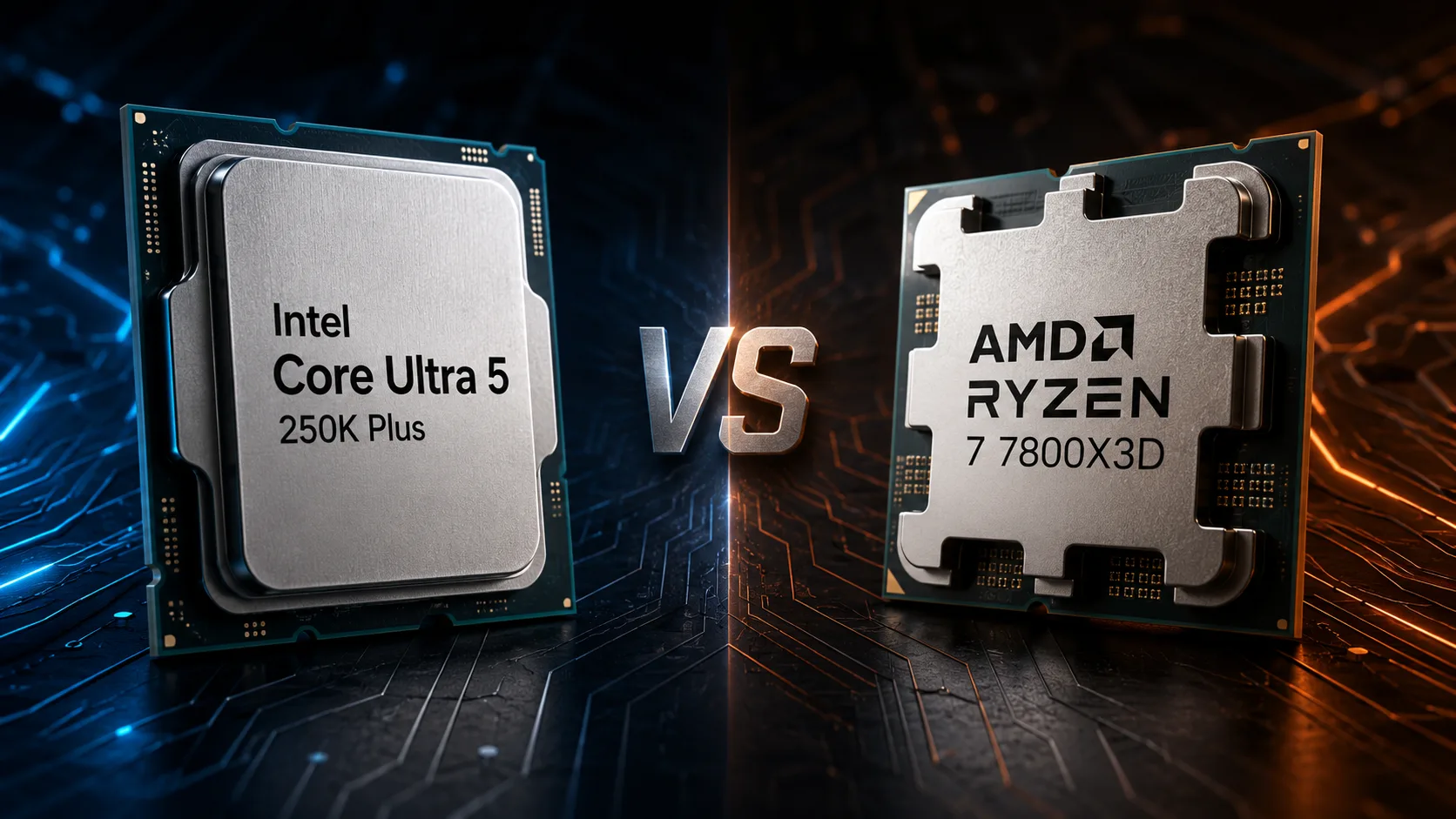
CPU Comparison Result
Intel Core Ultra 5 250K Plus vs AMD Ryzen 7 7800X3D: Which is Faster in Games and Work Tasks
The Intel Core Ultra 5 250K Plus and AMD Ryzen 7 7800X3D are designed for different scenarios. The 18-core Intel is significantly stronger in multi-threaded tasks, while the 8-core AMD excels in gaming thanks to its 96 MB of L3 cache.
The Core Ultra 5 250K Plus is priced around €230-270, while the Ryzen 7 7800X3D is approximately €360-365. However, it is important to consider the cost of the entire platform: savings on Intel can be invested in a more powerful graphics card.
Key Differences
| Specification | Intel Core Ultra 5 250K Plus | AMD Ryzen 7 7800X3D |
|---|---|---|
| Architecture | Arrow Lake Refresh | Zen 4 |
| Core Configuration | 6 P-cores + 12 E-cores | 8 Zen 4 cores |
| Cores / Threads | 18 / 18 | 8 / 16 |
| Maximum Frequency | 5.3 GHz | 5.0 GHz |
| L2 Cache | 30 MB | 8 MB |
| L3 Cache | 30 MB | 96 MB |
| Base Power / TDP | 125 W | 120 W |
| Maximum Turbo Power | 159 W | Not specified |
| Official Memory Support | DDR5-7200 | DDR5-5200 |
| Socket | LGA1851 | AM5 |
| Integrated Graphics | Intel Graphics, 4 Xe-cores | Radeon Graphics, 2 cores |
| Year of Release | 2026 | 2023 |
The Core Ultra 5 250K Plus does not support Hyper-Threading, therefore the 18 physical cores provide 18 threads. Its high multi-threaded performance is delivered by the twelve E-cores, which accelerate rendering, encoding, compiling, and other parallel tasks.
Intel specifies a frequency of up to 5.3 GHz, 30 MB of L3 cache, support for DDR5-7200, and a maximum turbo power of 159 W.
The Ryzen 7 7800X3D features eight cores and sixteen threads. It has an L3 cache size of 96 MB. The large cache reduces access to RAM and particularly benefits gaming performance. Its maximum frequency reaches 5.0 GHz, with a TDP of 120 W.
Geekbench 6 on Different Configurations
The table below shows Geekbench 6 results for several real configurations. The systems differ in memory, motherboards, BIOS settings, and power modes, hence the comparison reflects a general range of performance rather than results under identical conditions.
| Processor and Motherboard | Memory | Geekbench 6 Single-Core | Geekbench 6 Multi-Core |
|---|---|---|---|
| Core Ultra 5 250K Plus, ASUS ROG Strix Z890-E Gaming WiFi | 48 GB DDR5-8400 | 3225 | 21 397 |
| Ryzen 7 7800X3D, MSI MPG B850I Edge TI WiFi | 32 GB DDR5-6006 | 2767 | 13 689 |
| Ryzen 7 7800X3D, ASUS ROG Strix X670E-F Gaming WiFi | 64 GB DDR5-4800 | 2730 | 15 090 |
The first two systems were tested in Geekbench 6.7. In these configurations, the Core Ultra 5 250K Plus scored approximately 17% higher in Single-Core and 56% higher in Multi-Core.
The Intel system operated with DDR5-8400 and a performance-oriented power mode. Another configuration with the Ryzen 7 7800X3D scored 15,090 points in Multi-Core. The variability highlights how much results depend on memory, BIOS, and system settings.
Even taking this into account, the Core Ultra 5 250K Plus is significantly faster in multi-threaded tasks.
Gaming Performance
The main strength of the Ryzen 7 7800X3D is its gaming performance. Geekbench hardly reflects the benefit of the 96 MB of L3 cache, whereas in games, it can significantly reduce latencies and increase frame rates.
There are currently few direct tests of these processors under identical conditions. In tests, the Intel Core Ultra 5 250K Plus averaged close to the Ryzen 5 9600X across 37 games. By comparison, the Core Ultra 7 270K Plus fell behind the Ryzen 7 9800X3D by about 12% on average across 40 games. In both cases, a GeForce RTX 5090 was used to minimize GPU influence.
Overall, the Ryzen 7 7800X3D is likely to maintain an advantage in CPU-dependent games. The exact gap will depend on the game, graphics card, resolution, and memory settings.
The 7800X3D shines most under the following conditions:
- 1080p resolution;
- A high-performance graphics card;
- A monitor with a high refresh rate;
- Games sensitive to cache size and memory latencies;
- High average FPS and stable 1% low metrics are important.
At 1440p and especially at 4K, the difference between processors diminishes, as performance is often limited by the graphics card. This means a system with the Core Ultra 5 250K Plus paired with a more powerful GPU could outperform a build with the Ryzen 7 7800X3D and a lower-tier graphics card.
Work Applications
The Core Ultra 5 250K Plus is significantly faster in rendering, compiling, archiving, and video encoding. P-cores provide high speed per thread, while the twelve E-cores accelerate multi-threaded tasks.
The Ryzen 7 7800X3D is also suitable for work workloads but falls short against Intel in multi-threaded tasks. It is less competitive for regular rendering and editing since its main advantage is seen in gaming.
The Core Ultra 5 250K Plus also supports Quick Sync, which accelerates the encoding and decoding of compatible formats in certain editing and streaming applications.
The integrated graphics of both processors are suitable for image output and computer diagnostics but do not replace a discrete graphics card in a modern gaming system.
How Much Do the Processors Cost
| Region | Core Ultra 5 250K Plus | Ryzen 7 7800X3D |
|---|---|---|
| USA | recommended $219-229 | $416 at AMD’s official store |
| Europe | approximately €230-270 | approximately €360-365 |
The recommended price for Intel is $219-229. In European retail, the Core Ultra 5 250K Plus costs around €230-270.
AMD's official store lists the Ryzen 7 7800X3D at $416. In Finland, the processor was priced at about €360-365.
In European retail, the Ryzen is approximately €90-135 more expensive. This amount could be added to the budget for a graphics card, storage, or power supply.
Power Consumption and Cooling
The Core Ultra 5 250K Plus has a base power of 125 W. Under sustained load, consumption can reach 159 W, thus a cooler needs to be capable enough.
The TDP of the Ryzen 7 7800X3D is 120 W, with a maximum temperature of 89 °C. There is no stock cooler included. An AIO cooler is not essential: with normal case ventilation, an effective tower cooler is sufficient.
The Core Ultra 5 250K Plus also requires efficient cooling, especially if the motherboard does not limit turbo power.
What to Choose
Intel Core Ultra 5 250K Plus is suitable for:
- Rendering, compiling, and video encoding;
- Heavy multitasking;
- Streaming and editing;
- A versatile computer for work and gaming;
- Builds where savings on the processor allow for a higher-tier graphics card.
AMD Ryzen 7 7800X3D is suitable for:
- Primarily gaming computers;
- Systems with powerful graphics cards and high-refresh-rate monitors;
- CPU-dependent games;
- Maximizing frame rates at 1080p;
- Upgrading an already assembled AM5 platform.
Conclusion
The Ryzen 7 7800X3D is better suited for a gaming build with a powerful graphics card. Its eight cores fall short compared to Intel in multi-threaded tasks, but the 96 MB of L3 cache delivers superior gaming performance.
The Core Ultra 5 250K Plus is cheaper and significantly faster in rendering, encoding, and other well-parallelizable workloads. For a versatile PC, Intel offers better value, especially if the €90-135 savings allow for upgrading to a higher-tier graphics card.
In summary: Ryzen 7 7800X3D is for maximum FPS; Core Ultra 5 250K Plus is for work, multitasking, and a more balanced build.
Advantages
- More Total Cores: 18 (18 vs 8)
- Higher Technology: 3 nm (3 nm vs TSMC 5nm FinFET)
- Newer Launch Date: March 2026 (March 2026 vs April 2023)
- Larger L3 Cache: 96 MB (30 MB shared vs 96 MB)
Basic
CPU Specifications
Memory Specifications
GPU Specifications
Interfaces and Ports
Miscellaneous
Benchmarks
Related CPU Comparisons


Share in social media
Or Link To Us
<a href="https://cputronic.com/index.php/cpu/compare/intel-core-ultra-5-250k-plus-vs-amd-ryzen-7-7800x3d" target="_blank">Intel Core Ultra 5 250K Plus vs AMD Ryzen 7 7800X3D</a>