AMD Ryzen AI 5 430
vs
AMD Ryzen AI 7 445


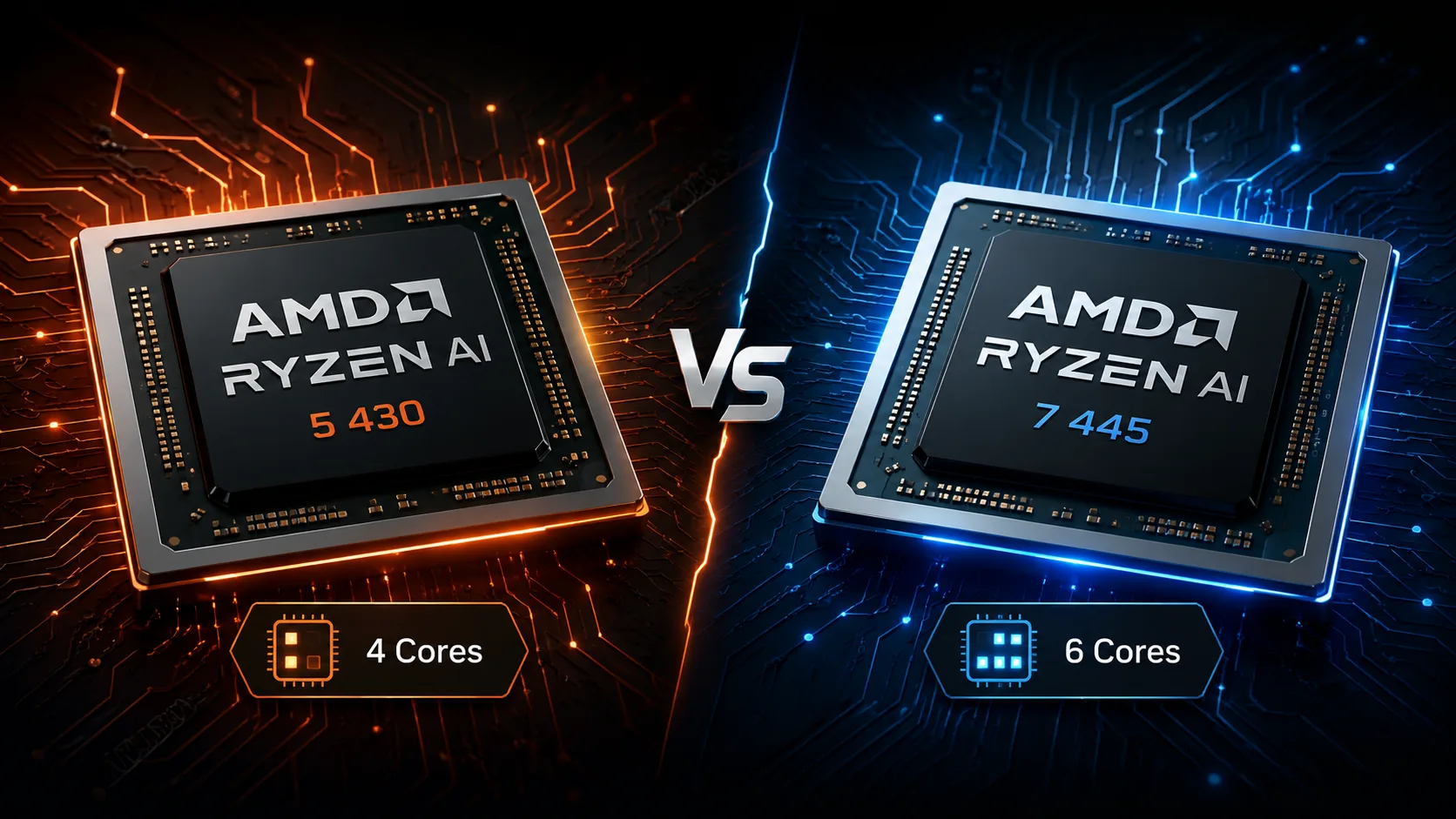
CPU Comparison Result
AMD Ryzen AI 5 430 vs Ryzen AI 7 445: Is It Worth Paying Extra for Six Cores?
AMD Ryzen AI 5 430 and Ryzen AI 7 445 belong to the same Gorgon Point series and are built on a combination of Zen 5 and Zen 5c cores. Both are equipped with integrated Radeon 840M graphics and a 50 TOPS XDNA 2 NPU. The main difference is the number of cores: the lower model has a 4/8 configuration, while the higher model has 6/12. Therefore, in regular tasks, the difference is modest, but under multithreaded load, the Ryzen AI 7 445 is noticeably faster.
Key Differences
| Specification | AMD Ryzen AI 5 430 | AMD Ryzen AI 7 445 |
|---|---|---|
| Cores / Threads | 4 / 8 | 6 / 12 |
| Core Configuration | 1× Zen 5 + 3× Zen 5c | 2× Zen 5 + 4× Zen 5c |
| Max Frequency | 4.5 GHz | 4.6 GHz |
| L2 Cache | 4 MB | 6 MB |
| Total L2 + L3 Cache | 12 MB | 14 MB |
| Radeon 840M Frequency | 2.8 GHz | 2.9 GHz |
| Standard TDP | 28 W | 28 W |
| cTDP Range | 15-28 W | 15-54 W |
| NPU Performance | 50 TOPS | 50 TOPS |
| Total AI Performance | up to 58 TOPS | up to 59 TOPS |
The cTDP range of the Ryzen AI 7 445 reaches 54 W, while the upper limit for the Ryzen AI 5 430 is 28 W. In a laptop with powerful cooling, the higher model can maintain high frequencies longer under full load.
In thin devices, the power limit is often reduced to 20-30 W, which narrows the advantage of the Ryzen AI 7 445.
In Which Laptops Are These Processors Found?
At the time of this comparison, the Ryzen AI 5 430 was most commonly found in Lenovo laptops:
- Lenovo IdeaPad 5 2-in-1 15AGP11;
- Lenovo ThinkPad T14s Gen 7;
- Lenovo ThinkPad X13 Gen 7;
- Lenovo Yoga Slim 7 14AGP11;
- Lenovo IdeaPad Slim 5 14AGP11 and 16AGP11.
The list of models for the Ryzen AI 7 445 is broader and includes devices from ASUS, Acer, and Lenovo:
- ASUS Zenbook 14 UM3406GA;
- ASUS Vivobook 14 M1407GA;
- Lenovo Yoga 7 2-in-1 16AGP11;
- Lenovo Yoga Slim 7 14AGP11;
- Acer Swift Go 16 AI;
- Lenovo IdeaPad Slim 5 14AGP11 and 16AGP11.
Some series are released with both processors. However, the CPU name alone is insufficient; power limits, memory, and cooling significantly impact laptop performance.
Geekbench 6 in Real Laptops
The table below summarizes the Geekbench 6 results for retail devices with both processors.
| Processor | Device | Single-Core | Multi-Core |
|---|---|---|---|
| Ryzen AI 5 430 | Lenovo ThinkPad T14s Gen 7 | 2,540 | 7,752 |
| Ryzen AI 5 430 | Lenovo IdeaPad 5 2-in-1 15AGP11 | 2,582 | 7,940 |
| Ryzen AI 7 445 | ASUS Zenbook 14 UM3406GA | 2,503 | 8,963 |
| Ryzen AI 7 445 | ASUS Vivobook 14 M1407GA | 2,617 | 8,968 |
| Ryzen AI 7 445 | Acer Swift Go 16 AI | 2,611 | 10,651 |
| Ryzen AI 7 445 | Lenovo Yoga 7 2-in-1 16AGP11 | 2,609 | 10,671 |
This is not a direct comparison under identical conditions: laptops differ in power profiles, memory, cooling, and Geekbench versions. However, the table shows the real range of results between retail models.
Single-Core Performance
In the single-core test, the ranges are almost identical:
- Ryzen AI 5 430: 2,540-2,582 points;
- Ryzen AI 7 445: 2,503-2,617 points.
The additional cores have little effect on the result here, and the maximum frequencies differ by 100 MHz. Therefore, the difference between specific laptops can sometimes be greater than the difference between the processors themselves.
In web browsing, office applications, and regular app launches, it will be challenging to notice the advantage of the Ryzen AI 7 445.
Multi-Core Performance
In the multi-core test, the gap is significantly larger:
- Ryzen AI 5 430: 7,752-7,940 points;
- Ryzen AI 7 445: 8,963-10,671 points.
Under similar conditions, the Ryzen AI 7 445 outperforms the lower model by about 14-16%. At higher power limits, the score exceeds 10,600 points, with the difference approaching one-third.
The results of laptops with the Ryzen AI 7 445 also vary significantly. The ASUS Zenbook 14 and Vivobook 14 achieve around 8,960 points, while the Acer Swift Go 16 AI and Lenovo Yoga 7 exceed 10,600. The variation between them reaches almost 20% due to power settings and cooling systems.
In short tasks and applications using one or two cores, the difference is much smaller.
Integrated Graphics
Both processors feature Radeon 840M with four RDNA 3.5 compute units. The graphics for the Ryzen AI 5 430 operate at a frequency of up to 2.8 GHz, while the Ryzen AI 7 445 can reach up to 2.9 GHz.
The difference in frequency does not exceed 4%, so in games, both processors deliver similar results. The performance of the Radeon 840M is more affected by:
- memory speed and operating mode;
- power limit allocated to the integrated graphics;
- cooling;
- manufacturer settings for the laptop.
In the devices from this selection, the Radeon 840M scores between 1,354 and 2,013 points in 3DMark Time Spy. This range is significantly greater than the difference in the rated frequencies of the two processors.
The main limitation remains the graphics with four CU. For gaming, the extra cost for the Ryzen AI 7 445 makes little difference.
AI Performance
Both processors are equipped with a 50 TOPS XDNA 2 NPU and meet the Copilot+ PC requirements.
The overall stated AI performance is:
- Ryzen AI 5 430 - up to 58 TOPS;
- Ryzen AI 7 445 - up to 59 TOPS.
Since the NPU is the same, there will be no noticeable difference in tasks using this block. Paying extra for the Ryzen AI 7 445 solely for AI features does not make sense.
Which Processor to Choose
The Ryzen AI 5 430 is better suited for:
- browsing and office applications;
- studying and video conferencing;
- watching videos;
- basic photo editing;
- programs that rarely use all cores.
It makes sense to pay extra for the Ryzen AI 7 445 if the laptop is needed for:
- working simultaneously with several heavy programs;
- programming and compiling;
- calculations in large spreadsheets and databases;
- video conversion;
- rendering;
- long tasks that utilize all cores.
The final gap depends on the cooling and power limits of a particular laptop. In a thin device, the Ryzen AI 7 445 can outperform the lower model by 14-16%, while at higher power limits, the difference can reach about one-third.
Conclusion
AMD Ryzen AI 5 430 and Ryzen AI 7 445 are close in single-core speed and use the same Radeon 840M and 50 TOPS NPU. The main advantage of the higher model is the two additional cores.
In multithreaded tasks, the Ryzen AI 7 445 is about 15% faster in thin laptops and up to 30-35% at higher power limits. If the price difference is not significant and the laptop is regularly used for heavy tasks, the additional cost is justified.
For browsing, documents, video conferencing, and multimedia, the Ryzen AI 5 430 hardly lags behind the higher model.
Advantages
- More Total Cores: 6 (4 vs 6)
- Higher Max Turbo Frequency: Up to 4.6 GHz (Up to 4.5 GHz vs Up to 4.6 GHz)
Basic
CPU Specifications
Memory Specifications
GPU Specifications
Miscellaneous
Benchmarks
Related CPU Comparisons






Share in social media
Or Link To Us
<a href="https://cputronic.com/index.php/cpu/compare/amd-ryzen-ai-5-430-vs-amd-ryzen-ai-7-445" target="_blank">AMD Ryzen AI 5 430 vs AMD Ryzen AI 7 445</a>