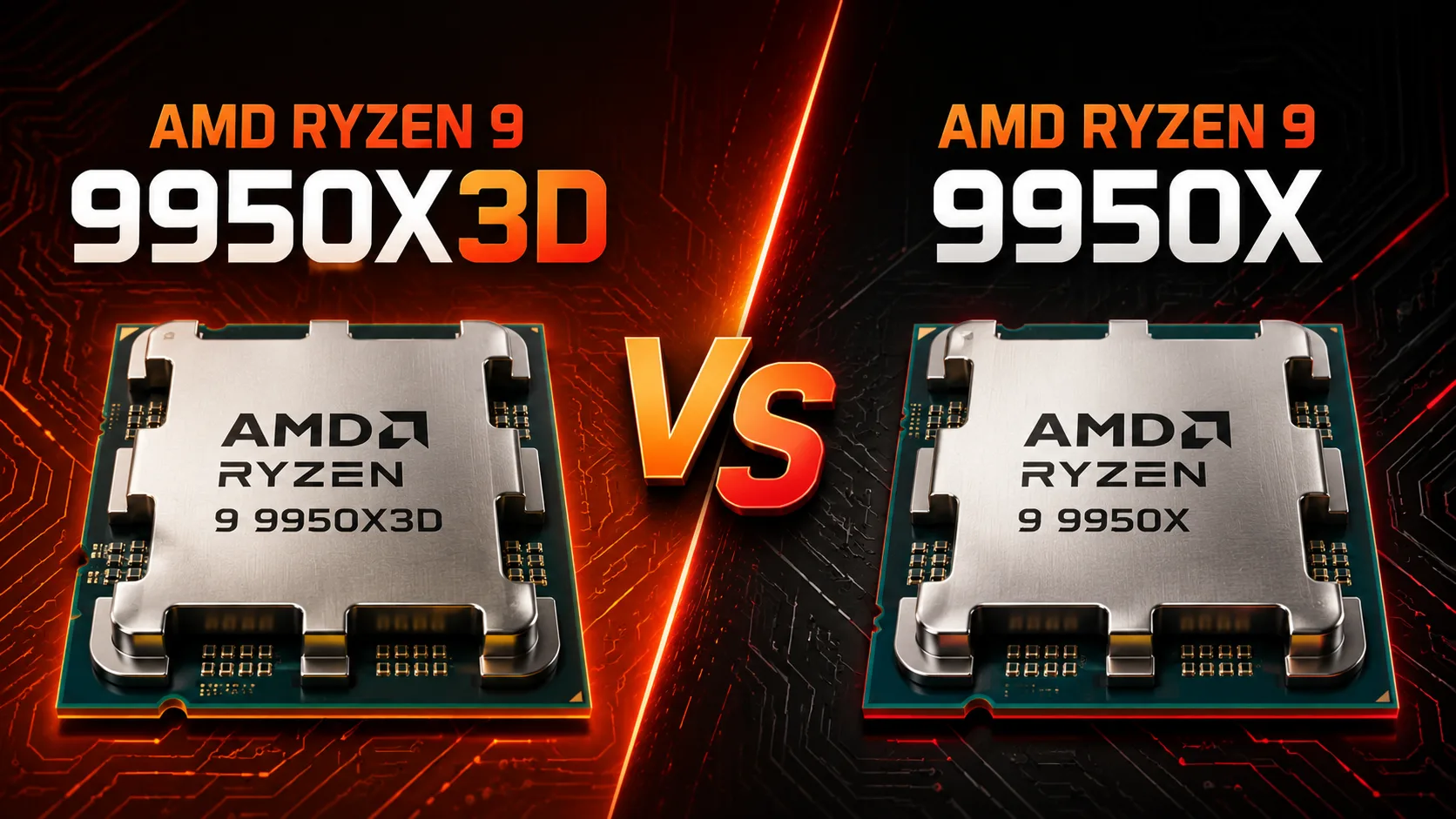
AMD Ryzen 9 9950X3D
vs
AMD Ryzen 9 9950X
CPU Comparison Result
AMD Ryzen 9 9950X3D vs Ryzen 9 9950X: Which Flagship to Choose for Gaming and Work
The Ryzen 9 9950X3D and Ryzen 9 9950X can easily be confused. Their names are nearly identical, both processors belong to the flagship Ryzen 9000 line, both have 16 cores, 32 threads, Zen 5 architecture, AM5 socket, DDR5 support, and PCIe 5.0. However, purchasing them "by seniority" is incorrect. They are not simply a better version and a simpler version; they are two processors with different purposes.
In short, the Ryzen 9 9950X is a powerful all-rounder with 16 cores for work, heavy multitasking, and serious home or professional tasks. The Ryzen 9 9950X3D is a flagship for those who want maximum performance in games but are not ready to give up high performance in work applications.
The main difference is the 3D V-Cache. The Ryzen 9 9950X has 64 MB of L3 cache, while the Ryzen 9 9950X3D has 128 MB of L3. On paper, this looks like just another line in the specifications, but in games, a large cache can significantly change the behavior of the processor. It helps in scenarios where latency, fast data access, and frame stability matter. Therefore, the X3D version is often interesting not only for the average FPS but also for a smoother gaming experience.
Key Differences Between Ryzen 9 9950X3D and Ryzen 9 9950X
| Parameter | Ryzen 9 9950X | Ryzen 9 9950X3D |
|---|---|---|
| Architecture | Zen 5 | Zen 5 |
| Cores / Threads | 16 / 32 | 16 / 32 |
| L3 Cache | 64 MB | 128 MB |
| 3D V-Cache | No | Yes |
| Socket | AM5 | AM5 |
| Memory | DDR5 | DDR5 |
| Main Purpose | Work and versatility | Gaming and premium builds |
| Best Scenario | Rendering, coding, editing, multitasking | Gaming, high FPS, top-tier GPU |
Why Ryzen 9 9950X3D is Better for a Gaming PC
The Ryzen 9 9950X3D should be chosen if gaming is not just an “evening pastime” for you but one of the main purposes of the build. This is especially true if the system has a GPU level like GeForce RTX 5080, RTX 5090, or another top-tier GPU, and if the monitor supports a high refresh rate.
Under these conditions, the processor no longer simply "needs to not interfere with the GPU." It begins to affect the final FPS, minimum drops, and smoothness. This is especially noticeable in CPU-intensive games: strategies, MMOs, simulators, esports projects, and some large open worlds.
The 9950X3D is great because it’s not just a pure gaming octa-core. It has 16 cores and 32 threads, so it remains a strong option for work tasks as well. That’s why it makes sense to consider it for an expensive all-purpose PC: video editing, coding, or rendering during the day, and gaming at max settings in the evening.
Why Ryzen 9 9950X is Still a Very Strong Choice
The Ryzen 9 9950X does not seem weaker just because there is the X3D model nearby. Its logic is different. This is a processor for those who need high stable performance without gaming specialization.
It works well for Blender, DaVinci Resolve, Premiere Pro, compiling large projects, archiving, photo processing, virtual machines, containers, and heavy multitasking. If the computer works most of the time while gaming takes up a smaller share, the 9950X often appears to be the more sensible purchase.
It’s important to not confuse “not X3D” with “worse.” The regular 9950X is still a flagship 16-core CPU. Its strong point lies not in the extra gaming cache, but in versatility and its price relative to the X3D version.
When Paying Extra for Ryzen 9 9950X3D is Not Necessary
The Ryzen 9 9950X3D is not always needed even in an expensive build. If you're mainly gaming at 4K, the load often bottlenecks at the GPU level. In such cases, the difference between processors may be less than expected based on reviews in 1080p.
The same applies to systems with mid-tier GPUs. If the GPU itself limits the FPS, the large cache of the processor is less effective. Therefore, buying the 9950X3D “just in case” is not always reasonable.
Another scenario is a work PC where gaming takes up 10-20% of the time. In this case, it’s better to invest in memory, SSD, or a GPU for work tasks or cooling rather than overspending for gaming maximum.
What to Choose for Different Scenarios
| Scenario | Best Choice |
|---|---|
| Top-tier gaming PC | Ryzen 9 9950X3D |
| Gaming at 1080p/1440p with high FPS | Ryzen 9 9950X3D |
| Gaming at 4K | Ryzen 9 9950X or 9950X3D, depending on price |
| Work, rendering, editing, coding | Ryzen 9 9950X |
| Workstation with evening gaming | Ryzen 9 9950X |
| One expensive PC for everything | Ryzen 9 9950X3D |
| Most rational purchase | Ryzen 9 9950X |
Platform and Cooling: You Can't Save Here
Both processors require a serious system. This is not the case where you can buy a flagship CPU, put it in the simplest motherboard, and call it done. You need a quality AM5 motherboard, good cooling, a proper case with airflow, and fast DDR5 memory.
Both processors have built-in Radeon Graphics, but its role is basic: to output images, help with diagnostics, and survive the temporary absence of a discrete GPU. For gaming and graphical tasks, a separate graphics card is still required.
Conclusion: Ryzen 9 9950X3D or Ryzen 9 9950X
Choose the Ryzen 9 9950X3D if you are building an expensive gaming PC or a versatile premium system where gaming is genuinely important. Its main advantage is the 3D V-Cache and 128 MB L3, which help achieve maximum FPS and smoother performance in gaming scenarios.
The Ryzen 9 9950X is better suited for those who need a powerful 16-core processor for work, multitasking, and general use. It may not be as gaming-focused, but it often appears more rational if the computer is occupied with work tasks most of the time.
In short: Ryzen 9 9950X3D is for gaming maximization and an expensive all-purpose PC, while Ryzen 9 9950X is for heavy work and a more balanced price-to-performance ratio.
Advantages
- Larger L3 Cache: 128 MB (128 MB vs 64 MB)
- Newer Launch Date: March 2025 (March 2025 vs August 2024)
Basic
CPU Specifications
Memory Specifications
GPU Specifications
Miscellaneous
Benchmarks
Related CPU Comparisons


Share in social media
Or Link To Us
<a href="https://cputronic.com/index.php/cpu/compare/amd-ryzen-9-9950x3d-vs-amd-ryzen-9-9950x" target="_blank">AMD Ryzen 9 9950X3D vs AMD Ryzen 9 9950X</a>