AMD Ryzen 5 7500X3D
vs
AMD Ryzen 5 7500F
CPU Comparison Result
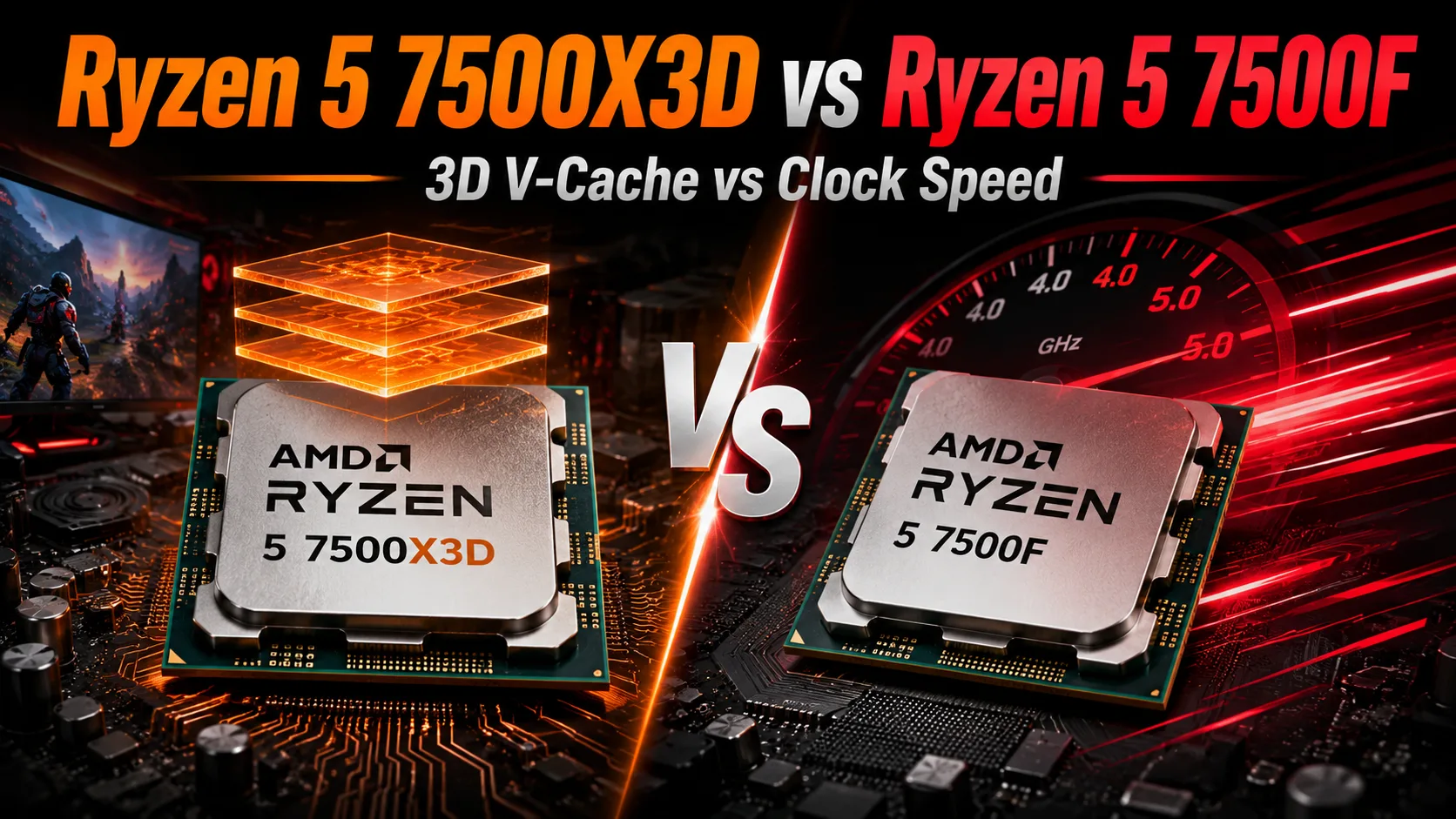
AMD Ryzen 5 7500X3D vs Ryzen 5 7500F: 96 MB L3 vs Higher Clock Speed
The Ryzen 5 7500X3D is significantly more expensive than the Ryzen 5 7500F, but performs slower in Geekbench and many workloads. The main distinction of the X3D is the additional 64 MB of 3D V-Cache, increasing the total L3 to 96 MB. In CPU-dependent games, this cache compensates for the lost 500 MHz Boost: in TechSpot's 12-game test, the 7500X3D outperformed the 7500F by an average of 21%.
Key Differences
| Specification | Ryzen 5 7500X3D | Ryzen 5 7500F |
|---|---|---|
| Architecture | Zen 4 | Zen 4 |
| Cores / Threads | 6 / 12 | 6 / 12 |
| Base Clock | 4.0 GHz | 3.7 GHz |
| Boost | Up to 4.5 GHz | Up to 5.0 GHz |
| L3 Cache | 96 MB | 32 MB |
| TDP | 65 W | 65 W |
| Socket | AM5 | AM5 |
| Integrated Graphics | Radeon Graphics, 2 cores | No |
Both processors utilize the Zen 4 architecture, with 6 cores, 12 threads, and a nominal TDP of 65 W. The Ryzen 5 7500F can boost up to 5.0 GHz compared to 4.5 GHz for the 7500X3D. The X3D model compensates for its lower clock speed with an additional 64 MB of 3D V-Cache, increasing the total L3 cache to 96 MB.
The 7500X3D also features basic integrated Radeon Graphics with two compute cores and a frequency of up to 2.2 GHz. While it's nearly impossible to play games on it, the computer can be run without a discrete graphics card. The Ryzen 5 7500F requires a separate graphics card.
Benchmarks in Real Builds
The Geekbench Browser already contains results for the 7500X3D and 7500F from specific desktop systems. These results come from different computers; therefore, the exact difference between the processors cannot be calculated based on them: memory, BIOS, power mode, and CPU settings vary.
| Processor | Motherboard | Memory | Geekbench 6 Single | Geekbench 6 Multi |
|---|---|---|---|---|
| Ryzen 5 7500X3D | ASRock B850M-C | 16 GB DDR5-5996 | 2567 | 11187 |
| Ryzen 5 7500X3D | Gigabyte B850 AORUS ELITE WIFI7 | DDR5 | 2370 | 10004 |
| Ryzen 5 7500F | Gigabyte A620M S2H | 16 GB DDR5-5594 | 2695 | 11477 |
| Ryzen 5 7500F | ASRock B650E PG Riptide WiFi | 32 GB DDR5-6188 | 2810 | 13477 |
All four results were obtained in Geekbench 6.7.1 under Windows. In the system with ASRock B650E PG Riptide WiFi, the Ryzen 5 7500F boosted to nearly 4.94 GHz; thus, this result is at the upper end of the sample. The maximum frequency of the 7500X3D in these runs remained around the advertised 4.5 GHz.
In Geekbench, the additional 500 MHz proves more beneficial than the larger L3 cache. Therefore, the 7500F is faster in this instance and is also cheaper.
In Games, the Advantage Goes to 7500X3D
TechSpot tested the processors with GeForce RTX 5090 and DDR5-6000 CL30 to minimize limitations from the graphics card. On average across 12 games, the Ryzen 5 7500X3D was found to be 21% faster than the 7500F. Such a difference is significant for two six-core Zen 4 processors.
In individual games, the advantage is even greater. In Baldur's Gate 3, the Ryzen 5 7500X3D achieved 172 fps. In Assetto Corsa Competizione, the result reached 260 fps on Medium, with a 31% advantage over the Ryzen 5 7600. Here, the additional 64 MB of cache provides more benefit than the lost 500 MHz Boost.
However, 21% is not a universal increase for every system. The test was conducted with the RTX 5090 and in scenarios where the bottleneck was indeed the CPU. When increasing resolution or with a less powerful graphics card, the system more often becomes limited by the GPU, and the difference between the 7500X3D and 7500F narrows.
3D V-Cache may also improve the 1% low performance. In The Last of Us Part II Remastered, TechSpot found that the 7500X3D had only a 6% advantage over the Ryzen 5 7600 in average FPS but a 25% advantage in 1% low. In some games, the additional cache significantly reduces frame drops more than it boosts average FPS.
Workloads
The downside of 3D V-Cache is the lower maximum clock speed. In Cinebench 2024, the Ryzen 5 7500X3D scored 792 points in TechSpot's multi-core test. This is a low score for a six-core Zen 4, and the additional cache provides almost no help under such workloads.
The X3D designation does not mean that the 7500X3D is faster in all tasks. Both processors have the same 6 cores and 12 threads, but the 7500F can run 500 MHz faster. For compilation, rendering, archiving, and other workloads where frequency and computational performance matter, the 7500F often comes out ahead.
The price difference of the 7500X3D is not due to additional cores or clock speed - the entire difference lies in the 3D V-Cache.
Price
In terms of price, the gap between the processors is considerably more significant than their performance outside of gaming. The Ryzen 5 7500X3D costs about $260.
OEM versions of the Ryzen 5 7500F are available for approximately $120-145. With these prices, the 7500X3D ends up costing almost twice as much as the OEM version of the 7500F. Therefore, the average gaming boost of 21% does not justify such a price difference on its own.
In a more expensive gaming build, the premium for the X3D appears more justified. If the system's performance is already CPU-limited, the 7500X3D enables more FPS without needing to replace the graphics card. In a budget build, it is often better to invest that money in a more powerful graphics card.
What to Choose
The Ryzen 5 7500X3D is primarily aimed at gaming builds. Its 96 MB L3 cache can provide around 20% additional performance in CPU-dependent games, with advantages even higher in certain titles. The maximum difference manifests at high FPS and in scenarios where performance isn't limited by the graphics card.
The Ryzen 5 7500F is more advantageous for an affordable build and a computer that's used for tasks beyond gaming. It is significantly cheaper and faster in many common CPU workloads, maintaining the same 6 cores and 12 threads.
The Ryzen 5 7500F wins in price and clock speed, while the Ryzen 5 7500X3D excels in gaming cache performance. The premium for the X3D is justified if gaming FPS is more important than performance outside of gaming and does not require cutting corners on the graphics card.
Advantages
- Larger L3 Cache: 96 MB (96 MB vs 32 MB)
- Newer Launch Date: November 2025 (November 2025 vs July 2023)
- Higher Max Turbo Frequency: Up to 5 GHz (Up to 4.5 GHz vs Up to 5 GHz)
Basic
CPU Specifications
Memory Specifications
GPU Specifications
Miscellaneous
Benchmarks
Related CPU Comparisons


Share in social media
Or Link To Us
<a href="https://cputronic.com/index.php/cpu/compare/amd-ryzen-5-7500x3d-vs-amd-ryzen-5-7500f" target="_blank">AMD Ryzen 5 7500X3D vs AMD Ryzen 5 7500F</a>