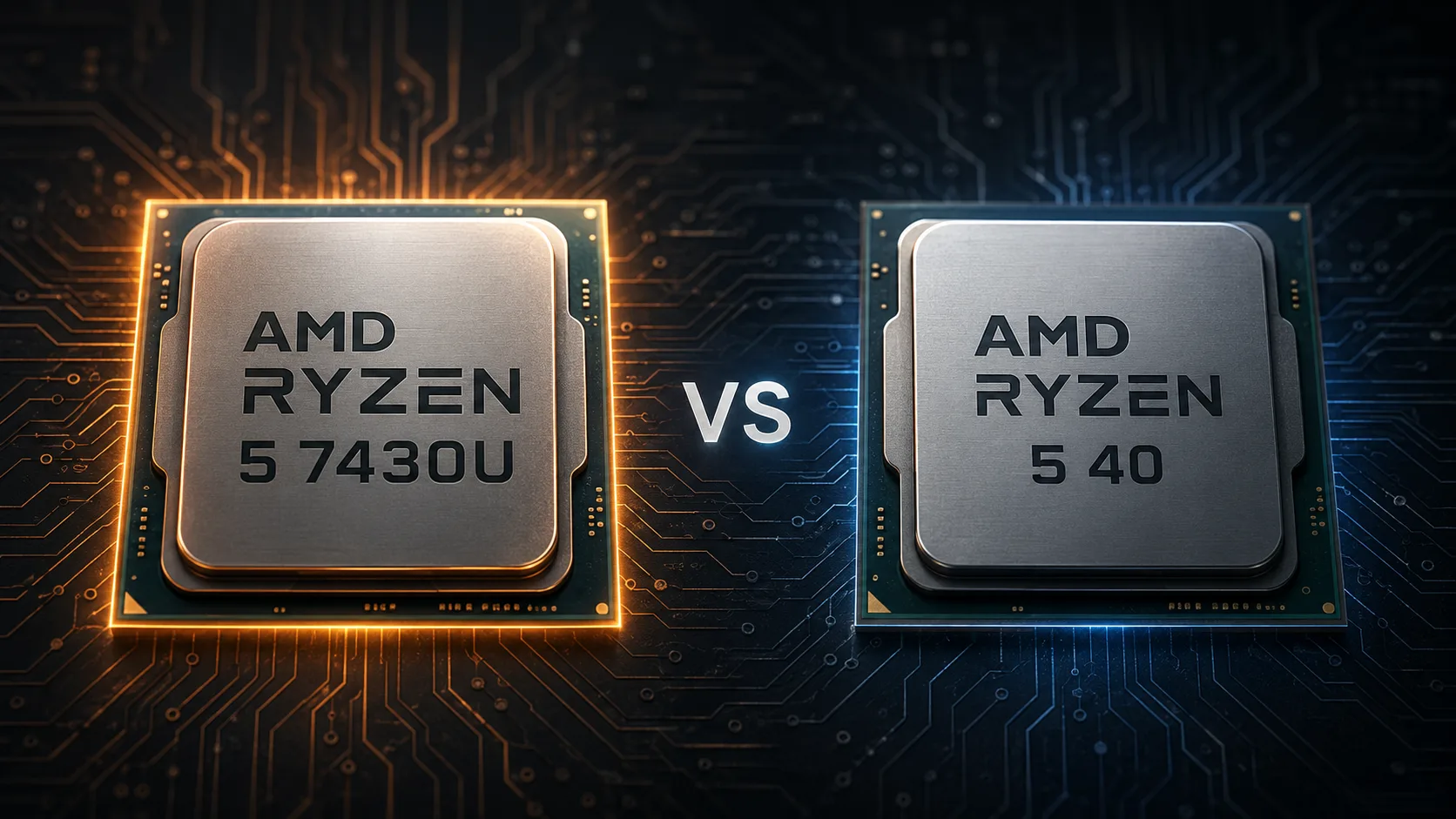
AMD Ryzen 5 7430U
vs
AMD Ryzen 5 40
CPU Comparison Result
AMD Ryzen 5 7430U vs Ryzen 5 40: Six-core Zen 3 vs Budget Mendocino
The Ryzen 5 40 appears newer due to its unusual name; however, it is technically the previous Ryzen 5 7520U: four Zen 2 cores, Radeon 610M graphics, and a maximum of 16GB LPDDR5. The Ryzen 5 7430U is also based on an older architecture, but its six Zen 3 cores, large cache, and Vega 7 graphics provide significantly higher performance.
The main question is: how much cheaper should a laptop with the Ryzen 5 40 be to offset the speed loss, weaker graphics, and memory limitations?
Key Differences
| Specification | AMD Ryzen 5 7430U | AMD Ryzen 5 40 |
|---|---|---|
| CPU Architecture | Zen 3 | Zen 2 |
| Cores / Threads | 6 / 12 | 4 / 8 |
| Max Frequency | 4.3 GHz | 4.3 GHz |
| L3 Cache | 16 MB | 4 MB |
| Process Technology | 7 nm | 6 nm |
| Integrated Graphics | Radeon Vega 7 | Radeon 610M |
| Graphics Units | 7 | 2 |
| Memory | DDR4-3200, LPDDR4X-4267 | LPDDR5-5500 |
| Maximum Memory | up to 64 GB | up to 16 GB |
| Nominal TDP | 15 W | 15 W |
The Ryzen 5 40 has a more modern process technology and fast LPDDR5, but the platform remains significantly simpler. The Ryzen 5 7430U has two more cores, four times more L3 cache, and significantly more powerful integrated graphics.
Ryzen 5 40 - A Renamed Ryzen 5 7520U
In terms of specifications, the Ryzen 5 40 completely replicates the Ryzen 5 7520U from the Mendocino family. The architecture, frequencies, cache, graphics, and memory controller remain unchanged.
Thus, the performance of the Ryzen 5 40 can be estimated using the results from laptops with the Ryzen 5 7520U. In benchmarks and system utilities, the processor may also be identified under its previous name.
The short designation does not indicate a new generation. The Ryzen 5 40 remains an entry-level solution for budget laptops.
Performance in Specific Laptops
Below are individual results from Geekbench 6. The final scores depend on cooling, power limits, and memory configuration; however, the gap between the processors remains across different devices.
| Processor and Laptop | Single-Core | Multi-Core |
|---|---|---|
| Ryzen 5 7430U - Lenovo IdeaPad Flex 5 14ABR8 | 1855 | 7089 |
| Ryzen 5 7430U - ASUS Zenbook 14 UM3402YA | 1819 | 6548 |
| Ryzen 5 7430U - Lenovo IdeaPad Slim 3 15ABR8 | 1842 | 5749 |
| Ryzen 5 40 / 7520U - HP Laptop 15-fc0xxx | 1363 | 4300 |
| Ryzen 5 40 / 7520U - ASUS Vivobook Go 15 E1504FA | 1373 | 4234 |
| Ryzen 5 40 / 7520U - Acer Aspire 3 A315-24P | 1370 | 4186 |
In this sample, the Ryzen 5 7430U shows:
- 1819-1855 points in single-core tests;
- 5749-7089 points in multi-core.
The Ryzen 5 40 is within a narrower range:
- 1363-1373 points in single-core tests;
- 4186-4300 points in multi-core.
Even the lowest score for the Ryzen 5 7430U in multi-core mode is considerably higher than the best results from the Ryzen 5 40. The difference far exceeds the typical variance between laptop configurations.
This table also clearly illustrates the impact of the specific chassis. The Lenovo IdeaPad Flex 5 allows the Ryzen 5 7430U to exceed 7000 points, while the more budget-friendly IdeaPad Slim 3 stays below 6000.
Everyday Tasks
Both processors are suitable for browsing, documents, video calls, and watching videos. In light tasks, the difference may be small, especially if the laptop with the Ryzen 5 40 has 16 GB of memory and a fast SSD.
The advantage of the Ryzen 5 7430U becomes apparent when running multiple programs simultaneously. Six cores and twelve threads handle large spreadsheets, archiving, compiling, photo processing, and background tasks much better.
The Ryzen 5 40 reaches full load faster. With a browser open, a video call in progress, and updates being installed, the system starts to lose responsiveness sooner.
The Ryzen 5 7430U is better suited for a work laptop where you don't have to constantly monitor the number of tabs and running applications. The Ryzen 5 40 is designed for limited office workloads.
Memory
The Ryzen 5 40 supports a maximum of 16 GB LPDDR5. In most laptops, the memory is soldered to the board, so it cannot be upgraded after purchase.
Configurations with 8 GB should be considered only for basic tasks. Part of the memory is reserved for integrated graphics, and modern browsers and Windows quickly consume the remaining amount.
The Ryzen 5 7430U supports up to 64 GB of memory. The specific implementation depends on the manufacturer: models with soldered memory, one SO-DIMM slot, or two removable modules can be found.
For a purchase intended to last several years, it's preferable to opt for a laptop with 16 GB in dual-channel mode or with the possibility of expansion. In models with DDR4, having two modules is particularly crucial for the Vega 7, as a single-channel configuration significantly limits the integrated graphics performance.
Integrated Graphics
The Radeon 610M is based on the RDNA 2 architecture but has only two compute units in the Ryzen 5 40. This is sufficient for the Windows interface, video playback, and connecting an external monitor.
In older and less demanding games, you'll need to use low settings and reduced resolutions.
Vega 7 has seven compute units and is considerably more powerful. In 3DMark Time Spy, laptops with the Ryzen 5 7430U achieve scores of approximately 900-1300, while the Radeon 610M typically scores between 550-600 points.
In this test, the advantage of Vega 7 reaches about one and a half to two times. The actual difference in games depends on memory, cooling, and the power settings of the specific laptop.
Vega 7 is suitable for undemanding online games, older titles, and some modern games at minimal settings. For heavy new games, both integrated graphics are weak, but they cannot be considered equivalent.
Specific Laptops with Ryzen 5 7430U
The Ryzen 5 7430U is found in models of various classes:
- ASUS Zenbook 14 UM3402 - a compact laptop with a quality case, usually with soldered memory;
- Lenovo ThinkPad E14 Gen 5 - a work model with easier upgrade options;
- Lenovo IdeaPad Flex 5 14ABR8 - a convertible that delivers high multi-core scores;
- Lenovo IdeaPad Slim 3 15ABR8 - a budget option with lower performance under prolonged load.
When choosing, it's essential to check the memory capacity, the presence of dual-channel mode, and the ability to install an additional module.
Specific Laptops with Ryzen 5 40
The Ryzen 5 40 and Ryzen 5 7520U are primarily installed in budget devices:
- ASUS Vivobook Go 15 E1504FA;
- Lenovo IdeaPad Slim 3 14AMN8 and 15AMN8;
- Acer Aspire 3 A315-24P;
- HP Laptop 15-fc.
The optimal configuration for this platform is 16 GB of memory and a 512 GB SSD. Options with 8 GB quickly hit limitations when multitasking.
Which to Choose
Choose the Ryzen 5 7430U for:
- Regular work with many tabs and applications;
- Programming and compiling;
- Photo processing;
- Large spreadsheets and archives;
- Undemanding gaming;
- A laptop with the ability to expand memory.
The Ryzen 5 40 is suitable for:
- Document work and studying;
- Browsing and video calls;
- Video playback;
- A budget home laptop;
- Scenarios where the lowest price is more critical than performance headroom.
The Ryzen 5 40 makes sense only with significant savings. A small price difference does not compensate for the weaker cores, graphics, and memory limitations.
Conclusion
At a comparable price, the Ryzen 5 7430U is significantly preferable. It is about a third faster in single-threaded workloads, over 50% faster when utilizing all cores, and has substantially more powerful integrated graphics.
The Ryzen 5 40 is a renamed Ryzen 5 7520U, not a next-generation processor. Its capabilities are adequate for documents, studying, and video, but it has limited multi-tasking headroom, and the maximum 16 GB of soldered memory limits the longevity of such laptops.
Opt for the Ryzen 5 40 only in a cheap configuration with 16 GB of memory. In all other cases, the Ryzen 5 7430U provides significantly more performance and flexibility.
Advantages
- More Total Cores: 6 (6 vs 4)
- Larger L3 Cache: 16 MB (16 MB vs 4 MB)
- Higher Technology: TSMC 6nm FinFET (TSMC 7nm FinFET vs TSMC 6nm FinFET)
- Higher Memory Type: LPDDR5 (DDR4 vs LPDDR5)
- Newer Launch Date: October 2025 (October 2023 vs October 2025)
Basic
CPU Specifications
Memory Specifications
GPU Specifications
Miscellaneous
Benchmarks
Related CPU Comparisons





Share in social media
Or Link To Us
<a href="https://cputronic.com/index.php/cpu/compare/amd-ryzen-5-7430u-vs-amd-ryzen-5-40" target="_blank">AMD Ryzen 5 7430U vs AMD Ryzen 5 40</a>