AMD Ryzen 5 230
vs
Qualcomm Snapdragon X X1-26-100
CPU Comparison Result
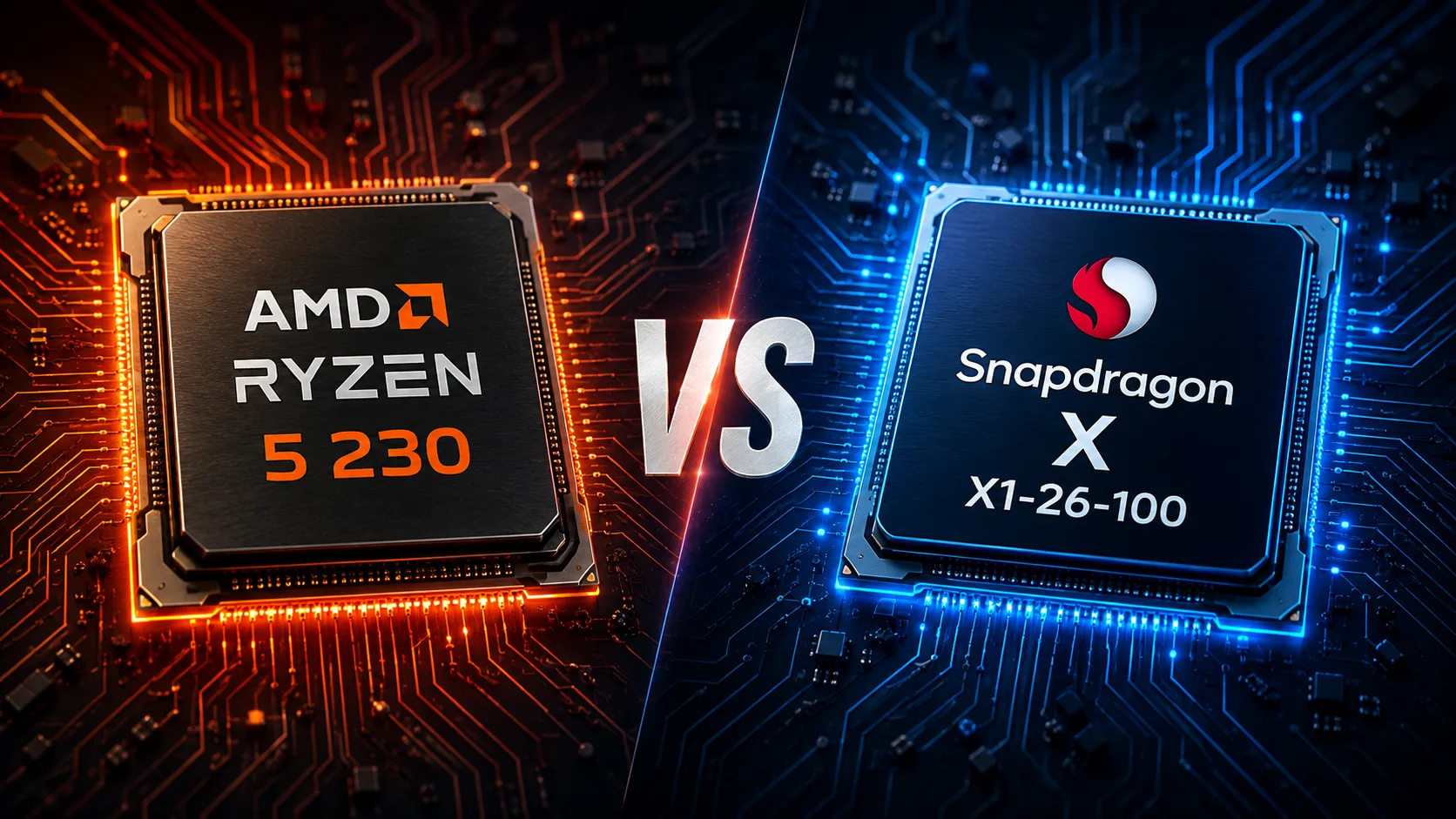
AMD Ryzen 5 230 vs Snapdragon X X1-26-100: x86 vs Arm in Real Laptops
On paper, the Snapdragon X X1-26-100 appears to be an unusual competitor to the Ryzen 5 230: eight Oryon cores versus six Zen 4 cores, and an NPU rated at 45 TOPS compared to 16 TOPS. In real laptops, the situation is less clear-cut. Ryzen is faster in single-core performance and significantly stronger in graphics, while Snapdragon excels in multi-threaded tests. Notably, laptops featuring the X1-26-100 are already available starting at approximately €630.
Key Differences
| Specification | AMD Ryzen 5 230 | Qualcomm Snapdragon X X1-26-100 |
|---|---|---|
| CPU | 6 cores / 12 threads Zen 4 | 8 cores / 8 threads Oryon |
| Max Clock Speed | 4.9 GHz | 3.0 GHz |
| Graphics | Radeon 760M | Adreno X1-45 |
| NPU | 16 TOPS | 45 TOPS |
| Platform | x86-64 | Arm64 |
| Main Advantage | Graphics and compatibility | Multi-threading and AI |
The Ryzen 5 230 maintains the familiar scheme for mobile Zen 4: six cores with SMT and a frequency of up to 4.9 GHz. The most important element here is the Radeon 760M - an RDNA 3 GPU with eight compute units, rather than basic office graphics.
The Snapdragon is structured differently. Its eight physical Oryon cores operate without SMT and are limited to a frequency of 3.0 GHz. Qualcomm compensates for the lower clock speed with a higher number of cores, fast LPDDR5x memory, and a much more powerful NPU.
AMD focuses on high clock speed, SMT, and stronger integrated graphics. Qualcomm features more physical cores and a significantly stronger NPU.
Benchmarks in Real Laptops
The average CPU score hides differences between specific laptops, which is why individual system results are presented below. Power settings, memory, and cooling significantly impact the final numbers.
| Laptop | Processor | Geekbench 6 Single | Geekbench 6 Multi | Price of Similar Configuration |
|---|---|---|---|---|
| HP ProBook 4 G1a 16 | Ryzen 5 230 | 2448 | 8437 | from €728 |
| HP ProBook 4 G2a 14 | Ryzen 5 230 | 2518 | 7536 | €1479 |
| HP OmniBook 3 16-bz0xxx | Snapdragon X X1-26-100 | 2142 | 10818 | €819 |
| HP EliteBook 6 G1q 14 | Snapdragon X X1-26-100 | 2146 | 10643 | €1249 |
| Acer Aspire 16 AI A16-11M | Snapdragon X X1-26-100 | 2138 | 10381 | around €1087 |
The prices are for configurations available for sale of the same model. The amount of memory and SSD may differ from the Geekbench test system.
On average, the Ryzen 5 230 scores around 2480 points in single-core tests compared to 2140 for the Snapdragon, giving AMD an advantage of about 16%.
In multi-core, the Snapdragon leads: approximately 10600 points versus around 8000 for Ryzen, indicating a difference of up to one-third.
The high clock speed of the Zen 4 assists Ryzen in single-threaded tests. The X1-26-100's clock speed is capped at 3.0 GHz, but it features eight physical cores compared to six in AMD's offering.
With Ryzen, results can vary significantly based on the specific laptop. For instance, the ProBook 4 G2a scores around 7400-7700 points in multi-core, so differences of a few hundred points between systems shouldn't be solely attributed to the processor.
Price: Snapdragon is No Longer an Expensive Exotic
The first Snapdragon X processors were mostly found in expensive AI laptops. The X1-26-100 has now reached the mainstream segment.
The Lenovo IdeaPad Slim 3 15Q8X10 with Snapdragon X X1-26-100, 16 GB LPDDR5x, 512 GB SSD, and Windows 11 Home can be found starting around €630. The version with a 1 TB SSD costs about €680.
The HP OmniBook 3 16 with the same processor, 16 GB memory, and 1 TB SSD is available for around €819.
For the Ryzen 5 230, the price range is even wider. The HP ProBook 4 G1a 16 with 16 GB memory and 512 GB SSD is priced at around €730, but the cheapest versions come without Windows. Models with Windows 11 Pro typically cost around €900.
The HP ProBook 4 G2a 14 with the Ryzen 5 230, 16 GB memory, 512 GB SSD, and Windows 11 Pro is priced at about €1480. However, this is a business series, so comparing its price directly with a consumer IdeaPad Slim 3 is not appropriate.
More importantly, laptops with the X1-26-100 are already priced below €700. Windows on Arm is no longer an exclusively expensive platform.
Radeon 760M Remains a Significant Advantage for Ryzen
In CPU tests, Snapdragon excels in multi-threading, but in terms of integrated graphics, Ryzen is distinctly stronger.
The Radeon 760M features eight RDNA 3 compute units and a frequency of up to 2.6 GHz. It significantly outperforms basic office iGPUs and enables gaming at 1080p with lowered settings.
The Adreno X1-45 in the Snapdragon X1-26-100 is considerably less powerful. Qualcomm claims up to 1.7 TFLOPS. For Windows, browsing, and video, the Adreno is sufficient, but in gaming, the Radeon 760M is faster.
The gaming difference is accentuated by Windows on Arm. Even when the Adreno provides enough performance, a particular game may depend on x86 components, drivers, or anti-cheat systems. Prism allows Windows 11 to run many x86 and x64 programs on Arm, but drivers do not work through emulation.
If the laptop is intended not only for work but also for gaming, the Ryzen 5 230 is significantly more preferable in this regard.
45 TOPS vs 16 TOPS
The AI capabilities of the Ryzen 5 230 deliver up to 16 TOPS. This is sufficient for certain local AI tasks, but the threshold for Copilot+ PC is 40 TOPS.
The Hexagon NPU in the Snapdragon X1-26-100 outputs up to 45 TOPS, thus laptops featuring it may qualify as Copilot+ PCs.
However, simply having a high TOPS number does not guarantee acceleration for regular applications; the benefits are realized only where the application genuinely utilizes the NPU. For browser, Word, Excel, or video viewing, additional TOPS alone do not make the laptop faster.
In NPU-supported applications, the advantage of 45 TOPS over 16 TOPS is indeed substantial.
How Much Windows on Arm Hinders Currently
The main concern when purchasing Snapdragon devices is no longer the speed of the processor but rather software compatibility.
Windows 11 employs Prism to run x86 and x64 applications on Arm. Microsoft 365, Chrome, Zoom, Spotify, Blender, DaVinci Resolve, and many other popular programs already have Arm64 versions.
In typical office work, Arm limitations are now encountered significantly less often. For browsing, document work, video calls, and video playback, the processor architecture usually poses no problem.
However, emulation only extends to user code. Drivers and other kernel-mode components must have an Arm64 version.
Older printers and scanners, specific corporate hardware, professional utilities, some VPN clients, and games should still be checked for Arm64 support prior to purchase.
The Ryzen 5 230 does not have this additional condition.
Which Processor to Choose
The Ryzen 5 230 is better suited for a versatile Windows laptop. It is preferable if gaming, older peripherals, specific programs are important, or if one simply does not want to verify every application for Arm support. The Radeon 760M also significantly enhances the laptop's capabilities beyond office tasks.
The Snapdragon X X1-26-100 is more interesting for browsing, office work, video calls, and modern Arm64 software. In such tasks, it offers strong multi-threading, a 45 TOPS NPU, and is already found in laptops priced below €700.
Conclusion
The Ryzen 5 230 is approximately 16% faster in single-core Geekbench 6 and features a stronger Radeon 760M. The Snapdragon X X1-26-100 is approximately one-third faster in multi-core performance and nearly three times more powerful in terms of NPU.
Previously, one of the disadvantages of Snapdragon was the high price of laptops. With the X1-26-100, this argument is no longer valid: Lenovo laptops with 16 GB of memory and Windows are already available from around €630.
The main question now is not about processor speed but about the compatibility of necessary programs with Arm. If all essential software runs natively or works well through Prism, the X1-26-100 offers very strong multi-threading for the money. If the laptop needs to run games, older programs, and various peripherals without prior checks, the Ryzen 5 230 remains significantly more versatile.
Advantages
- Newer Launch Date: February 2025 (February 2025 vs January 2025)
- More Total Cores: 8 (6 vs 8)
Basic
CPU Specifications
Memory Specifications
GPU Specifications
AI Specifications
Connectivity
Interfaces and Ports
Miscellaneous
Benchmarks
Related CPU Comparisons




Share in social media
Or Link To Us
<a href="https://cputronic.com/index.php/cpu/compare/amd-ryzen-5-230-vs-qualcomm-snapdragon-x-x1-26-100" target="_blank">AMD Ryzen 5 230 vs Qualcomm Snapdragon X X1-26-100</a>