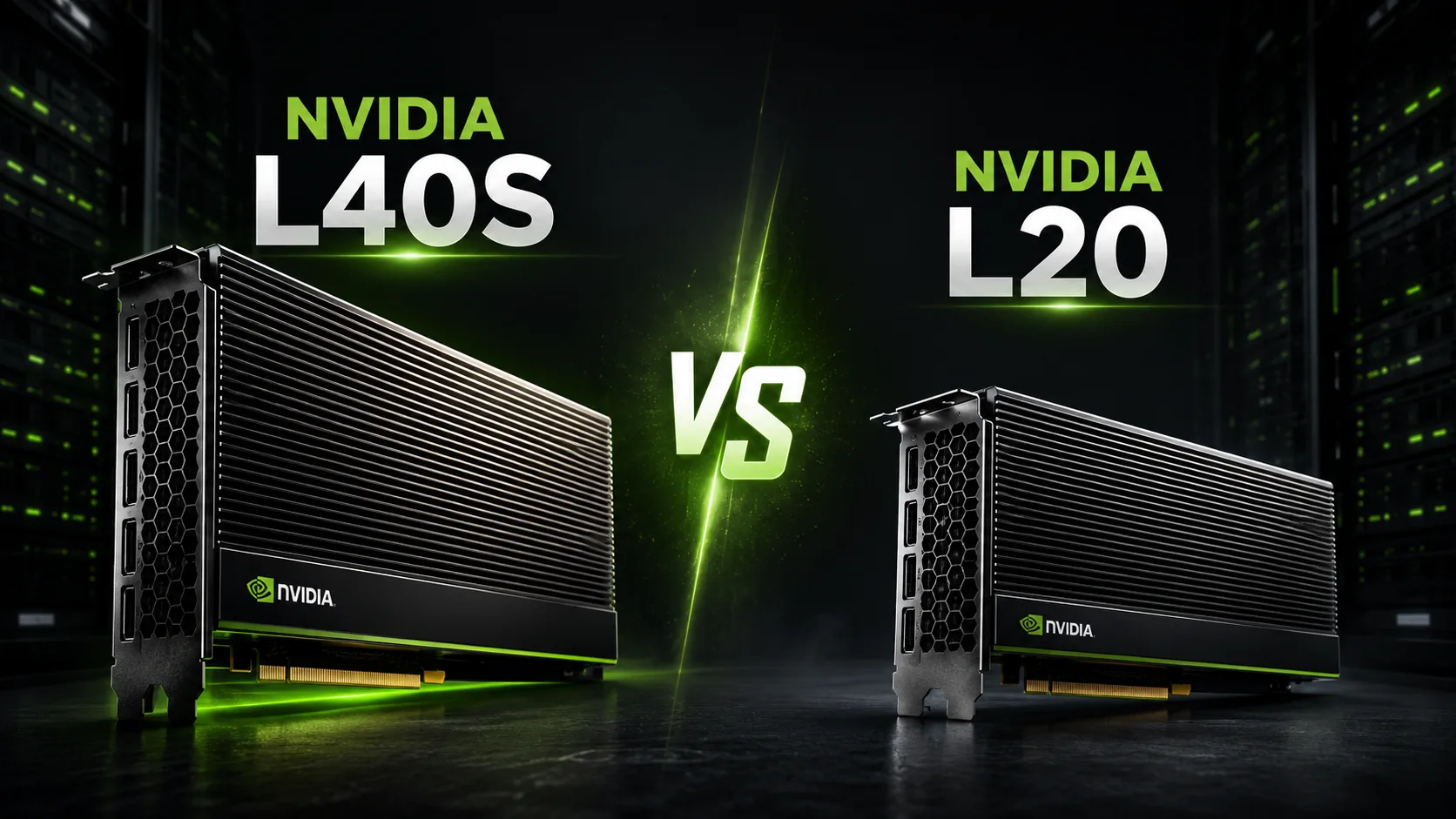
NVIDIA L40S
vs
NVIDIA L20
GPU Comparison Result
NVIDIA L40S vs NVIDIA L20: Same Memory, Different Performance
The NVIDIA L40S and L20 are built on the Ada Lovelace architecture and come equipped with 48 GB of GDDR6 memory with ECC. They both feature a 384-bit bus, a bandwidth of 864 GB/s, and a PCIe 4.0 x16 interface. On these specifications, the models appear similar, but the L40S belongs to a notably higher class.
It has more CUDA, Tensor, and RT cores, making it better suited for generative AI, inference-heavy workloads, rendering, and virtual workstations. The L20 maintains a large amount of memory but significantly lags in computational speed.
Key Differences
| Specification | NVIDIA L40S | NVIDIA L20 |
|---|---|---|
| Architecture | Ada Lovelace | Ada Lovelace |
| CUDA cores | 18,176 | 11,776 |
| Tensor cores | 568 | 368 |
| RT cores | 142 | 92 |
| FP32 Performance | 91.6 TFLOPS | approximately 59.3 TFLOPS |
| Memory | 48 GB GDDR6 ECC | 48 GB GDDR6 ECC |
| Memory Bandwidth | 864 GB/s | 864 GB/s |
| Interface | PCIe 4.0 x16 | PCIe 4.0 x16 |
| Maximum Power | 350 W | approximately 300 W |
| Cooling | Passive | Passive |
The L40S contains about 54% more CUDA cores. A comparable advantage is observed in FP32 computations, and in tensor operations, the gap may be even larger.
What 48 GB of Memory Provides
The main advantage of the L20 is the same memory size as the L40S. This allows for loading large language models, complex scenes, large datasets, and multiple virtual desktops.
However, the memory size primarily determines whether a task fits on the accelerator. The execution speed depends on the computational blocks and tensor performance.
Both cards can run the same model, but the L40S processes requests more quickly, supports a greater user load, and requires less time for training or retraining. The same memory bandwidth does not compensate for the GPU power difference.
Artificial Intelligence
The L40S is designed for mixed server workloads: inference, neural network training, generative AI, video processing, and professional visualization. It supports fourth-generation Tensor cores, FP8, and the Transformer Engine.
The L20 is better suited for more moderate scenarios:
- Inference with a small number of simultaneous requests;
- Running models that require up to 48 GB of memory;
- Periodic retraining;
- Servers with limited power consumption.
In a consistently loaded service, the advantages of the L40S become especially apparent: a single accelerator can handle more requests without increasing the number of cards.
Rendering and Virtual Workstations
The L40S is equipped with 142 RT cores compared to 92 in the L20. This makes it preferable for ray tracing, photorealistic rendering, digital twins, and complex scenes in NVIDIA Omniverse.
The additional CUDA cores accelerate simulation, geometry processing, and rendering computational stages. Both models are also suitable for remote engineering, design, and media production workstations.
The L40S and L20 use passive cooling, so they require a server chassis with directed airflow. They are not designed for standard desktop computers lacking specially arranged cooling systems.
Power Consumption and Scalability
The maximum power of the L40S reaches 350 W, while the L20 consumes about 300 W. In a multi-GPU server, the difference affects power supplies, cooling, and equipment density.
At the same time, the L40S consumes more but provides significantly higher performance per installed accelerator.
Both models operate via PCIe and do not support memory pooling via NVLink. In systems with multiple GPUs, the result depends on the PCIe topology, CPU platform, and software optimization.
Which to Choose
Choose the NVIDIA L40S if the accelerator will be used continuously for generative AI, high-load inference, model training, rendering, or multiple virtual workstations. It is significantly faster and provides more performance per server slot.
Consider the NVIDIA L20 when 48 GB of memory is important but maximum speed is not required. It is suitable for moderate inference, graphics virtualization, video processing, and professional visualization.
The L20 cannot be considered a direct analog to the L40S. It retains the same memory size and bandwidth but belongs to a lower tier of computational performance. For moderate workloads, this is sufficient, but for consistently loaded systems, the L40S is markedly preferable.
Advantages
- More Shading Units: 18176 (18176 vs 11776)
- Newer Launch Date: November 2023 (October 2022 vs November 2023)
Basic
Memory Specifications
Display and Media
3x DisplayPort 1.4a
Theoretical Performance
Miscellaneous
Benchmarks

Share in social media
Or Link To Us
<a href="https://cputronic.com/gpu/compare/nvidia-l40s-vs-nvidia-l20" target="_blank">NVIDIA L40S vs NVIDIA L20</a>