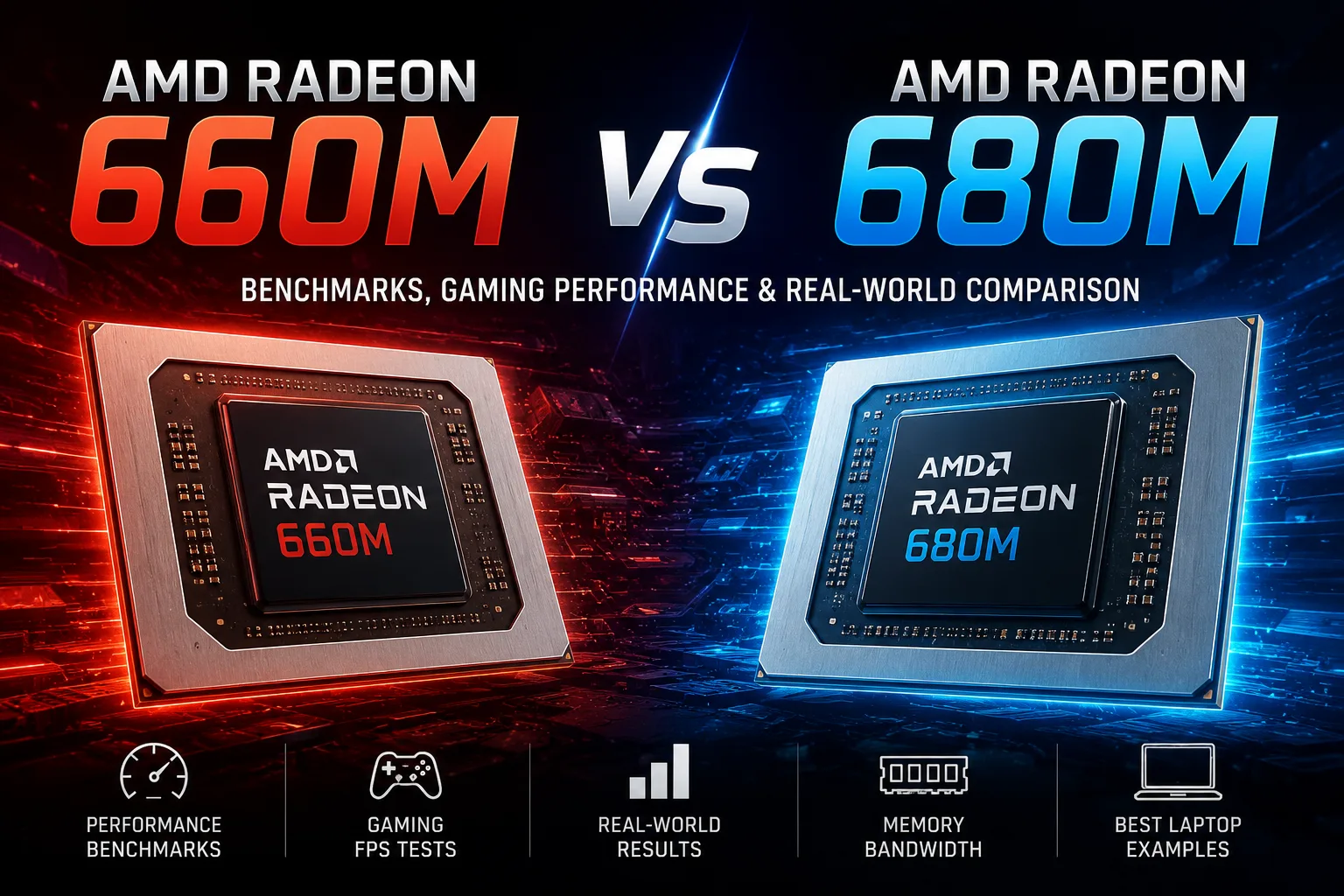
AMD Radeon 660M
vs
AMD Radeon 680M
GPU Comparison Result
AMD Radeon 660M vs Radeon 680M: How Much Faster is the 680M in Games and 3DMark
The AMD Radeon 660M and Radeon 680M utilize the same RDNA 2 architecture but belong to different levels of integrated graphics. The Radeon 680M has twice as many compute units and a higher clock speed. This does not result in double the performance, but in 3DMark, the advantage of the higher model typically reaches 45-55%. The specific result depends on RAM speed, power limits, and laptop cooling.
| Parameter | AMD Radeon 660M | AMD Radeon 680M |
|---|---|---|
| Architecture | RDNA 2 | RDNA 2 |
| Compute Units | 6 CU | 12 CU |
| Stream Processors | 384 | 768 |
| Max Clock Speed | up to 1900 MHz | up to 2200 MHz |
| Typical Processors | Ryzen 5 6600U, 6600H, 7535U | Ryzen 7 6800U, 6800H, 7735U |
| Main Class of Devices | Budget and office laptops | Performance laptops without discrete graphics |
Both models use system memory instead of their own video memory. Therefore, a laptop with fast LPDDR5-6400 can significantly outperform a device with DDR5-4800, even if they both have the same GPU.
Why the Radeon 680M is Not Twice as Fast
The Radeon 680M has double the compute units: 12 compared to 6. The clock speed is also higher-up to 2200 MHz instead of 1900 MHz. However, the performance of integrated graphics does not scale linearly with the number of compute units.
The CPU and GPU are housed in the same chip package and share a common power limit. Under simultaneous load, the system redistributes the available energy between CPU cores and graphics. In thin laptops, cooling becomes an additional limitation.
The bandwidth of the RAM does not increase with the number of compute units either. The Radeon 680M quickly hits the limits of DDR5 or LPDDR5, so some of its resources are not always fully utilized.
According to average test results, the Radeon 680M outperforms the Radeon 660M by about 53% in 3DMark Time Spy Graphics and by 46% in Fire Strike Graphics. This is a significant gap, but far from double.
Results in Specific Laptops
The table below shows the Graphics Score, not the overall 3DMark score. This reduces the influence of CPU core performance on the comparison.
| Integrated Graphics | Laptop and Processor | CPU Package Power Limits | Fire Strike Graphics | Time Spy Graphics |
|---|---|---|---|---|
| Radeon 660M | Lenovo ThinkPad L14 G5, Ryzen 5 7535U | 30 / 25 W | 3527 | 1016 |
| Radeon 660M | Lenovo ThinkPad Z13, Ryzen 5 PRO 6650U | up to 28 W | 4487 | 1588 |
| Radeon 660M | Lenovo IdeaPad 5 Pro 16ARH7, Ryzen 5 6600HS | 60 / 42 W | 4993 | 1580 |
| Radeon 680M | Asus Zenbook S 13 OLED, Ryzen 7 6800U | 30 / 25 W | 6683 | 2287 |
| Radeon 680M | Lenovo ThinkPad T14 G3, Ryzen 7 PRO 6850U | 30 / 25 W | 7050 | 2289 |
| Radeon 680M | HP Dragonfly Pro, Ryzen 7 7736U | 51 / 40 W | 7549 | 2607 |
The first value of the limit indicates short-term power, while the second indicates sustained power. This is the total power of the CPU package, within which the CPU and integrated graphics share the available watts.
The table shows that even a fast implementation of the Radeon 660M does not catch up to a typical Radeon 680M. The IdeaPad 5 Pro with the Ryzen 5 6600HS and a high power limit scored 4993 points in Fire Strike Graphics. The Asus Zenbook S 13 OLED with the Radeon 680M achieved 6683 points with significantly lower limits.
There is also considerable variation within a single model. The Radeon 660M in the ThinkPad L14 G5 scored only 1016 points in Time Spy Graphics, while in the ThinkPad Z13, the score reached 1588 points. The difference exceeds 50%, even though both graphics belong to the same model.
The HP Dragonfly Pro shows the upper limits of the Radeon 680M's capabilities. The high score was achieved not only due to LPDDR5-6400 but also due to aggressive CPU package limits of 51/40 W. Such graphics would perform slower in a thinner or quieter configured laptop.
Performance in Games
The Radeon 660M is primarily designed for less demanding games. It works best at resolutions of 1280 × 720 or 1600 × 900 with low settings. In esports titles, Full HD can be used, but the outcome heavily depends on the specific game and the laptop's memory.
The Radeon 680M operates much more confidently at 1920 × 1080. In older, networked, and moderately demanding games, low or medium settings are often available. In heavy modern titles, it still requires lowering graphics quality or enabling FSR.
The practical difference looks like this:
- where the Radeon 660M requires 720p and minimum preset, the Radeon 680M often allows for switching to 900p or 1080p;
- if the Radeon 660M delivers borderline frame rates, the Radeon 680M is more likely to provide a more stable result;
- in the most demanding games, both graphics remain a limited solution and do not replace a discrete graphics card.
The Radeon 680M is also better suited for working with graphic applications, hardware acceleration, and connecting high-resolution monitors. However, the performance gain depends on the software: not all tasks can utilize the additional compute units.
What to Check Before Buying a Laptop
The name of the integrated graphics does not guarantee a certain level of performance. Before purchasing, it is important to check:
- the type and speed of the RAM;
- whether the memory operates in dual-channel mode;
- power limits of the CPU;
- 3DMark results specifically for the chosen laptop model;
- device behavior under prolonged load;
- the possibility of upgrading the memory.
Particular caution should be taken with laptops that have a single memory stick or limited power limits. In such configurations, the Radeon 680M can lose a significant part of its advantages, while the Radeon 660M can drop to the level of much weaker integrated graphics.
Which Model to Choose
The Radeon 660M is suitable for office tasks, browsing, video watching, programming, and occasional undemanding gaming. It is justified in a budget laptop if graphical performance is not a primary criterion.
The Radeon 680M should be chosen for a laptop without a discrete graphics card that is intended for gaming or graphic applications. The difference of 45-55% is large enough to be felt not only in tests but also under real workloads.
Conclusion
The Radeon 680M is significantly faster than the Radeon 660M due to the doubled number of compute units and higher clock speed. On average, the higher graphics outperform the lower one by about 46% in Fire Strike and 53% in Time Spy.
There is no doubling of performance due to limited memory bandwidth, the shared power limit with the CPU, and cooling capabilities. Nevertheless, the Radeon 680M is a full step above: it handles Full HD better and provides more headroom in games and graphic applications.
The Radeon 660M remains a basic solution for business laptops. The Radeon 680M is a more suitable configuration for a device without a discrete graphics card.
Advantages
- Higher Boost Clock: 2200MHz (1900MHz vs 2200MHz)
- More Shading Units: 768 (384 vs 768)
Basic
Memory Specifications
Display and Media
Theoretical Performance
Miscellaneous
Benchmarks
Related GPU Comparisons


Share in social media
Or Link To Us
<a href="https://cputronic.com/gpu/compare/amd-radeon-660m-vs-amd-radeon-680m" target="_blank">AMD Radeon 660M vs AMD Radeon 680M</a>