Qualcomm Snapdragon 8s Gen 3
vs
MediaTek Dimensity 8500

SoC Comparison Result
Snapdragon 8s Gen 3 vs Dimensity 8500: Qualcomm is no longer the default favorite
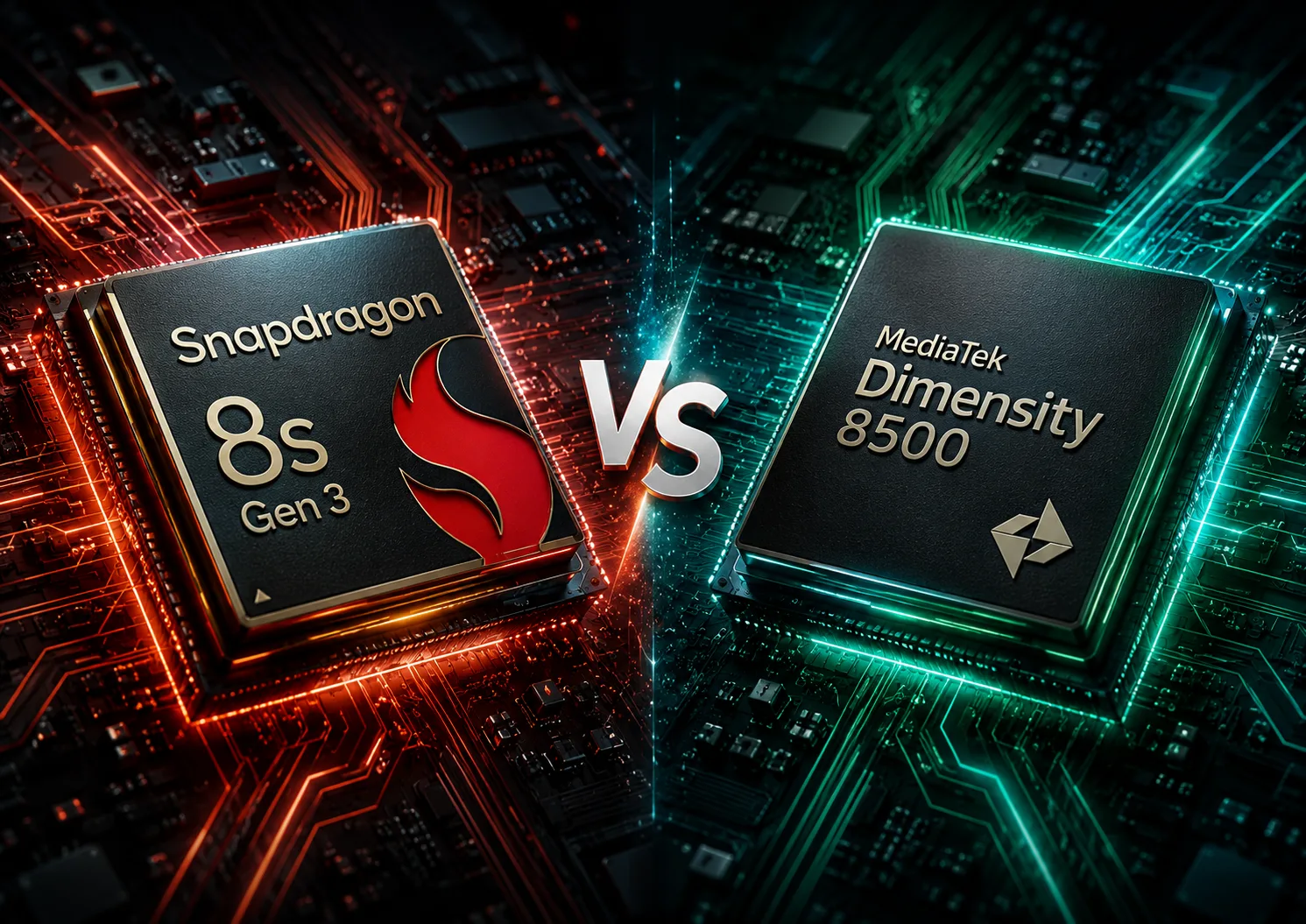
Snapdragon 8s Gen 3 and MediaTek Dimensity 8500 compete in the same class: powerful chips for mid-range smartphones that are often purchased as a more affordable alternative to true flagships. However, their approaches are different. Qualcomm relies on a proven platform: Adreno graphics, strong connectivity, Wi-Fi 7, X70 modem, and good gaming compatibility. MediaTek counters with a newer CPU architecture, high multi-threaded performance, fast memory, and aggressive benchmark results.
The Snapdragon 8s Gen 3 officially supports CPU frequencies up to 3.0 GHz, features the Snapdragon X70 modem, and Wi-Fi 7 through FastConnect 7800. The Dimensity 8500 uses a fully performant configuration with Cortex-A725 cores, supports LPDDR5X at 9600 Mbps, UFS 4 + MCQ, and Wi-Fi 6E.
In brief: who is better
In terms of pure performance, Dimensity 8500 looks stronger. It scores higher on AnTuTu, has a more powerful multi-threaded CPU, and noticeably better GPU Compute. This chip is for those who want the maximum speed in its price range.
Snapdragon 8s Gen 3 is not just about the numbers. Its strength lies in the Qualcomm platform: Adreno graphics, mature drivers, Wi-Fi 7, X70 modem, good gaming support, and predictable behavior in global smartphones.
Therefore, the correct conclusion is: Dimensity 8500 is more powerful as hardware, Snapdragon 8s Gen 3 is more reliable as a ready-made platform.
Key Differences
| Parameter | Snapdragon 8s Gen 3 | Dimensity 8500 |
|---|---|---|
| Class | sub-flagship / affordable premium | fresh MediaTek sub-flagship |
| CPU | 1x Cortex-X4 3.0 GHz + 4x Cortex-A720 2.8 GHz + 3x Cortex-A520 2.0 GHz | 1x Cortex-A725 3.4 GHz + 3x Cortex-A725 3.2 GHz + 4x Cortex-A725 2.2 GHz |
| Core Approach | one powerful X-core + mid and small cores | all cores of the high-performance Cortex-A725 |
| GPU | Adreno 735 | Mali-G720 MC8 |
| Memory | LPDDR5X | LPDDR5X up to 9600 Mbps |
| Storage | UFS 3.1 / UFS 4.0 | UFS 4 + MCQ |
| Connectivity | Snapdragon X70, Wi-Fi 7 | 5G-Advanced, Wi-Fi 6E |
| Strong Point | gaming, connectivity, drivers, stability | multi-threading, AnTuTu, GPU Compute, fresh architecture |
Architecture: Qualcomm bets on balance, MediaTek on punch
Snapdragon 8s Gen 3 uses a classic hybrid architecture: one powerful Cortex-X4 core, four Cortex-A720, and three energy-efficient Cortex-A520. This is a good option for mixed tasks: interface, browser, camera, gaming, background processes, and standard multitasking. It has a strong main core, so in tasks where single-thread speed is crucial, Snapdragon performs very confidently.
Dimensity 8500 is more aggressive. It lacks small Cortex-A5xx cores: all eight cores belong to Cortex-A725, but are divided into groups with different frequencies and cache sizes. The top core operates up to 3.4 GHz, the next three cores up to 3.2 GHz, and the four lower-performance cores up to 2.2 GHz.
This is not “eight identical big cores,” but a performance architecture with varying levels of power. This approach reveals its strengths especially well in multi-threaded tasks, where the load is distributed across several cores at once.
Performance: Dimensity 8500 significantly ahead in multi-threading
In averaged benchmarks, Dimensity 8500 looks more powerful. In AnTuTu 11, it scores around 2.15 million points, while Snapdragon 8s Gen 3 scores around 1.8 million. In Geekbench 6, the situation is more nuanced: Snapdragon is faster in single-core tasks, but Dimensity is significantly stronger in multi-core performance. GPU Compute is also higher for MediaTek.
| Benchmark | Snapdragon 8s Gen 3 | Dimensity 8500 |
|---|---|---|
| AnTuTu 11 | ~1 795 718 | ~2 153 969 |
| Geekbench 6 Single-Core | ~1938 | ~1721 |
| Geekbench 6 Multi-Core | ~5143 | ~6716 |
| Geekbench 6 GPU Compute | ~9182 | ~13 461 |
The practical implication is this: Snapdragon 8s Gen 3 is faster in tasks where one powerful thread is important - for example, in certain interface scenarios, browsers, and quick short operations. Dimensity 8500 is better suited for long multi-threaded workloads: processing photos and videos, heavy multitasking, archiving, AI tasks, and applications that can load several cores simultaneously.
Gaming: Dimensity is stronger in hardware, Snapdragon is calmer in compatibility
On paper, Dimensity 8500 looks very powerful: Mali-G720 MC8, high GPU Compute, and an overall AnTuTu score higher than Snapdragon 8s Gen 3. This provides a good foundation for demanding games, especially if the smartphone has decent cooling and the manufacturer hasn't restricted power limits.
However, in gaming, one cannot only look at bare numbers. Snapdragon 8s Gen 3 has Adreno, which is an important advantage. Many games, emulators, and graphical modes are better optimized on Qualcomm. Therefore, in a real smartphone, Snapdragon may turn out to be more stable, especially if the specific model has better cooling, firmware, and performance optimization.
It can be phrased more accurately as: Dimensity 8500 is potentially faster, but Snapdragon 8s Gen 3 may be more predictable. If the manufacturer has sufficiently cooled the Dimensity 8500, it will be very strong. If cooling is inadequate, the advantage in benchmarks quickly diminishes.
Cameras, connectivity, and platform
Snapdragon 8s Gen 3 is stronger specifically as a complete platform. It features the Snapdragon X70 modem, with claimed download speeds of up to 6.5 Gbps, Wi-Fi 7 through FastConnect 7800, an 18-bit ISP, and Snapdragon Elite Gaming technologies. For global smartphones, this is important: lower risk with compatibility, more stable gaming behavior, more familiar camera processing, and stronger wireless capabilities.
Dimensity 8500 also doesn’t look weak. It features 5G-Advanced, camera support up to 320 MP, 4K60 recording, AV1 playback, NPU 880, WQHD+ support up to 144 Hz, and fast LPDDR5X memory at 9600 Mbps. But in terms of wireless capabilities, Qualcomm has a formal advantage: Snapdragon 8s Gen 3 supports Wi-Fi 7, while Dimensity 8500 supports Wi-Fi 6E.
For most users, this may not be a decisive factor, but when comparing platforms, Qualcomm still has the edge here.
Smartphones and real purchase
Snapdragon 8s Gen 3 is already well represented in global models. It can be seen, for instance, in POCO F6, Realme GT 6, Xiaomi 14 Civi, and Motorola Edge 50 Ultra. This is a plus: there are already reviews, battery testing, gaming measurements, and a clear picture regarding firmware for these devices.
Dimensity 8500 is newer, so there is currently more variability regarding specific devices and versions. The standard Dimensity 8500, Ultra versions, Elite, and regional variants may differ in settings, cooling, and performance in tests. Therefore, when purchasing a smartphone with Dimensity 8500, it is especially important to look not only at the chip but also at the specific model: battery, cooling system, screen brightness, memory, firmware, and actual stress tests.
What to Choose
Opt for Snapdragon 8s Gen 3 if stable gaming, Adreno graphics, Wi-Fi 7, strong connectivity, global firmware, and predictable behavior are important. It may not be the newest chip in terms of numbers, but it remains a very balanced option.
Opt for Dimensity 8500 if you want maximum performance for your money. It excels in multi-threading, scores higher in AnTuTu, performs better in GPU Compute, and looks more promising for demanding tasks. It should especially shine in smartphones with large batteries and decent cooling solutions.
Conclusion
Dimensity 8500 appears more powerful as a processor in this comparison. It is newer, faster in multi-threaded tasks, and stronger in overall synthetic performance. Snapdragon 8s Gen 3 can no longer be considered the best just because it's Qualcomm.
However, Snapdragon 8s Gen 3 remains a safer choice as a platform. It features Adreno graphics, Wi-Fi 7, X70 modem, good gaming compatibility, and many already released global smartphones.
If maximum power is needed, Dimensity 8500 is more interesting. If stability, gaming, connectivity, and a proven platform are more important, Snapdragon 8s Gen 3 is still a very strong option.
Advantages
- Higher Frequency: 3400 MHz (3000 MHz vs 3400 MHz)
- Newer Launch Date: January 2026 (March 2024 vs January 2026)
Basic
4x 2.8 GHz – Cortex-A720
3x 2.0 GHz – Cortex-A520
GPU Specifications
Connectivity
Memory Specifications
Miscellaneous
Benchmarks
Comparison of Devices
Related SoC Comparisons



Share in social media
Or Link To Us
<a href="https://cputronic.com/en/soc/compare/qualcomm-snapdragon-8s-gen-3-vs-mediatek-dimensity-8500" target="_blank">Qualcomm Snapdragon 8s Gen 3 vs MediaTek Dimensity 8500</a>