Qualcomm Snapdragon 8 Gen 4
vs
MediaTek Dimensity 8300

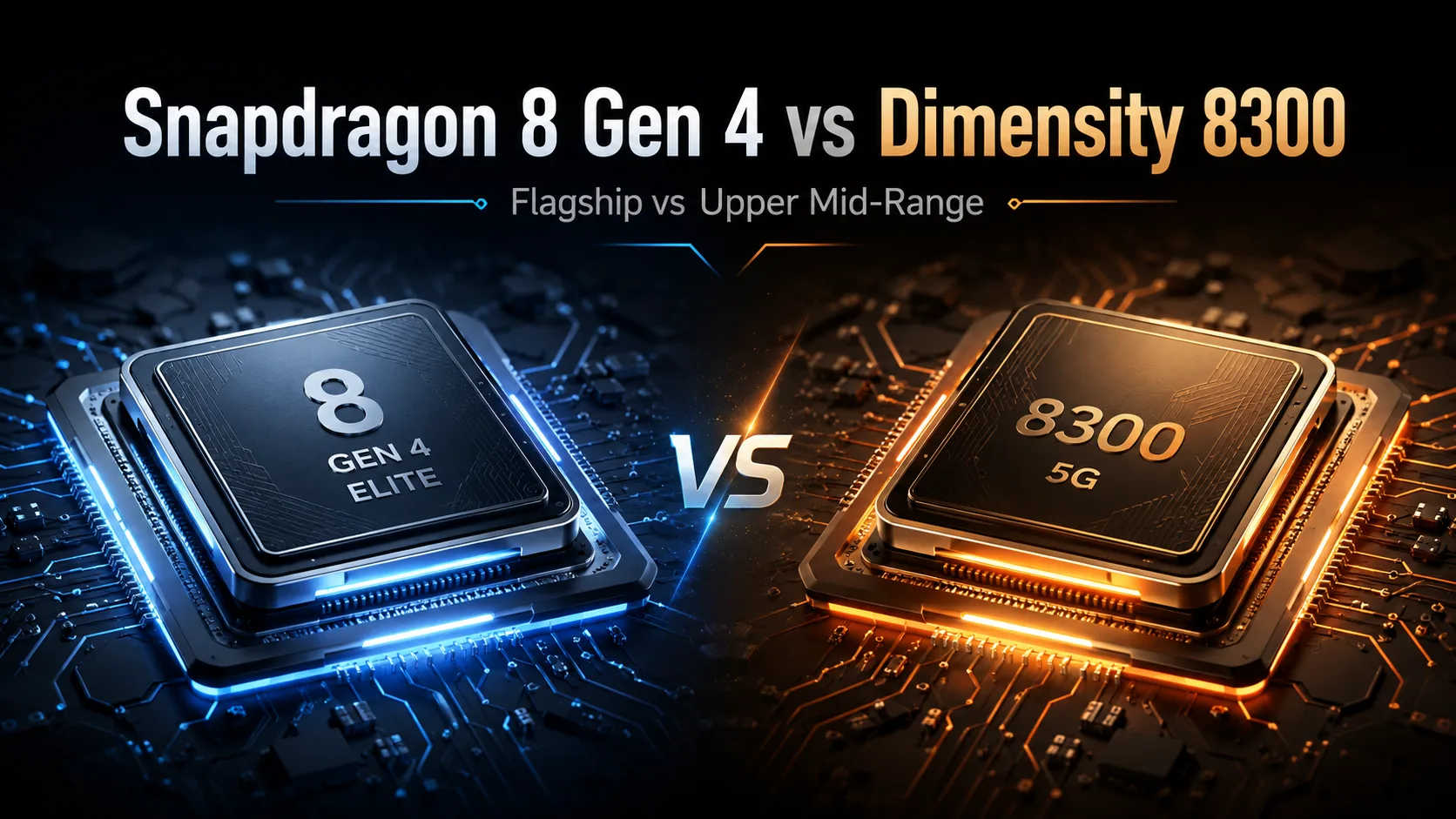
SoC Comparison Result
Qualcomm Snapdragon 8 Gen 4 vs MediaTek Dimensity 8300: flagship vs strong mid-range
Snapdragon 8 Gen 4 is the working title of the chip that was released as Snapdragon 8 Elite. Qualcomm has moved away from the "Gen 4" naming scheme; the generation received a new CPU architecture called Oryon, and the company positioned it as a larger leap rather than just an usual annual update.
MediaTek Dimensity 8300 is of a lower class. It is not a direct competitor to Snapdragon 8 Elite, but one of the strongest chips in the upper mid-range segment. Therefore, the comparison here is not about an equal fight, but rather about the difference between a flagship platform and a more affordable yet fast chip.
Difference in Class
Snapdragon 8 Elite is designed for expensive flagship smartphones. It features custom Qualcomm Oryon cores, Adreno graphics, a powerful Hexagon NPU, Snapdragon X80 modem, and support for Wi-Fi 7. This is a platform for gaming, heavy applications, AI processing, camera usage, and longevity for several years.
Dimensity 8300 is a lower class, but remains modern regarding memory, storage, and wireless interfaces. It uses 4 Cortex-A715 cores, 4 Cortex-A510 cores, Mali-G615 MC6 graphics, LPDDR5X memory up to 8533 Mbps, and UFS 4.0 + MCQ storage. For the upper mid-range, this is a successful combination: fast interface, quick application launch, and sufficient capacity for modern games at medium and high settings, depending on the project.
Here, different classes of devices are being compared. Snapdragon 8 Elite is chosen for maximum performance. Dimensity 8300 is selected for high speed without flagship pricing.
CPU: Snapdragon Moves to a Different Class
The most noticeable gap can be seen in the CPU. Snapdragon 8 Elite uses Oryon cores with frequencies up to 4.47 GHz. Dimensity 8300 is based on a combination of Cortex-A715 and Cortex-A510. For the upper mid-range, such a CPU is still strong, but it cannot compete on equal footing with the Oryon in Snapdragon 8 Elite.
Snapdragon wins particularly in single-core performance. This impacts not only Geekbench scores. High single-core performance aids in browser usage, heavy applications, emulators, photo processing, handling complex tasks, and system responsiveness under load.
In regular tasks, Dimensity 8300 does not create an impression of a weak chip. However, in gaming, emulators, photo processing, and sustained load, Snapdragon 8 Elite provides a greater CPU reserve for several years.
Graphics and Gaming
In gaming, the gap is even more pronounced. Adreno in Snapdragon 8 Elite is better suited for high settings, high FPS, and demanding scenes. Here, Snapdragon is not just faster than Dimensity 8300; it also has more headroom in graphics, stability, and new games with heavier graphics.
Dimensity 8300 with Mali-G615 MC6 handles most popular games and runs demanding projects, but often requires lowering settings. It is also more dependent on the device’s cooling; in a thin body or during extended gaming, FPS reserves will be lower.
The main limitation of Dimensity 8300 compared to Snapdragon remains the graphics. The CPU in Dimensity 8300 is still sufficient for its class, but in gaming, the flagship Adreno offers a different level of performance.
Memory and Storage
Dimensity 8300 does not behave like a budget platform in regular use. LPDDR5X up to 8533 Mbps and UFS 4.0 + MCQ help in quickly opening applications, installing games, switching between tasks, and ensuring the system is not limited by a slow storage device.
Therefore, in everyday scenarios, the difference between chips will be less noticeable than in tests. Messengers, browsers, cameras, YouTube, social networks, and most applications do not require the level of Snapdragon 8 Elite. Snapdragon is more noticeable where high peak power, sustained load, or maximum gaming headroom is needed.
Camera, Video, and AI
Dimensity 8300 supports the necessary camera and video capabilities for its class: sensors up to 320 MP, 14-bit HDR-ISP, 4K video, Video HDR, stabilization, noise reduction, and AI functions for autofocus, exposure, and white balance.
Snapdragon 8 Elite offers a stronger image processing unit. It has more capabilities for AI photo and video processing, semantic segmentation, low-light shooting enhancement, and extended post-processing of images. Still, the final camera quality ultimately depends on the sensor, optics, and specific smartphone processing.
In AI scenarios, Snapdragon is also ahead. Dimensity 8300 supports local AI functions, but Snapdragon 8 Elite offers greater headroom for generative functions, photo and video processing, and future AI capabilities in Android.
Connectivity and Platform
Snapdragon 8 Elite excels in connectivity: Snapdragon X80 modem, peak 5G speeds of up to 10 Gbps, and Wi-Fi 7. Dimensity 8300 supports 5G up to 5.17 Gbps, Wi-Fi 6E, and Bluetooth 5.4.
Dimensity 8300 is sufficient for regular 5G, Wi-Fi, and Bluetooth, but it falls short of Snapdragon regarding maximum modem speeds and Wi-Fi 7 support. In terms of wireless capabilities, Snapdragon is a higher class.
Benchmarks
| Test | Snapdragon 8 Elite / 8 Gen 4 | Dimensity 8300 / 8300-Ultra | Approximate Difference |
|---|---|---|---|
| Geekbench 6 Single-Core | around 2700-3000+ | around 1150-1300 | Snapdragon is about 2.2-2.5 times faster |
| Geekbench 6 Multi-Core | around 8300-9400 | around 3800-4200 | Snapdragon is about twice as fast |
| AnTuTu 10 | around 2.5-2.8 million | around 1.3-1.5 million | Snapdragon is about 70-100% faster |
| Graphics tests | flagship level Adreno | upper mid-range level Mali-G615 MC6 | Snapdragon is noticeably stronger in games |
Benchmarks confirm the class difference. Snapdragon 8 Elite is almost twice as fast in the overall score and significantly outpaces in single-core performance. Dimensity 8300 remains fast for its price, but it can no longer contend for leadership against flagship Snapdragon.
Exact figures depend on the smartphone, cooling, test version, and manufacturer settings. However, the overall picture is stable: Snapdragon 8 Elite is significantly faster in CPU, noticeably more powerful in GPU, and belongs to a different class regarding overall performance.
What to Choose
Snapdragon 8 Elite / Snapdragon 8 Gen 4 is suitable for those who need a flagship smartphone with maximum headroom. It is better for heavy gaming, sustained loads, emulators, AI functions, advanced cameras, fast connectivity, and a purchase intended for several years.
Dimensity 8300 is more advantageous if the smartphone price is important. It noticeably lags behind Snapdragon 8 Elite, but provides a fast interface, modern memory, UFS 4.0, quick app functionality, and gaming capabilities with medium and high settings in most projects.
In summary: Snapdragon 8 Elite is the choice for maximum performance, while Dimensity 8300 is for purchasing without overpaying for a flagship. If the best gaming and processing headroom is needed, Snapdragon remains notably ahead. Dimensity 8300 may fall short against the flagship, but it remains one of the best options within the lower premium segment.
Advantages
- Higher Technology: 3 nm (3 nm vs 4 nm)
- Higher Frequency: 4000 MHz (4000 MHz vs 3350 MHz)
- Newer Launch Date: October 2024 (October 2024 vs November 2023)
Basic
6x 0 GHz – Cortex-A730
3x 3.2 GHz – Cortex-A715
4x 2.2 GHz – Cortex-A510
GPU Specifications
Connectivity
Memory Specifications
Miscellaneous
Benchmarks
Related SoC Comparisons




Share in social media
Or Link To Us
<a href="https://cputronic.com/en/soc/compare/qualcomm-snapdragon-8-gen-4-vs-mediatek-dimensity-8300" target="_blank">Qualcomm Snapdragon 8 Gen 4 vs MediaTek Dimensity 8300</a>