Qualcomm Snapdragon 8 Gen 3
vs
MediaTek Dimensity 8500

SoC Comparison Result
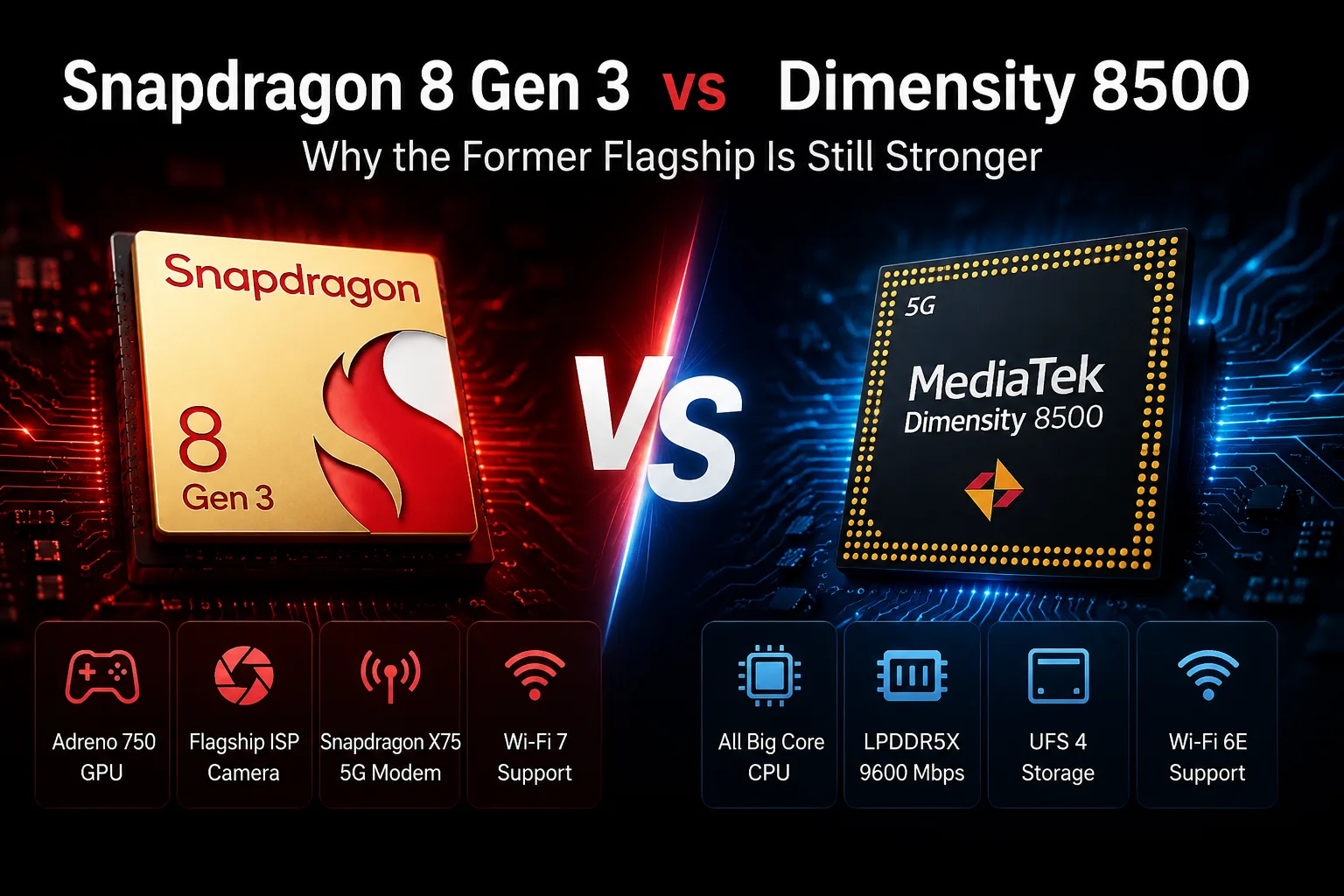
Snapdragon 8 Gen 3 vs Dimensity 8500: Why the Former Flagship Still Prevails
Snapdragon 8 Gen 3 is older than Dimensity 8500, but this does not make it weaker. Qualcomm released it as a flagship chip, while Dimensity 8500 is aimed at more affordable smartphones. Therefore, comparing them solely based on their release years isn't adequate; key factors include graphics, modem, ISP, memory, and performance under sustained loads.
Dimensity 8500 approaches Snapdragon 8 Gen 3 in multi-core tests and supports fast memory, but Qualcomm excels in graphics, camera functionality, connectivity, and single-core performance.
| Parameter | Snapdragon 8 Gen 3 | Dimensity 8500 |
|---|---|---|
| Segment | flagship | upper mid-range |
| CPU Architecture | Cortex-X4 + A720 + A520 | 8 Cortex-A725 cores |
| CPU Strength | single-core and peak performance | multi-core and newer architecture |
| Graphics | Adreno 750 | Mali-G720 MC8 |
| Memory | flagship LPDDR5X/UFS configurations | LPDDR5X 9600 Mbps, UFS 4 |
| Connectivity | Snapdragon X75, Wi-Fi 7 | 5G, Wi-Fi 6E |
| Competitive Edge | gaming, camera, video, connectivity | price, multi-core, new models cheaper than flagships |
CPU: Cortex-X4 vs Eight Cortex-A725
Snapdragon 8 Gen 3 utilizes a 1+5+2 configuration: one Cortex-X4 core, five Cortex-A720 cores, and two Cortex-A520 cores. This setup provides high single-core speed and reduces power consumption during light tasks.
In contrast, Dimensity 8500 follows a different approach. MediaTek opts for an All Big Core scheme: all eight cores belong to the Cortex-A725 family but operate at various frequencies. The top core reaches up to 3.4 GHz, three others up to 3.2 GHz, and the remaining four up to 2.2 GHz.
Thus, in multi-core performance, Dimensity 8500 nears Snapdragon 8 Gen 3 more closely than in single-core performance. In single-threaded tasks, Qualcomm holds the advantage. The Cortex-X4 is a more powerful flagship-level core and is better suited for short peak tasks: launching applications, browsing, interface interactions, and some gaming scenarios.
The performance difference in benchmarks can be summarized as follows:
| Test | Snapdragon 8 Gen 3 | Dimensity 8500 |
|---|---|---|
| Geekbench 6 Single-Core | around 2300 | around 1600-1750 |
| Geekbench 6 Multi-Core | around 7300-7500 | around 6600-6800 |
| AnTuTu 11 | around 2.3 million | around 2.1 million |
These figures should be taken as estimates rather than fixed specifications. The results depend on the smartphone, cooling solutions, firmware, and test versions. Overall, the picture is clear: Dimensity 8500 is closer in multi-threaded performance, while Snapdragon 8 Gen 3 is significantly stronger in single-threaded tasks.
Graphics: Snapdragon's Main Advantage
While the CPU gap is not always apparent, the graphics difference is crucial for real-world smartphone choices. Snapdragon 8 Gen 3 features the Adreno 750 GPU-a flagship-level graphics processor with ample headroom for demanding games, high settings, emulators, and prolonged gaming sessions.
Dimensity 8500 comes equipped with the Mali-G720 MC8. For its segment, this is a strong GPU, but it doesn't quite reach Adreno 750 levels. In typical gaming scenarios, Dimensity 8500 will suffice, but under maximum settings and during extended sessions, Qualcomm's advantage will be more evident.
Another plus for Snapdragon is the optimization for Adreno in games and emulators. This isn't always noticeable in synthetic benchmarks but is significant in real-world usage.
Memory and Storage: Dimensity 8500 Looks Modern
Dimensity 8500 supports fast LPDDR5X memory up to 9600 Mbps and UFS 4. For a non-flagship chip, this is a strong configuration. Fast memory is beneficial for gaming, photo processing, AI functions, and video recording.
Snapdragon 8 Gen 3 is also found in smartphones with fast storage and flagship-level memory. However, much of this varies by model: manufacturers may choose different memory chips, capacities, cooling solutions, and power limits.
In terms of memory and storage, Dimensity 8500 does not appear outdated alongside Snapdragon 8 Gen 3, even though it belongs to a lower segment.
Camera, Video, and Connectivity: Snapdragon’s Edge
The CPU and GPU do not reveal the full differences between these chips. In smartphones, the ISP, modem, Wi-Fi, and photo/video processing play essential roles. Here, Snapdragon 8 Gen 3 is stronger.
Snapdragon 8 Gen 3 features a flagship ISP, the Snapdragon X75 modem, and Wi-Fi 7. This is crucial for camera phones, stable connectivity, fast data transfer, HDR video, and real-time frame processing.
Dimensity 8500 has a simpler but still capable setup: supporting cameras up to 320 MP, 4K60 video, AV1 playback, Wi-Fi 6E, and Bluetooth 5.4. These specifications are sufficient for more budget-friendly devices. However, Snapdragon 8 Gen 3 is designed for premium models, evident in its multimedia and communication capabilities.
What to Choose
Snapdragon 8 Gen 3 is better suited for demanding gaming, emulators, camera phones, video recording, and tasks where single-core speed matters. A notable plus is Wi-Fi 7. Additionally, there is a broader selection of smartphones and numerous real-world tests available.
Dimensity 8500 makes more sense in models below the flagship segment. It provides a modern CPU, fast multi-core performance, LPDDR5X, UFS 4, and adequate graphics for everyday gaming. Its limitations will become apparent not in the interface but in demanding graphics, camera capabilities, connectivity, and lengthy gaming sessions.
Conclusion
Snapdragon 8 Gen 3 is older but remains stronger in terms of overall specifications. It has higher single-core performance, more powerful graphics, a better modem, a superior multimedia subsystem, and a wider selection of flagship smartphones.
Dimensity 8500 is a robust chip for models below flagship level. MediaTek emphasizes a new CPU architecture, fast memory, and high multi-core performance in more affordable smartphones. However, Dimensity 8500 does not fully replace Snapdragon 8 Gen 3. If maximum performance for gaming, camera, and connectivity is required, Snapdragon is the better choice. If price and quick everyday responsiveness are more important, Dimensity 8500 appears more practical.
Advantages
- Higher Frequency: 3400 MHz (3300 MHz vs 3400 MHz)
- Newer Launch Date: January 2026 (October 2023 vs January 2026)
Basic
5x (3x3.2 GHz/2x3.0GHz) – Cortex-A720
2x 2.3 GHz – Cortex-A520
GPU Specifications
Connectivity
Memory Specifications
Miscellaneous
Benchmarks
Comparison of Devices
Related SoC Comparisons



Share in social media
Or Link To Us
<a href="https://cputronic.com/en/soc/compare/qualcomm-snapdragon-8-gen-3-vs-mediatek-dimensity-8500" target="_blank">Qualcomm Snapdragon 8 Gen 3 vs MediaTek Dimensity 8500</a>