Qualcomm Snapdragon 8 Gen 3
vs
MediaTek Dimensity 8300

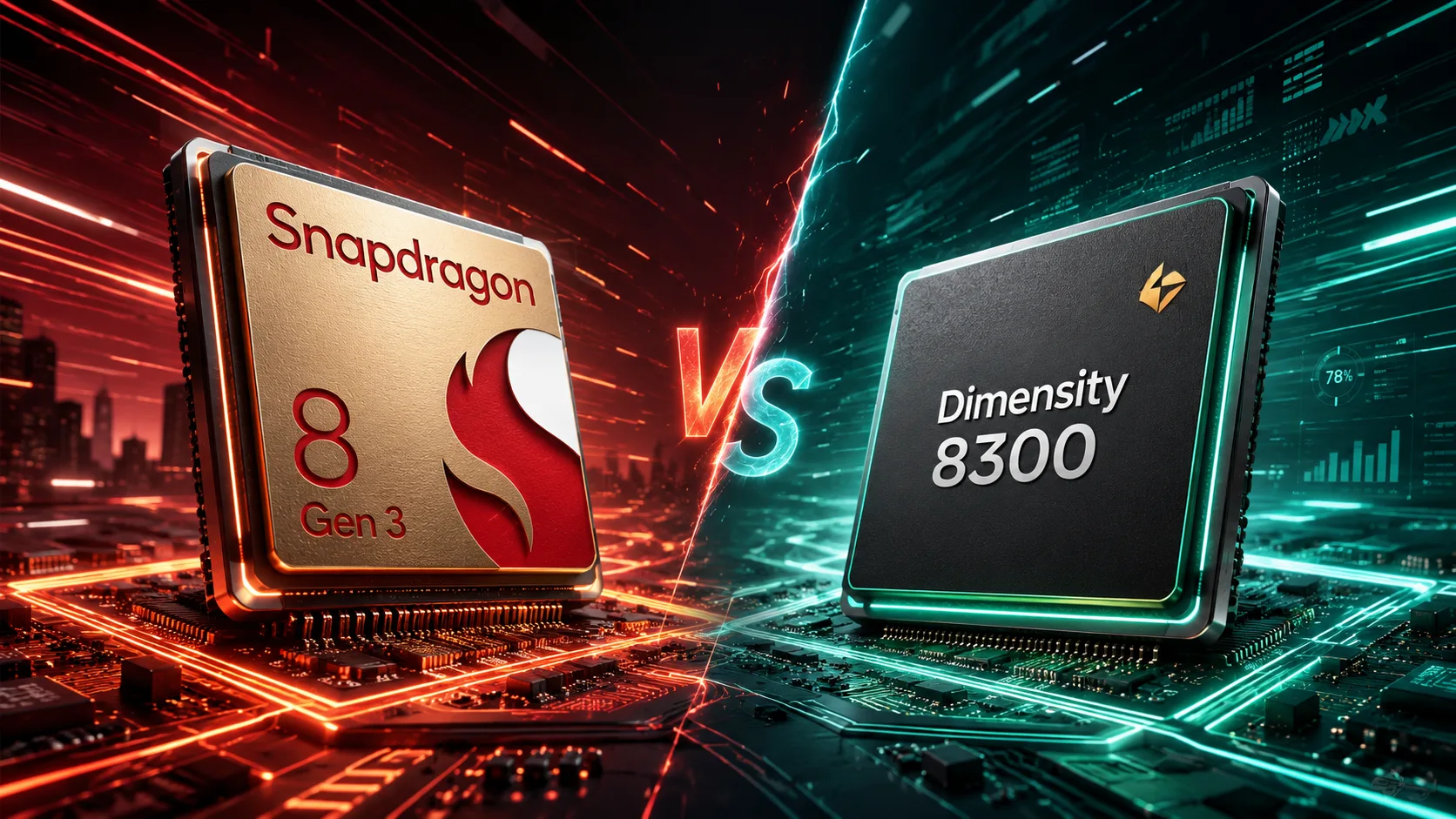
SoC Comparison Result
Snapdragon 8 Gen 3 vs Dimensity 8300: Performance Comparison
The Snapdragon 8 Gen 3 and Dimensity 8300 were released around the same time and are manufactured using a 4nm process, but they belong to different classes. Qualcomm is aimed at high-end flagship devices, whereas MediaTek is more commonly found in upper mid-range smartphones.
Therefore, the main question is not which processor is faster: Snapdragon clearly excels in CPU performance and particularly in graphics. It is more important to understand whether this advantage justifies the higher cost of the device, considering that the Dimensity 8300 already offers LPDDR5X, UFS 4.0, and adequate speed for most games.
Key Differences
| Parameter | Snapdragon 8 Gen 3 | Dimensity 8300 | Practical Significance |
|---|---|---|---|
| Class | Flagship | Upper Mid-Range | Snapdragon is more commonly found in more expensive devices |
| CPU | 1 × Cortex-X4, 5 × Cortex-A720, 2 × Cortex-A520 | 4 × Cortex-A715, 4 × Cortex-A510 | Qualcomm has a more powerful main core and more performance cores |
| Maximum Frequency | Up to 3.3 GHz for the standard version | Up to 3.35 GHz | Close frequencies do not imply the same performance |
| Graphics | Adreno 750 | Mali-G615 MC6 | Snapdragon's main advantage is revealed in demanding games |
| Memory and Storage | LPDDR5X, UFS 4.0 | LPDDR5X, UFS 4.0 with MCQ | Both platforms provide fast application loading in everyday use |
| Video Recording | Up to 8K at 30 FPS, 4K at 120 FPS | Up to 4K at 60 FPS | Snapdragon offers more video recording options |
| Wireless Network | Wi-Fi 7 | Wi-Fi 6E | The difference matters only when a compatible router is available |
| 5G | Snapdragon X75, sub-6 and mmWave | Sub-6, up to 5.17 Gbps | Qualcomm's modem is technologically superior |
The Snapdragon 8 Gen 3 features Cortex-X4 and Cortex-A720, Adreno 750 graphics, X75 modem, and FastConnect 7800. The Dimensity 8300 includes four Cortex-A715, four Cortex-A510, Mali-G615 MC6, APU 780, and supports UFS 4.0.
CPU Performance
| Test | Snapdragon 8 Gen 3 | Dimensity 8300 | Snapdragon Advantage |
|---|---|---|---|
| Geekbench 6 Single Core | 2192 | 1506 | 46% |
| Geekbench 6 Multi Core | 7085 | 4844 | 46% |
| AnTuTu 10 | 1,933,536 | 1,518,170 | 27% |
In Geekbench 6, Snapdragon is about 46% faster in both single and multi-core modes. In AnTuTu, the difference narrows to 27% because the comprehensive test considers not only the CPU but also graphics, memory, storage, and interface speed.
The advantage cannot be explained solely by frequency. Snapdragon has a powerful main core, the Cortex-X4, along with five Cortex-A720 cores. The Dimensity 8300 utilizes four Cortex-A715 from the previous generation and relies more on the energy-efficient Cortex-A510 cluster after their utilization.
In browsers, social media, and regular applications, the difference often gets masked by a fast storage drive and sufficient memory. It becomes more apparent during video exports, processing large photos, unpacking archives, installing apps, and sustained multi-threaded workloads.
What Specific Devices Show
The results of actual smartphones are usually lower than the average figures for the platform. Factors affecting them include the version of Geekbench, firmware, temperature, power mode, and manufacturer's restrictions.
| Device | Processor | Geekbench 6 Single | Geekbench 6 Multi |
|---|---|---|---|
| ASUS Zenfone 11 Ultra | Snapdragon 8 Gen 3 | around 2180 | around 6850 |
| Xiaomi 14 Ultra | Snapdragon 8 Gen 3 | around 2090 | around 6480 |
| OnePlus 12 | Snapdragon 8 Gen 3 | around 1890 | around 6060 |
| Lenovo Idea Tab Pro | Dimensity 8300 | around 1400 | around 4400-4500 |
| Xiaomi 14T | Dimensity 8300-Ultra | around 1340 | around 4250 |
| POCO X6 Pro | Dimensity 8300-Ultra | around 1170 | around 3840 |
For the Zenfone 11 Ultra, Xiaomi 14 Ultra, OnePlus 12, and POCO X6 Pro, aggregated results from the Geekbench database are provided. For the Xiaomi 14T and Lenovo Idea Tab Pro, characteristic runs were used, so the figures should be considered as a guideline rather than a definitive ranking of the models.
Even among Snapdragon smartphones, the difference in multi-core tests reaches about 13%. The variability among devices utilizing Dimensity is even broader. This illustrates why the result from a single run cannot be automatically applied to all models with the same processor.
The designation Dimensity 8300-Ultra is used by Xiaomi and POCO. The CPU configuration remains the same: one Cortex-A715 up to 3.35 GHz, three more up to 3.2 GHz, and four Cortex-A510 up to 2.2 GHz.
The Lenovo Idea Tab Pro differs from smartphones not only in casing. The tablet has Mali-G615 MC5 graphics, while the POCO X6 Pro and Xiaomi 14T use MC6. Therefore, its graphics results cannot be considered a full demonstration of the maximum capabilities of Dimensity 8300.
Graphics and Gaming
The main advantage of Snapdragon 8 Gen 3 is Adreno 750. In Geekbench Vulkan, the OnePlus 12 scores about 16,300 points, while the POCO X6 Pro gets around 5,000. A synthetic test cannot be directly translated into FPS, but the gap clearly demonstrates the margin of graphical power.
With Dimensity 8300, most mobile games can be run at high settings and 60 FPS. Limitations arise in demanding projects, especially when simultaneously increasing resolution, quality of effects, and frame rates.
Snapdragon is better suited for:
- maximum graphic settings;
- displays with 90-144 Hz refresh rates;
- emulators;
- hardware ray tracing;
- prolonged gaming sessions.
Mali-G615 MC6 also supports hardware ray tracing but has a smaller headroom. In the most demanding games, users of devices with Dimensity often have to lower individual settings for stable 60 FPS. MediaTek officially claims support for hardware ray tracing and HyperEngine gaming technologies, but in terms of pure performance, Adreno 750 remains significantly ahead.
Snapdragon also offers a practical advantage in emulators: Adreno is better supported by alternative drivers and more often receives optimizations for Vulkan. However, the outcome still depends on the specific game and software version.
Heating and Stability
Both processors are manufactured according to TSMC's 4nm standards, but an identical process does not guarantee the same heating. Snapdragon is faster and capable of consuming more power under full load, so it is particularly important for it to have quality cooling.
In a major flagship or gaming smartphone, Snapdragon maintains high frequencies longer. In a thin case, part of the advantage may diminish after a few minutes of gaming due to thermal limits.
Dimensity 8300 has lower peak performance but allows manufacturers to keep it within a more moderate power envelope. This does not make the chip automatically cooler or more energy-efficient; battery life also depends on the screen, battery capacity, modem, and firmware settings.
When choosing a gaming smartphone, it is more important to look at FPS stability after 15-30 minutes of load, rather than the maximum result of a short test.
Camera, Video, and Connectivity
Dimensity 8300 formally supports cameras with resolutions up to 320 MP, while Snapdragon 8 Gen 3 supports up to 200 MP. These figures say little about photo quality: the outcome is determined by the sensor, optics, stabilization, and manufacturer's algorithms.
In video recording, the advantage of Snapdragon is more pronounced. The platform supports 8K recording at 30 FPS and 4K at 120 FPS, while Dimensity 8300 is limited to 4K at 60 FPS. The smartphone manufacturer may not implement all available modes, but Qualcomm's platform offers more possibilities.
Snapdragon also offers Wi-Fi 7, mmWave, and theoretical 5G download speeds of up to 10 Gbps. Dimensity is limited to Wi-Fi 6E and sub-6 networks with speeds up to 5.17 Gbps. For most users, the difference is secondary: real speed is defined by the carrier, coverage, and router.
In Which Devices the Processors Are Found
Snapdragon 8 Gen 3 is primarily found in flagship models:
- Samsung Galaxy S24 Ultra;
- Xiaomi 14 and Xiaomi 14 Ultra;
- OnePlus 12;
- Honor Magic6 Pro;
- ASUS Zenfone 11 Ultra;
- ASUS ROG Phone 8;
- REDMAGIC 9 Pro.
Dimensity 8300 is found in more affordable smartphones and tablets:
- POCO X6 Pro;
- Xiaomi 14T;
- Redmi K70E;
- Lenovo Idea Tab Pro.
OnePlus, ASUS, and Xiaomi officially list Snapdragon 8 Gen 3 in the specifications of their respective models. Xiaomi confirms Dimensity 8300-Ultra in the POCO X6 Pro and Xiaomi 14T, while Lenovo uses the standard Dimensity 8300 in the Idea Tab Pro.
Smartphones with Snapdragon are usually more expensive not only due to the processor. Along with it, buyers often receive more advanced cameras, wireless charging, quality materials, better haptics, and more complex cooling systems. Thus, it is incorrect to compare devices solely based on the price of the chip.
Which Processor to Choose
Choose Snapdragon 8 Gen 3 if:
- you need maximum settings and a high frame rate;
- performance in emulators is important;
- frequent video recording or editing is planned;
- you need a noticeable power reserve for several years;
- you are interested in Wi-Fi 7, mmWave, and advanced camera modes;
- the price difference between devices is not significant.
Dimensity 8300 is more rational if:
- the smartphone based on it is significantly cheaper;
- 60 FPS at high settings is sufficient;
- 8K recording and Wi-Fi 7 are not needed;
- screen, battery, or memory capacity are more important;
- maximum performance is not a priority.
Conclusion
Snapdragon 8 Gen 3 is approximately 46% faster in Geekbench 6 and 27% faster in AnTuTu 10, and the advantage of Adreno 750 in demanding graphics is even more pronounced. It is a more powerful platform for gaming, emulation, video recording, and sustained loads.
Dimensity 8300 does not compete with it on equal terms but provides quick system operation, LPDDR5X, UFS 4.0, and comfortable 60 FPS in most games. Its main argument is the lower cost of devices.
When the prices are close, it is advisable to choose Snapdragon 8 Gen 3. Dimensity 8300 is justified when it allows significant savings or provides a better screen, battery, or greater memory capacity.
Advantages
- Higher Frequency: 3350 MHz (3300 MHz vs 3350 MHz)
- Newer Launch Date: November 2023 (October 2023 vs November 2023)
Basic
5x (3x3.2 GHz/2x3.0GHz) – Cortex-A720
2x 2.3 GHz – Cortex-A520
3x 3.2 GHz – Cortex-A715
4x 2.2 GHz – Cortex-A510
GPU Specifications
Connectivity
Memory Specifications
Miscellaneous
Benchmarks
Comparison of Devices
Related SoC Comparisons




Share in social media
Or Link To Us
<a href="https://cputronic.com/en/soc/compare/qualcomm-snapdragon-8-gen-3-vs-mediatek-dimensity-8300" target="_blank">Qualcomm Snapdragon 8 Gen 3 vs MediaTek Dimensity 8300</a>