Qualcomm Snapdragon 8 Elite
vs
MediaTek Dimensity 9500

SoC Comparison Result
Qualcomm Snapdragon 8 Elite vs MediaTek Dimensity 9500
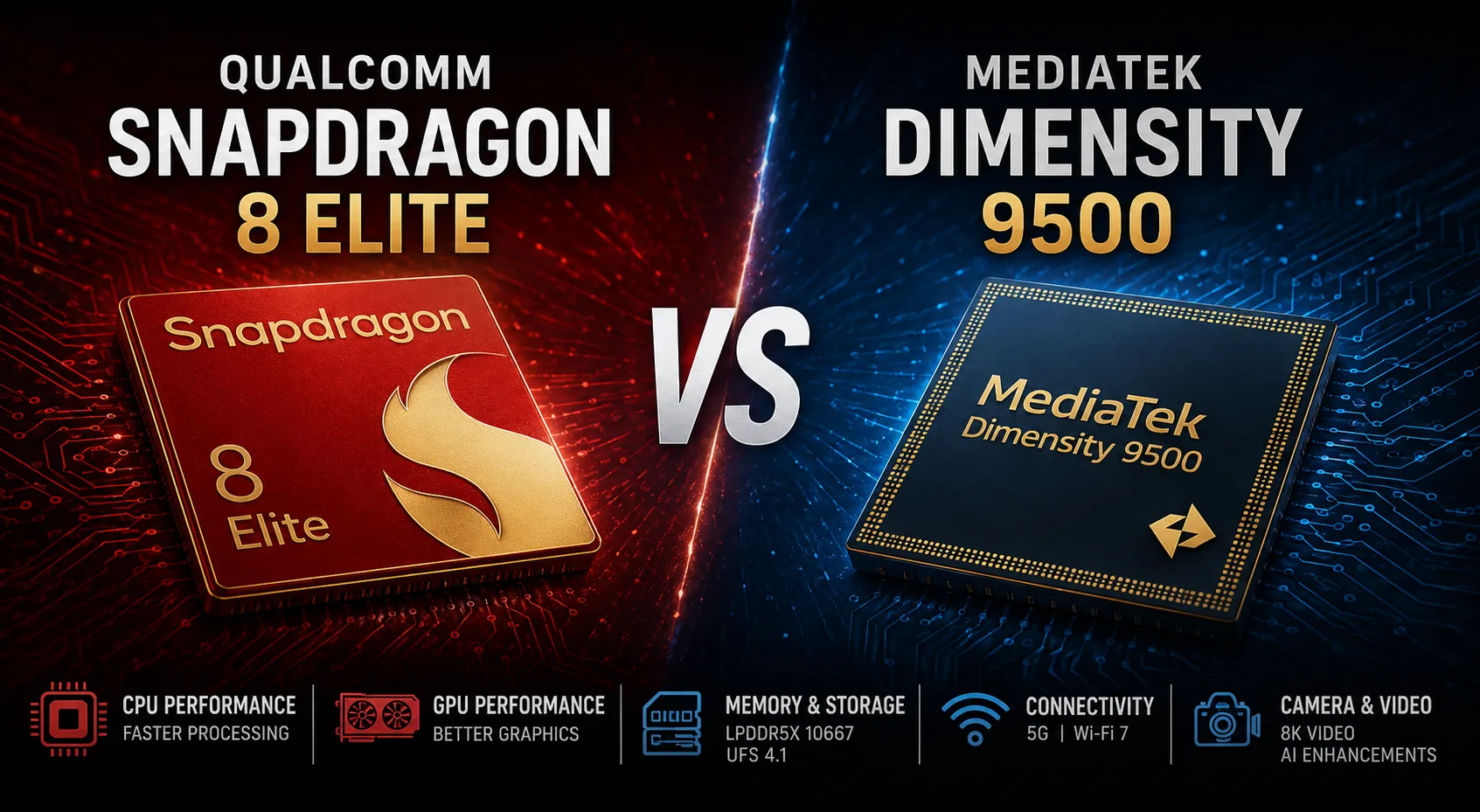
Qualcomm Snapdragon 8 Elite and MediaTek Dimensity 9500 are flagship chips from different generations. Snapdragon 8 Elite became Qualcomm's first smartphone flagship with Oryon cores and significantly increased CPU performance over previous Snapdragons. Dimensity 9500 was released later and features a new Arm C1 architecture, Mali-G1 Ultra graphics, and faster memory.
The main difference is simple: Dimensity 9500 is stronger in CPU, GPU, memory, and storage, whereas Snapdragon 8 Elite relies on Qualcomm's established platform. If the prices of the smartphones are the same, the advantage will often lie with MediaTek. If a Snapdragon smartphone is significantly cheaper, better cooled, or maintains frequencies longer, it can still be a good purchase.
Main Differences
| Parameter | Snapdragon 8 Elite | Dimensity 9500 |
|---|---|---|
| CPU | Qualcomm Oryon | Arm C1-Ultra / C1-Premium / C1-Pro |
| CPU Configuration | 2+6 | 1+3+4 |
| Maximum Frequency | up to 4.32/4.47 GHz depending on the version | up to 4.21 GHz |
| GPU | Adreno 830 | Mali-G1 Ultra MC12 |
| Memory | LPDDR5X | LPDDR5X 10667 |
| Storage | UFS 4.0 | UFS 4.1, 4-lane |
| Wi-Fi | Wi-Fi 7 up to 5.8 Gbps | Wi-Fi 7 up to 7.3 Gbps |
| Video | up to 8K HDR | up to 8K60, 4K120 with EIS |
Snapdragon 8 Elite utilizes Oryon cores, Adreno 830 graphics, and a strong Qualcomm modem. This is a proven platform for Android flagships: manufacturers are already well-acquainted with its modem, drivers, gaming profiles, and power management settings.
Dimensity 9500 is a newer flagship platform. It features a different CPU configuration, faster memory, support for UFS 4.1, and a GPU that often outperforms Adreno 830 in modern graphics tests. This comparison is not between two simultaneous flagships, but rather Snapdragon from 2024 against a newer MediaTek platform.
CPU: Dimensity 9500 is Faster
In processor testing, Dimensity 9500 often shows higher scores. In Geekbench 6, it scores around 3300-3400 points in Single-Core and about 10500-10600 points in Multi-Core. Snapdragon 8 Elite typically holds around 3000-3100 and 9300-9500 points.
The difference is not huge, but it is consistent: it exceeds the usual range of results. Dimensity 9500 is faster both in single-threaded and multi-threaded tasks. The advantage is more noticeable in short, heavy tasks: launching apps, processing photos, browsing heavy pages, decompressing archives, and mixed workloads.
Snapdragon 8 Elite's CPU is fast enough for any typical tasks, but the performance headroom is higher in Dimensity 9500.
Graphics: Adreno No Longer Has an Automatic Advantage
Adreno has long been a more predictable option for gaming: better optimization, stable Vulkan support, and fewer issues in particular projects. With Snapdragon 8 Elite, the Adreno 830 graphics remains fast by flagship standards, and this chip is still very good for gaming.
However, Dimensity 9500 features Mali-G1 Ultra MC12. In graphics performance, MediaTek is no longer catching up to Qualcomm but often surpasses it in modern tests. This is especially evident in heavy scenarios such as 3DMark Steel Nomad Light and Solar Bay, where modern graphical architecture and ray tracing are important.
In gaming, the outcome depends on the specific smartphone: cooling, power limits, drivers, and manufacturer settings. Therefore, Snapdragon 8 Elite can no longer be automatically considered the best gaming option solely because of Adreno. In synthetic tests, Dimensity 9500 is stronger in GPU, although Qualcomm may perform better in specific games due to optimization.
Memory, Storage, and Platform
Dimensity 9500 supports faster memory and UFS 4.1. LPDDR5X 10667 and UFS 4.1 with 4 lanes are important for video recording, large file transfers, quick application installation, and local computations.
Snapdragon 8 Elite uses LPDDR5X and UFS 4.0. This is sufficient for a flagship smartphone, but in terms of storage subsystem, Dimensity 9500 is more modern. In user interface, the difference is rarely noticeable, but for a premium smartphone, headroom is important.
Snapdragon 8 Elite excels in modem capabilities. It has a fast 5G modem, supports Wi-Fi 7, and offers a combination that is more commonly found in premium Android smartphones and better understood by manufacturers. Qualcomm’s advantage here lies not in peak numbers, but in the predictability of its modem and drivers. This is especially important for connectivity, roaming, and stability across different networks.
AI, Camera, and Video
Both chips support local AI tasks: photo and video processing, object recognition, voice features, and generative scenarios. Snapdragon 8 Elite uses Hexagon NPU, while Dimensity 9500 employs NPU 990. According to specifications, the NPU 990 in Dimensity 9500 is more powerful, but the end user will only notice the difference where the manufacturer truly leverages the NPU.
In terms of camera specifications, Dimensity 9500 leads: up to 320 MP, 8K60 and 4K120 with electronic stabilization. However, the line "8K60" alone does not guarantee a better camera. Photo and video quality depends not only on the SoC but also on the sensor, optics, stabilization, and manufacturer algorithms.
What to Choose
Dimensity 9500 is better suited if CPU, GPU, fast memory, and a modern storage solution are priorities. It is faster in processor tests, stronger in new GPU benchmarks, and supports LPDDR5X 10667 and UFS 4.1. For the same price, a smartphone with Dimensity 9500 is preferable.
Snapdragon 8 Elite is worth considering if a specific smartphone is cheaper, better cooled, maintains frequencies longer, or has a better camera, display, and battery life. The main advantages of Snapdragon 8 Elite are its modem, drivers, gaming compatibility, and predictable performance in Android flagships.
Conclusion
MediaTek Dimensity 9500 surpasses Snapdragon 8 Elite in hardware capabilities. It is faster in CPU tasks, quicker in modern GPU benchmarks, and better suited for new high-end flagships.
Snapdragon 8 Elite remains a fast flagship chip with a good modem, drivers, and gaming compatibility. However, at the same price, it is less advantageous. Choosing it should not be based on absolute performance, but rather on the specific smartphone: price, cooling, camera, display, and battery life.
Advantages
- Higher Frequency: 4320 MHz (4320 MHz vs 4210)
- Newer Launch Date: September 2025 (October 2024 vs September 2025)
Basic
GPU Specifications
Connectivity
Memory Specifications
Miscellaneous
- FLAC
- HE-AACv1
- HE-AACv2
- MP3
- H.265
- AV1
- VP9
Benchmarks
Comparison of Devices
Related SoC Comparisons


Share in social media
Or Link To Us
<a href="https://cputronic.com/en/soc/compare/qualcomm-snapdragon-8-elite-vs-mediatek-dimensity-9500" target="_blank">Qualcomm Snapdragon 8 Elite vs MediaTek Dimensity 9500</a>