Qualcomm Snapdragon 8 Elite Gen 5
vs
Apple M4 iPad


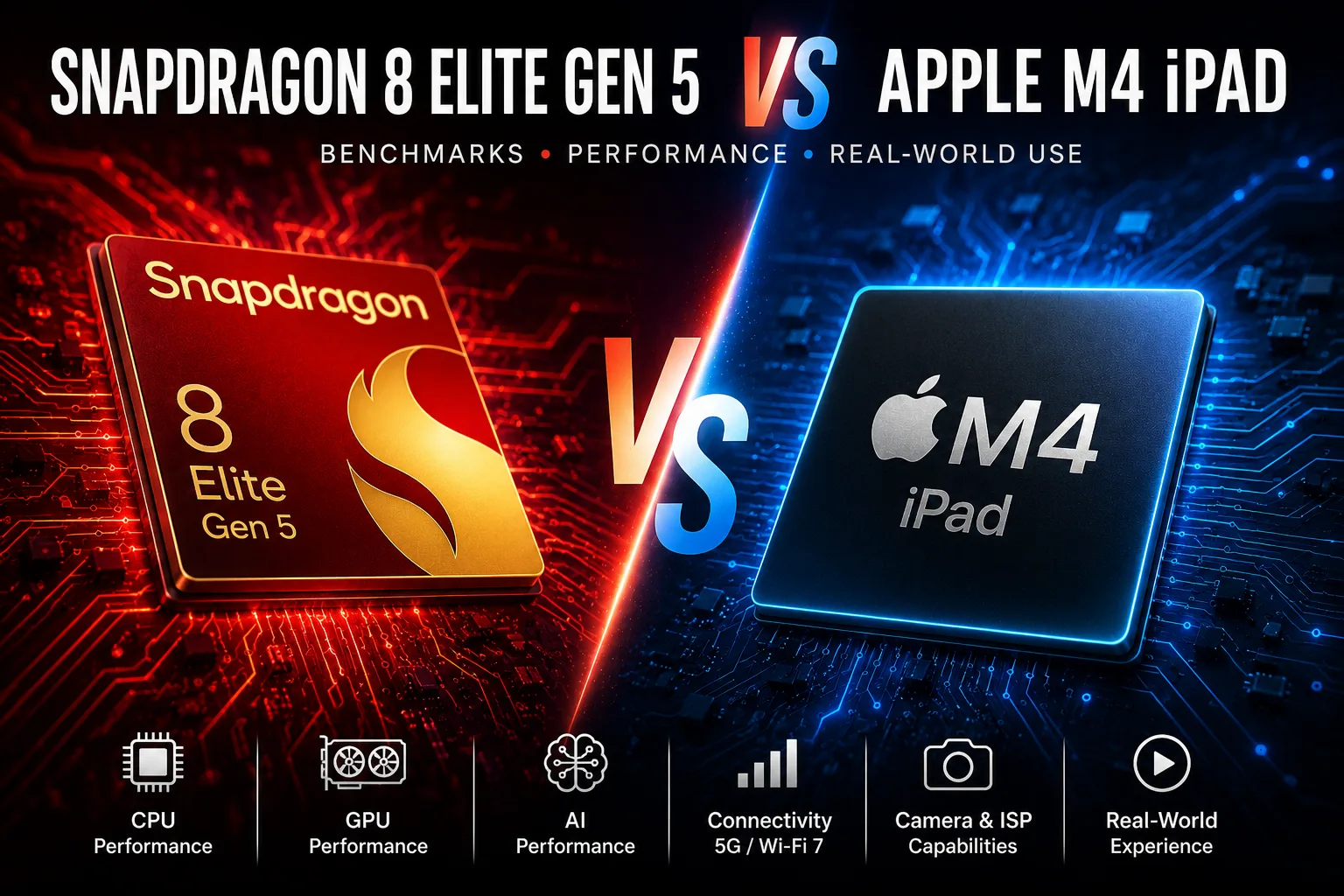
SoC Comparison Result
Snapdragon 8 Elite Gen 5 vs. Apple M4 iPad: Close in Peak Performance, Weaker Under Load
The Snapdragon 8 Elite Gen 5 is already fast enough to be compared with Apple’s M4 in the iPad Pro. In single-core Geekbench tests, the difference is minimal, with the M4 usually slightly ahead in 3DMark, while AnTuTu 11 shows a significant advantage for Snapdragon as a mobile platform. However, the divide remains: Snapdragon is close in short tests, but the M4 excels in multi-core and sustained workloads.
This is not a comparison of two chips of the same class. The Snapdragon 8 Elite Gen 5 is a complete SoC for a flagship smartphone: CPU, GPU, NPU, modem, ISP, wireless connectivity, and camera units. The Apple M4 in the iPad Pro operates within a larger device with better heat dissipation, making it more suited for video editing, graphics, photo processing, and other heavy tasks.
Why Direct Comparison is Conditional
The Snapdragon 8 Elite Gen 5 uses next-generation Oryon cores. In its top configuration, it includes two Prime cores and six performance cores, with frequencies reaching up to 4.74 GHz in certain versions. This is a high level for a smartphone chip: Qualcomm brings Android flagships into the range of peak CPU tests for Apple’s M-series.
The Apple M4 has a different CPU configuration. The higher version for the iPad Pro features 10 cores: four performance and six efficiency cores. In the lower configurations of the iPad Pro, a 9-core variant is used, so it’s essential to check which version was used in the tests. For comparison with the top Snapdragon, it's more logical to consider the M4 with the 10-core CPU.
The advantage of the M4 is not only due to its architecture but also to the iPad Pro's form factor. The tablet can dissipate heat more efficiently, allowing it to maintain high performance longer in tasks like video export, RAW photo processing, and handling heavy projects.
| Test | Snapdragon 8 Elite Gen 5 | Apple M4 iPad | Difference |
|---|---|---|---|
| Geekbench 6 Single Core | 3757 | 3842 | M4 is about 2% faster |
| Geekbench 6 Multi Core | 12644 | 14383 | M4 is about 14% faster |
| AnTuTu 11 | 4,177,588 | 3,116,013 | Snapdragon is about 34% higher |
| 3DMark Solar Bay | 13959 | 14365 | M4 is slightly higher |
| 3DMark Solar Bay Unlimited | 14509 | 15334 | M4 is slightly higher |
| 3DMark Steel Nomad Light | 3157 | 3497 | M4 is about 11% higher |
AnTuTu 11 needs to be interpreted with caution. While it shows the overall speed of the platform, it does not provide a clear answer regarding which CPU or GPU is faster, especially when comparing Android and iPadOS. It is more useful to look at Geekbench and 3DMark for CPU and graphical performance.
CPU: Snapdragon Close in Single-Core, M4 Stronger in Multi-Core
In single-core Geekbench tests, the difference between the Snapdragon 8 Elite Gen 5 and Apple M4 is small. For a smartphone SoC, this is a high level. Interface, browsing, application launches, camera performance, and short resource-intensive operations should be executed very quickly.
In multi-core testing, the M4 takes a more noticeable lead. This is important for tasks where the load lasts not seconds, but minutes: video export, photo processing, archiving, handling multiple heavy browser tabs, and large documents with editing or graphics applications. Here, the iPad Pro leverages the advantage of its form factor and thermal management.
The Snapdragon 8 Elite Gen 5 is already close to the M4 in peak CPU performance, but it cannot be called a full equivalent of the M4. Smartphones have less thermal headroom, so Apple retains the advantage in long-duration computational tasks.
GPU: Close Numbers, Different Ecosystems
The gap in graphics performance is also small. The Apple M4 often leads in 3DMark, but the Snapdragon 8 Elite Gen 5 is now close in level. The Adreno remains one of the strongest graphics options in the Android segment, especially for games with high frame rates and modern mobile engines.
In practice, the result depends on the API and the game’s optimization. Qualcomm supports Android, Vulkan, and custom gaming settings from smartphone manufacturers, while Apple utilizes Metal, Dynamic Caching, hardware ray tracing, mesh shading, and a tight integration of the chip, Metal, and iPadOS.
Conclusion: The Apple M4 is slightly faster in graphical synthetic tests, but the Snapdragon 8 Elite Gen 5 is in the same performance class. In gaming, the outcome will depend on the specific project and device.
AI: Snapdragon Stronger as a Smartphone Platform, M4 as Part of iPadOS
Qualcomm emphasizes the Hexagon NPU and local AI tasks: generative on-device models, contextual features, camera enhancements, scene recognition, and assistant functionalities without mandatory cloud processing.
The Apple M4 includes a 16-core Neural Engine. In the iPad Pro, it is crucial not in isolation but as part of iPadOS and applications: photo and video processing, object recognition, acceleration of media tasks, and Apple tool integration.
A comparison based solely on TOPS provides little insight. For users, the individual figure matters less than support in applications and the speed of specific tasks.
Connectivity, Camera, and Media: Where Snapdragon Excels
When considering not just the CPU and GPU, the Snapdragon 8 Elite Gen 5 has a more complete set of smartphone blocks. It includes a flagship 5G modem, Wi-Fi 7, advanced ISP, support for high-resolution cameras, rapid photo and video processing, gaming features, and AI task blocks on-device. This is a complete SoC for a flagship smartphone, not merely a computing chip.
The Apple M4 in the iPad Pro does not compete with it regarding the range of smartphone features. The iPad Pro has a different scenario: a large display, robust media blocks, ProRes support, and performance with applications for editing, drawing, photo processing, and note-taking.
Thus, Snapdragon is stronger as a mobile platform, while the M4 is more powerful as a basis for a performance-oriented tablet.
Conclusion
The Snapdragon 8 Elite Gen 5 is better suited for flagship Android smartphones: it has strong graphics, modern connectivity, advanced ISP, gaming capabilities, and on-device AI tasks.
The Apple M4 iPad is better for sustained loads: multi-core computing, graphics, editing, photo processing, and working with a large screen.
If computational stability is essential, the M4 is superior. If a complete smartphone SoC with a modem, camera, ISP, Android gaming, and local AI is needed, then the Snapdragon has the edge. Qualcomm has significantly narrowed the gap with Apple, but the class of the device still influences final performance.
Advantages
- Higher Frequency: 4600 MHz / 4740 MHz (4600 MHz / 4740 MHz vs 4400 MHz)
- Newer Launch Date: September 2025 (September 2025 vs May 2024)
Basic
GPU Specifications
Connectivity
Memory Specifications
Miscellaneous
Benchmarks
Comparison of Devices
Related SoC Comparisons




Share in social media
Or Link To Us
<a href="https://cputronic.com/en/soc/compare/qualcomm-snapdragon-8-elite-gen-5-vs-apple-m4-ipad" target="_blank">Qualcomm Snapdragon 8 Elite Gen 5 vs Apple M4 iPad</a>