Qualcomm Snapdragon 7s Gen 4
vs
MediaTek Dimensity 9500s
SoC Comparison Result
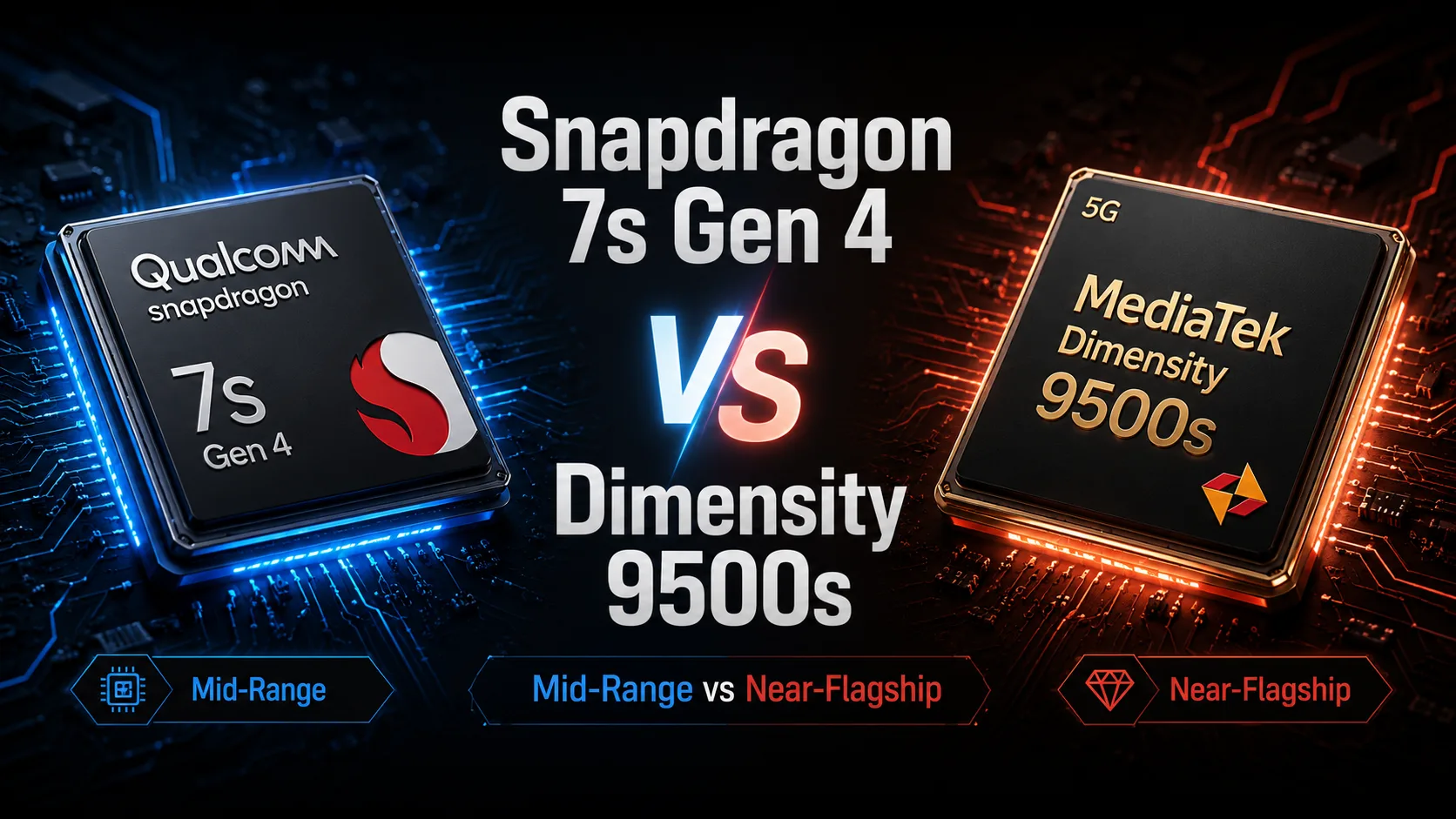
Snapdragon 7s Gen 4 vs Dimensity 9500s: Mid-range vs Almost Flagship
Due to the s index, the Snapdragon 7s Gen 4 and Dimensity 9500s may seem like closely related models. In reality, they are platforms of different levels: Qualcomm belongs to the mid-range segment, while MediaTek is positioned as almost flagship. Therefore, the comparison is useful not as an equal duel, but as a check on smartphone pricing: if the models are priced similarly, the Snapdragon 7s Gen 4 variant is harder to justify in terms of performance.
The Snapdragon 7s Gen 4 is suitable for everyday tasks: interface, 5G, camera, video, navigation, and light gaming. The Dimensity 9500s is designed for heavier workloads: gaming, fast LPDDR5X memory, UFS 4, Wi-Fi 7, complex camera systems, and performance headroom for several years.
| Specification | Snapdragon 7s Gen 4 | Dimensity 9500s |
|---|---|---|
| Class | mid-range | almost flagship |
| Process Technology | 4 nm | 3 nm |
| CPU | 1+3+4, up to 2.7 GHz | 1+3+4, up to 3.73 GHz |
| GPU | Adreno 810 | Immortalis-G925 |
| Memory | LPDDR5 / LPDDR4X | LPDDR5X up to 10667 Mbps |
| Storage | UFS 3.1 | UFS 4 + MCQ |
| AnTuTu 11 | around 1.04 million | around 3.04 million |
| Geekbench 6 Single-Core | around 1237 | around 2680 |
| Geekbench 6 Multi-Core | around 3281 | around 8358 |
| Wi-Fi | Wi-Fi 6 / 6E | Wi-Fi 7 |
| Video | 4K HDR | 8K60 decode, 8K30 encode |
CPU: Dimensity 9500s is Significantly Faster
The Snapdragon 7s Gen 4 utilizes an octa-core configuration with one high-performance core clocked at up to 2.7 GHz, three performance cores, and four efficiency cores. This is sufficient for a mid-range smartphone: browsing, messaging, navigation, video, banking apps, and regular multitasking should not be a problem.
The Dimensity 9500s features a higher-end configuration: one Cortex-X925 up to 3.73 GHz, three Cortex-X4, and four Cortex-A720. This setup is aimed at high peak performance and is better suited for heavy multithreaded tasks.
In Geekbench 6, the difference is approximately twofold in single-core performance and more than twofold in multi-core performance. In Telegram and browsers, this may go unnoticed, but in demanding tasks it will become obvious: photo processing, editing, archiving, gaming, emulators, and prolonged multitasking place greater strain on the CPU.
GPU: The Most Noticeable Advantage of Dimensity 9500s
The Adreno 810 in the Snapdragon 7s Gen 4 is suitable for popular games, but heavier titles will require lowering settings. Especially if a stable frame rate, high resolution, and prolonged gaming sessions without noticeable dips are needed.
The Immortalis-G925 is significantly stronger than the Adreno 810 in demanding games and will keep its GPU headroom for longer. Therefore, in gaming, the difference between the chips will be more noticeable than during regular interface use.
The Snapdragon 7s Gen 4 is an option for moderate gaming. The Dimensity 9500s is better suited for high settings and a longer gaming lifespan.
Memory, Storage, and Connectivity
The Snapdragon 7s Gen 4 supports LPDDR5 and UFS 3.1. For the mid-range segment, this is still a standard set, but in gaming, video recording, and handling large files, LPDDR5X and UFS 4 will be faster.
The Dimensity 9500s employs LPDDR5X up to 10667 Mbps and UFS 4 + MCQ. In normal system navigation, the difference may be minimal, but it becomes more apparent when launching large games, installing heavy applications, recording video, and handling large files.
In terms of connectivity, MediaTek is also ahead: Wi-Fi 7 and a 5G modem with a claimed download speed of up to 7 Gbps versus Wi-Fi 6/6E and 5G up to 2.9 Gbps in the Snapdragon 7s Gen 4. Such speeds are rarely achievable in real networks, but support for Wi-Fi 7 makes the Dimensity 9500s a more modern option.
Camera and Video
The Snapdragon 7s Gen 4 is designed for mid-range cameras. It supports 4K HDR video and basic mobile photography. The final quality still depends on the sensor, optics, stabilization, and manufacturer's algorithms.
The Dimensity 9500s is designed for more complex camera systems: sensors up to 320 MP, 8K video, and heavier computational processing. This does not guarantee a better camera in every smartphone, but it gives the manufacturer more options for premium camera phones.
Where the Difference Will Be Noticeable
In simple tasks, the Snapdragon 7s Gen 4 will not be a bottleneck. It can handle messengers, browsers, YouTube, maps, cameras, and occasional gaming without maximum settings.
The difference with the Dimensity 9500s becomes apparent in high-load tasks:
- demanding games and emulators;
- video shooting and processing;
- launching large applications;
- multitasking with a large number of background processes;
- local AI functions;
- performance headroom for 2-3 years.
This is not a case where two chips differ only in clock speeds. The Snapdragon 7s Gen 4 remains a mid-range solution, while the Dimensity 9500s belongs to a more premium level.
Conclusion
The Snapdragon 7s Gen 4 is justified in a budget smartphone where price, reasonable daily speed, and moderate energy consumption are important. It is not designed for flagship graphics, UFS 4, Wi-Fi 7, and significant headroom for heavy gaming.
The Dimensity 9500s should be chosen for gaming, video, LPDDR5X, UFS 4, Wi-Fi 7, and performance headroom. It is faster in CPU, significantly stronger in GPU, and better suited for smartphones that are intended to last more than a year.
If the smartphones are priced similarly, the model with the Dimensity 9500s appears stronger in terms of specifications and longevity. The Snapdragon 7s Gen 4 makes sense only at a significantly lower price point.
Advantages
- Higher Technology: 3 nm (4 nm vs 3 nm)
- Higher Frequency: 3730 MHz (2700 MHz vs 3730 MHz)
- Newer Launch Date: January 2026 (August 2025 vs January 2026)
Basic
3x 3.3 GHz – Cortex-X4
4x 2.4 GHz – Cortex-A720
GPU Specifications
Connectivity
Memory Specifications
Miscellaneous
- AIFF
- CAF
- MP3
- MP4
- WAV
- FLAC
- HE-AACv1
- HE-AACv2
- MP3
- H.265
- VP9
- H.265
- AV1
- VP9
Benchmarks
Comparison of Devices
Related SoC Comparisons



Share in social media
Or Link To Us
<a href="https://cputronic.com/en/soc/compare/qualcomm-snapdragon-7s-gen-4-vs-mediatek-dimensity-9500s" target="_blank">Qualcomm Snapdragon 7s Gen 4 vs MediaTek Dimensity 9500s</a>