Qualcomm Snapdragon 7 Gen 4
vs
MediaTek Dimensity 7100

SoC Comparison Result
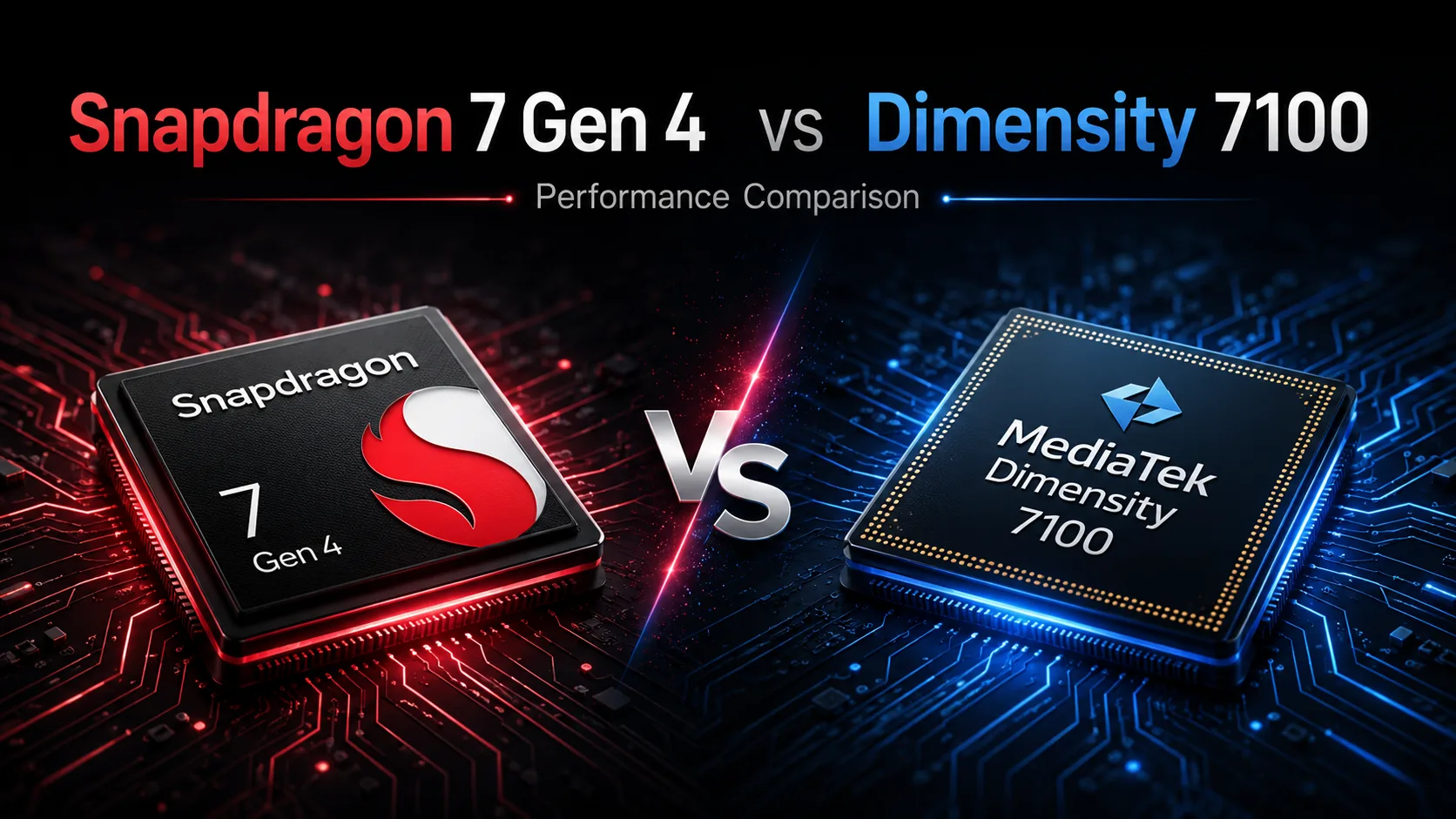
Snapdragon 7 Gen 4 vs Dimensity 7100: Qualcomm is noticeably faster
MediaTek Dimensity 7100 was released later than Snapdragon 7 Gen 4 but utilizes a significantly older CPU architecture. Snapdragon features Cortex-A720 and Cortex-A520 cores, a 4nm manufacturing process, and an Adreno 722 GPU, while Dimensity 7100 is equipped with Cortex-A78, Cortex-A55, and Mali-G610 MC2. In real-world smartphones, Qualcomm is around 20% faster in CPU performance, and in 3DMark, its advantage exceeds 100%.
Key Differences
| Feature | Snapdragon 7 Gen 4 | Dimensity 7100 |
|---|---|---|
| Manufacturing Process | 4 nm TSMC | 6 nm TSMC |
| CPU | 1x Cortex-A720 2.8 GHz + 4x Cortex-A720 2.4 GHz + 3x Cortex-A520 1.8 GHz | 4x Cortex-A78 2.4 GHz + 4x Cortex-A55 2.0 GHz |
| GPU | Adreno 722 | Mali-G610 MC2 |
| Memory | Up to LPDDR5X-8400 | Up to LPDDR5-5500 |
| Storage | Up to UFS 4.0 | Up to UFS 3.1 |
| Wi-Fi | Wi-Fi 7 | Wi-Fi 6 |
| Bluetooth | 6.0 | 5.4 |
| Maximum 5G Speed | Up to 4.2 Gbps | Up to 3.3 Gbps |
| Camera | Up to 200 MP | Up to 200 MP |
Snapdragon features five performance cores (Cortex-A720), including one at 2.8 GHz, while MediaTek has four Cortex-A78 cores running at 2.4 GHz. Cortex-A78 belongs to an older Arm generation and significantly underperforms compared to A720 in terms of performance per clock.
The gap in graphics performance is even larger. Mali-G610 MC2 is significantly weaker than Adreno 722 and reaches its performance ceiling much faster in demanding games.
Real-World Smartphone Performance
The table includes results from commercially available smartphones, as cooling, memory, and power settings affect the final scores.
| Smartphone | Processor | Geekbench 6 Single | Geekbench 6 Multi | AnTuTu 11 | 3DMark Steel Nomad Light |
|---|---|---|---|---|---|
| realme 15 Pro 5G | Snapdragon 7 Gen 4 | 1201 | 3549 | 1,251,276 | 666 |
| realme P4 Pro 5G | Snapdragon 7 Gen 4 | 1209 | 3575 | 1,282,176 | 670 |
| vivo V60 | Snapdragon 7 Gen 4 | 1247 | 3557 | 1,257,854 | 667 |
| Infinix Note Edge | Dimensity 7100 | 995 | 2925 | 774,911 | 278 |
| Tecno Pova 8 5G | Dimensity 7100 | 996 | 2944 | 757,391 | 277 |
In this sample, smartphones with Snapdragon 7 Gen 4 average about 1219 points in Geekbench 6 Single-Core and 3560 in Multi-Core. The average results for Dimensity 7100 are 996 and 2935 points, respectively. Qualcomm's advantage is around 22% in both CPU tests.
In AnTuTu, the gap is significantly larger. The average score of three Snapdragon devices is about 1.26 million points compared to 766k for Dimensity. Snapdragon is approximately 65% faster.
The comparison page uses AnTuTu 10 results, so they cannot be directly compared to the AnTuTu 11 figures in the table above.
Snapdragon is much faster in games
The largest gap between the processors can be seen in graphical tests. The realme 15 Pro, realme P4 Pro, and vivo V60 score 666-670 points in 3DMark Steel Nomad Light. Infinix Note Edge and Tecno Pova 8 5G with Dimensity 7100 only score 277-278 points.
Adreno 722 is approximately 2.4 times faster in this test.
In real games, the gap depends on the settings and optimization, but Adreno 722 has significantly more headroom. Dimensity 7100 handles less demanding online games and many heavy games at lowered settings. In more demanding titles, Mali-G610 MC2 often forces a reduction in graphics quality or rendering resolution.
For a gaming smartphone, Snapdragon 7 Gen 4 is significantly preferable.
The gap is smaller in everyday tasks
For messaging, video, navigation, and regular browsing, both processors have sufficient capabilities. In these tasks, the difference is less noticeable than in gaming.
Snapdragon is faster in photo processing, app installation, working with heavy web pages, and sustained multi-threaded load. This doesn’t turn Dimensity 7100 into a slow processor, but Qualcomm has a higher performance cushion.
Memory, Storage, and Wireless Interfaces
Snapdragon 7 Gen 4 supports LPDDR5X, UFS 4.0, Wi-Fi 7, and Bluetooth 6.0. Dimensity 7100 supports LPDDR5, UFS 3.1, Wi-Fi 6, and Bluetooth 5.4.
However, these are the capabilities of the processor itself, not mandatory specifications of each smartphone. For example, vivo V60 with Snapdragon 7 Gen 4 is released with LPDDR4X and UFS 2.2, and Infinix Note Edge with Dimensity 7100 also uses UFS 2.2.
Mid-range manufacturers often cut costs on memory and storage even when the processor supports faster standards. Support for UFS 4.0 in Snapdragon specifications does not guarantee that a specific smartphone will have such storage.
4nm vs 6nm
Snapdragon 7 Gen 4 is manufactured using a 4nm process by TSMC, while Dimensity 7100 is produced using a 6nm process. The more modern process combined with the new CPU cores gives Snapdragon an efficiency advantage, but the battery life of a specific smartphone cannot be predicted purely from these figures: too much depends on the display, battery, and power settings.
Conclusion
Snapdragon 7 Gen 4 is noticeably faster than Dimensity 7100. In real smartphones, its advantage is around 20% in Geekbench 6, approximately 65% in AnTuTu 11, and over 140% in 3DMark Steel Nomad Light. Snapdragon also has a more modern platform: 4nm manufacturing process, Cortex-A720/A520, Wi-Fi 7, Bluetooth 6.0, and UFS 4.0 support.
At the same price, the choice is clear - Snapdragon 7 Gen 4. Dimensity 7100 only becomes competitive in a cheaper smartphone or when it has a clear advantage in screen, camera, battery, or memory.
Advantages
- Higher Technology: 4 nm (4 nm vs 6 nm)
- Higher Frequency: 2800 MHz (2800 MHz vs 2400 MHz)
- Newer Launch Date: January 2026 (May 2025 vs January 2026)
Basic
4x 2 GHz – Cortex-A55
GPU Specifications
Connectivity
Memory Specifications
Miscellaneous
- FLAC
- HE-AACv1
- HE-AACv2
- MP3
- H.265
- VP9
Benchmarks
Comparison of Devices
Related SoC Comparisons






Share in social media
Or Link To Us
<a href="https://cputronic.com/en/soc/compare/qualcomm-snapdragon-7-gen-4-vs-mediatek-dimensity-7100" target="_blank">Qualcomm Snapdragon 7 Gen 4 vs MediaTek Dimensity 7100</a>