Qualcomm Snapdragon 6s 4G Gen 2
vs
MediaTek Dimensity 6300

SoC Comparison Result
Snapdragon 6s 4G Gen 2 vs Dimensity 6300: Fresh Name vs More Relevant Platform
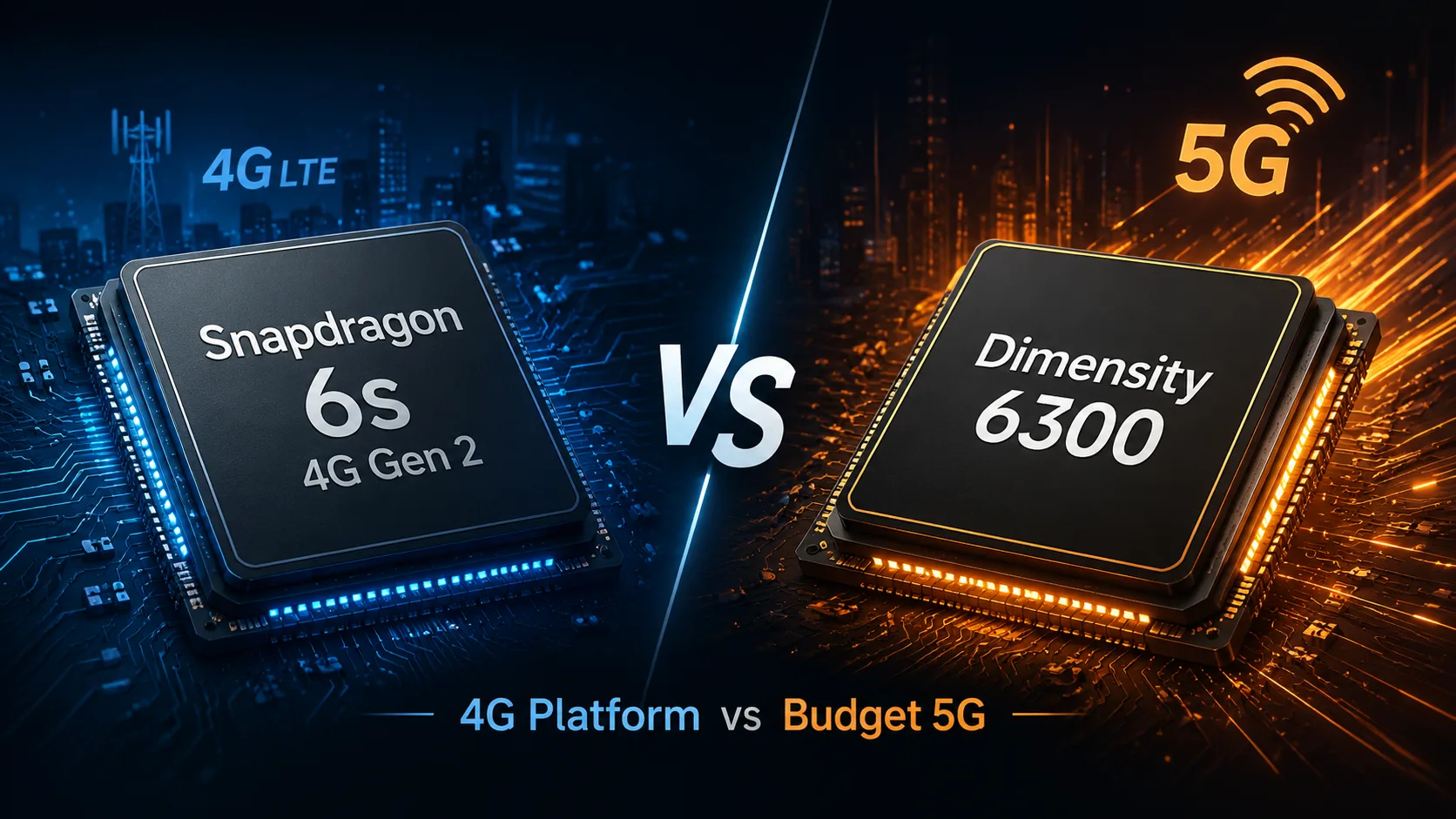
Snapdragon 6s 4G Gen 2 is presented as a fresh budget chip from Qualcomm, but a comparison with the Dimensity 6300 immediately reveals the difference: this is a 4G platform versus a budget 5G. Snapdragon is sufficient for basic tasks but is designed for the cheapest devices. Dimensity 6300 is better suited for a new budget smartphone: it has a faster CPU, stronger graphics, and supports 5G.
The Main Difference - Architecture and Modem
In terms of specifications, the Snapdragon 6s 4G Gen 2 looks acceptable for the budget class. It features an 8-core CPU, with a frequency of up to 2.9 GHz, support for Full HD+ displays at up to 120 Hz, cameras of up to 108 MP, and UFS 2.2 memory. This is sufficient for a cheap smartphone or tablet.
However, frequency is not the only important factor. The Snapdragon 6s 4G Gen 2 relies on an older configuration of Cortex-A73/A53 cores and Adreno 610 graphics. The Dimensity 6300 uses Cortex-A76/A55 and Mali-G57 MC2. This doesn't make the Dimensity 6300 a gaming chip, but it leaves more headroom for performance in heavy applications, multitasking, and gaming.
| Specification | Snapdragon 6s 4G Gen 2 | Dimensity 6300 |
|---|---|---|
| CPU | 4× Cortex-A73 + 4× Cortex-A53 | 2× Cortex-A76 + 6× Cortex-A55 |
| CPU Frequency | Up to 2.9 GHz | Up to 2.4 GHz |
| Graphics | Adreno 610 | Mali-G57 MC2 |
| Process Technology | 6 nm | 6 nm |
| Memory | LPDDR4X, UFS 2.2 | LPDDR4X, UFS 2.2 |
| Display | Full HD+ up to 120 Hz | Full HD+ up to 120 Hz |
| Connectivity | 4G LTE | 5G SA/NSA |
Performance: Dimensity is Faster in CPU and Overall Load
In real-world tests, the Snapdragon 6s 4G Gen 2 does not seem to be a failure. It handles the interface, browser, messaging apps, video, and light gaming quite well. However, in benchmarks, the Dimensity 6300 shows higher results, especially in CPU and overall system ratings.
| Test | Snapdragon 6s 4G Gen 2 | Dimensity 6300 |
|---|---|---|
| Geekbench 6 Single Core | Around 480-490 | Around 720-790 |
| Geekbench 6 Multi Core | Around 1500-1530 | Around 1880-2030 |
| AnTuTu 10/11 | Approximately 410-520 k | Approximately 450-525 k |
In Telegram, YouTube, and simple browsing, the difference is hardly noticeable. Both chips are suitable for basic scenarios. The gap is more apparent in heavy websites, switching between multiple applications, system updates, photo processing, and gaming. Snapdragon reaches its performance limit sooner, while the Dimensity 6300 handles mixed loads better.
In graphics, the advantage also lies with MediaTek. The Adreno 610 is an old budget GPU. The Mali-G57 MC2 is not designed for heavy gaming, but it is stronger and more modern. Simple games will run on both chips, but in demanding projects, the Dimensity 6300 often provides more stable FPS or allows for higher-than-minimum settings.
Connectivity: Dimensity's Advantage is Obvious
The main gap between these chips is the modem. The Snapdragon 6s 4G Gen 2 is limited to LTE. This is acceptable in a 4G tablet or the cheapest phone, but this limitation must be considered when buying a new smartphone.
The Dimensity 6300 supports 5G SA/NSA. This is not only a question of maximum speed: a smartphone with 5G is less likely to become obsolete in the next few years. In the budget segment, this is especially vital, as such devices are often purchased for the long term.
Where Snapdragon 6s 4G Gen 2 is Appropriate
The Snapdragon 6s 4G Gen 2 is suitable for a different class of devices. It is a platform for inexpensive 4G smartphones and tablets, where price, battery life, large screen, messaging, YouTube, browsing, navigation, and simple games are important.
The weakness is evident when such a chip is placed in a new smartphone without a clear discount. The name sounds fresh, but the limitations remain the same: LTE instead of 5G, weak graphics, and modest CPU reserve.
What to Choose
The Dimensity 6300 is a more successful option for a budget smartphone. It scores higher in Geekbench, usually ranks higher in AnTuTu, features more modern graphics, and supports 5G. It's not at a gaming level, but for a budget phone, the Dimensity 6300 offers more headroom.
The Snapdragon 6s 4G Gen 2 makes sense at a significantly lower price or in a device where 5G is not needed: a simple phone, tablet, or a model for basic communication and video. In such scenarios, it is acceptable. However, when comparing smartphones for several years, the choice leans towards the Dimensity 6300.
Conclusion
The Snapdragon 6s 4G Gen 2 is an adequate 4G platform for cheap devices. But its fresh name should not confuse anyone: in comparison with the Dimensity 6300, it falls short as a foundation for a new smartphone.
The Dimensity 6300 wins not just by a single benchmark score but as an entire platform. It has higher CPU performance, stronger graphics, and supports 5G. The Snapdragon 6s 4G Gen 2 should only be considered for its low price, while the Dimensity 6300 should be chosen for a more relevant device.
Advantages
- Higher Frequency: 2900 MHz (2900 MHz vs 2400 MHz)
- Newer Launch Date: December 2025 (December 2025 vs April 2024)
Basic
GPU Specifications
Connectivity
Memory Specifications
Miscellaneous
Benchmarks
Related SoC Comparisons



Share in social media
Or Link To Us
<a href="https://cputronic.com/en/soc/compare/qualcomm-snapdragon-6s-4g-gen-2-vs-mediatek-dimensity-6300" target="_blank">Qualcomm Snapdragon 6s 4G Gen 2 vs MediaTek Dimensity 6300</a>