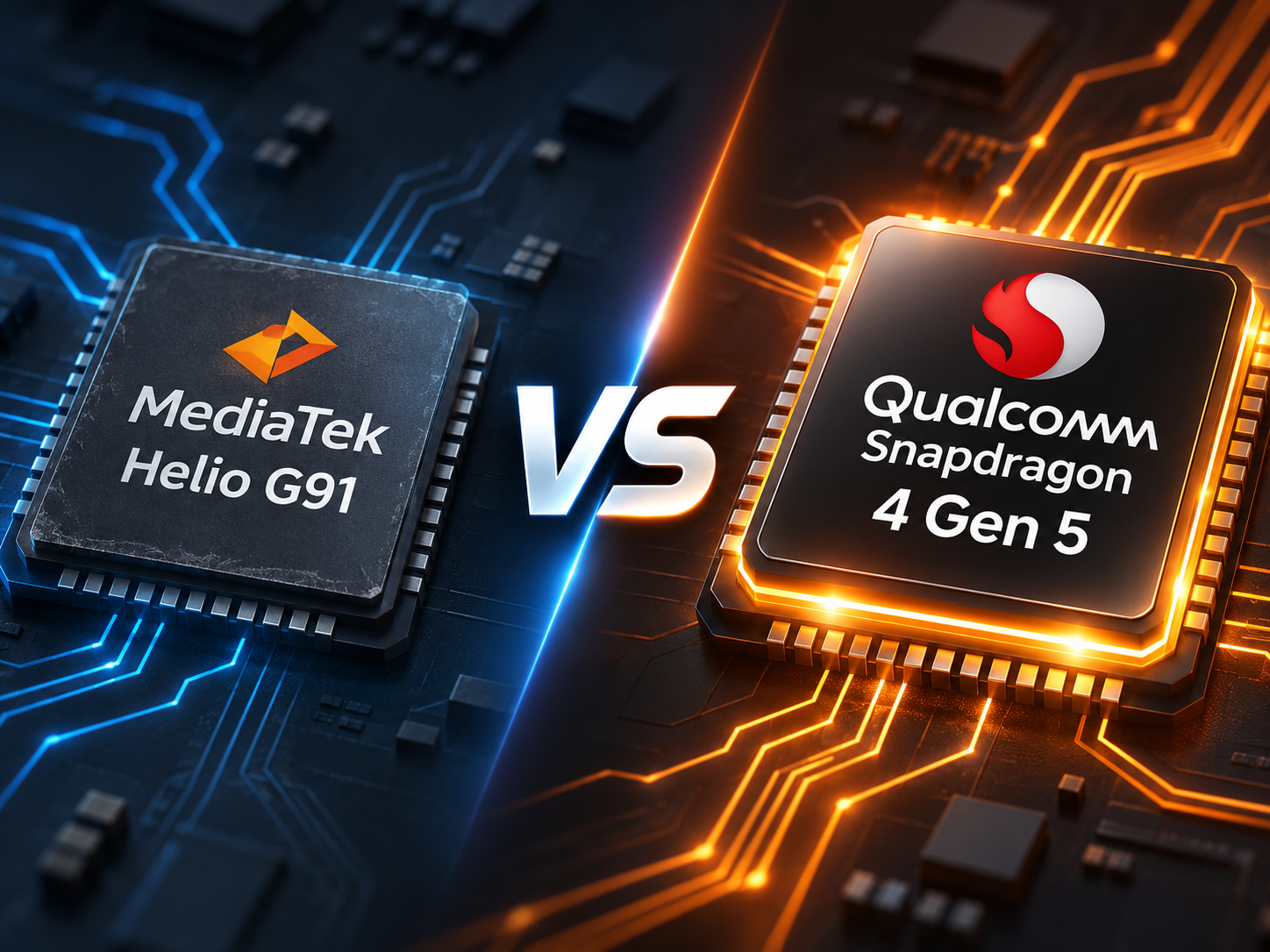
MediaTek Helio G91
vs
Qualcomm Snapdragon 4 Gen 5
SoC Comparison Result
Helio G91 vs. Snapdragon 4 Gen 5: Performance, Gaming, and Price Comparison
The Qualcomm Snapdragon 4 Gen 5 noticeably outperforms the MediaTek Helio G91 in CPU performance and supports 5G networks. In tests of the Redmi 17 smartphones, the difference is especially large in the single-threaded Geekbench 6 test, where the Qualcomm version scores almost 2.5 times higher. The Snapdragon is also faster in the 3DMark graphics test, although both platforms belong to the budget segment.
Key Differences
| Specification | Helio G91 | Snapdragon 4 Gen 5 |
|---|---|---|
| Release year | 2024 | 2026 |
| Process technology | 12 nm | 4 nm |
| Performance cores | 2 × Cortex-A75, 2.0 GHz | 2 × Cortex-A78, 2.4 GHz |
| Efficiency cores | 6 × Cortex-A55, 1.8 GHz | 6 × Cortex-A55, 2.0 GHz |
| Graphics | Mali-G52 MC2 | Adreno 629 |
| LPDDR4X frequency | Up to 1800 MHz | Up to 2133 MHz |
| Storage support | eMMC 5.1 | Up to UFS 3.1 |
| Mobile networks | 4G LTE | 5G |
The Snapdragon 4 Gen 5 uses Cortex-A78 cores instead of the older Cortex-A75 cores. They deliver higher performance at the same clock speed, while Qualcomm has also increased the maximum frequency of its two high-performance cores from 2.0 to 2.4 GHz.
Both chips have eight cores in a 2+6 configuration. However, the Snapdragon is manufactured using a more modern 4 nm process, giving it an advantage in potential power efficiency. Actual power consumption depends on the smartphone’s power settings and cooling.
Geekbench 6 and AnTuTu 11: Smartphone Results
The Redmi 13 4G and Redmi 17 4G use the Helio G91-Ultra, while the Tecno Spark 30 uses the standard Helio G91. These versions are practically identical in terms of CPU core and graphics configurations.
| Smartphone | Processor | Geekbench 6 Single | Geekbench 6 Multi | AnTuTu 11 |
|---|---|---|---|---|
| Tecno Spark 30 | Helio G91 | 420 | 1 442 | 354 158 |
| Redmi 13 4G | Helio G91-Ultra | 430 | 1 369 | 376 039 |
| Redmi 17 4G | Helio G91-Ultra | 402 | 1 399 | 365 150 |
| Redmi 17 5G | Snapdragon 4 Gen 5 | 995 | 2 320 | 619 773 |
| POCO M8x 5G | Snapdragon 4 Gen 5 | 908 | 2 112 | 624 021 |
Across the devices shown, the Snapdragon 4 Gen 5 scores 128% higher on average in Geekbench 6 Single-Core and 58% higher in Multi-Core. The difference in AnTuTu 11 is approximately 70%.
Qualcomm’s biggest advantage appears in the single-threaded test. This is important for web browsing, interface performance, and applications in which a significant portion of operations is performed sequentially.
The gap is smaller in multi-threaded workloads, but the Snapdragon is still noticeably faster thanks to its more powerful Cortex-A78 cores and higher Cortex-A55 clock speeds.
Benchmark results may vary depending on the smartphone’s configuration, firmware, and power-consumption limits.
Graphics and Gaming Performance
The Helio G91 uses the Mali-G52 MC2 with two compute units. The Snapdragon 4 Gen 5 features the Adreno 629, a newer Qualcomm graphics accelerator.
The graphics performance of the Redmi 17 4G and Redmi 17 5G can be compared using their 3DMark Wild Life Extreme results.
| Smartphone | Graphics | 3DMark Wild Life Extreme |
|---|---|---|
| Redmi 17 4G | Mali-G52 MC2 | 202 |
| Redmi 17 5G | Adreno 629 | 351 |
In Wild Life Extreme, the Snapdragon has an advantage of approximately 74%. This is a significant increase in graphics performance, but it does not mean a comparable FPS increase in every game.
Qualcomm also claims that the Adreno 629 delivers a 77% performance increase compared with the Adreno 613 graphics in the Snapdragon 4 Gen 4. This figure refers to the previous Qualcomm generation, not to the Helio G91.
Both platforms are powerful enough for simple games. In more demanding titles, the Snapdragon makes it possible to use higher settings or achieve a higher frame rate, while the Helio G91 will more often require reduced graphics quality. However, both platforms remain budget solutions that are not designed for maximum settings in demanding 3D games.
Memory, Storage, and Mobile Connectivity
Both platforms support LPDDR4X memory. The Helio G91 has a maximum specified frequency of 1800 MHz, while the Snapdragon 4 Gen 5 supports up to 2133 MHz. However, Qualcomm has not added LPDDR5 support, so moving to the newer chip does not mean using next-generation memory.
The more significant difference concerns storage. The Helio G91 supports eMMC 5.1, whereas the Snapdragon 4 Gen 5 allows the use of UFS 3.1. In actual devices, the platforms’ capabilities are not fully implemented: the Redmi 17 4G uses eMMC 5.1, while the Redmi 17 5G uses UFS 2.2.
Faster storage helps reduce delays when installing applications, loading files, and updating the system.
Qualcomm has an obvious advantage in mobile connectivity: the Snapdragon 4 Gen 5 supports 5G, while the Helio G91 is limited to LTE.
Global versions of the Redmi 17 4G and Redmi 17 5G feature 7 500 mAh batteries. The Indian Redmi 17 5G is specified with a 7 900 mAh capacity. Therefore, the regional smartphone configuration must be taken into account when comparing battery life.
Which Smartphone Is the Better Buy in 2026?
The Helio G91 is used primarily in budget 4G smartphones. Models based on the Snapdragon 4 Gen 5 are usually more expensive, but they offer higher performance and support for fifth-generation networks.
Approximate prices as of November 2026:
| Smartphone | Processor | Approximate price |
|---|---|---|
| Tecno Spark 30 | Helio G91 | $110-150 |
| Redmi 13 4G | Helio G91-Ultra | $140-180 |
| Redmi 17 4G | Helio G91-Ultra | $155-200 |
| Redmi 17 5G | Snapdragon 4 Gen 5 | $160-220 |
| POCO M8x 5G | Snapdragon 4 Gen 5 | $220-260 |
The Redmi 17 4G and Redmi 17 5G are suitable for a direct comparison. With only a small price difference, the Qualcomm model delivers significantly higher CPU performance, supports 5G, and uses UFS 2.2 storage instead of eMMC 5.1.
However, the specifications of a finished device are not limited to its processor. For example, the Redmi 13 4G has a display resolution of 2460 × 1080 pixels, while the Redmi 17 5G uses a 1600 × 720-pixel display. If display resolution is more important than processor speed, the older smartphone may be more appealing.
At a price of around $110-130, the Helio G91 remains an acceptable solution for everyday tasks. In the $170-200 range, it is already worth looking for models based on the Snapdragon 4 Gen 5 or other more powerful platforms.
Conclusion
The Snapdragon 4 Gen 5 outperforms the Helio G91 in CPU and GPU performance, supports 5G, and allows the use of faster storage. The difference is especially noticeable in single-threaded workloads and demanding 3D graphics.
At a similar price, the Snapdragon 4 Gen 5 is the preferable option. The Helio G91 remains a choice for inexpensive smartphones intended for everyday tasks and less demanding games.
Advantages
- Higher Frequency: 2000 MHz (2000 MHz vs Up to 2.4 GHz)
- Higher Technology: 4 nm (12 nm vs 4 nm)
- Newer Launch Date: May 2026 (June 2024 vs May 2026)
Basic
6x 1.8 GHz – Cortex-A55
GPU Specifications
Connectivity
Memory Specifications
Miscellaneous
Benchmarks
Related SoC Comparisons



Share in social media
Or Link To Us
<a href="https://cputronic.com/en/soc/compare/mediatek-helio-g91-vs-qualcomm-snapdragon-4-gen-5" target="_blank">MediaTek Helio G91 vs Qualcomm Snapdragon 4 Gen 5</a>