MediaTek Dimensity 8500
vs
Google Tensor G4

SoC Comparison Result
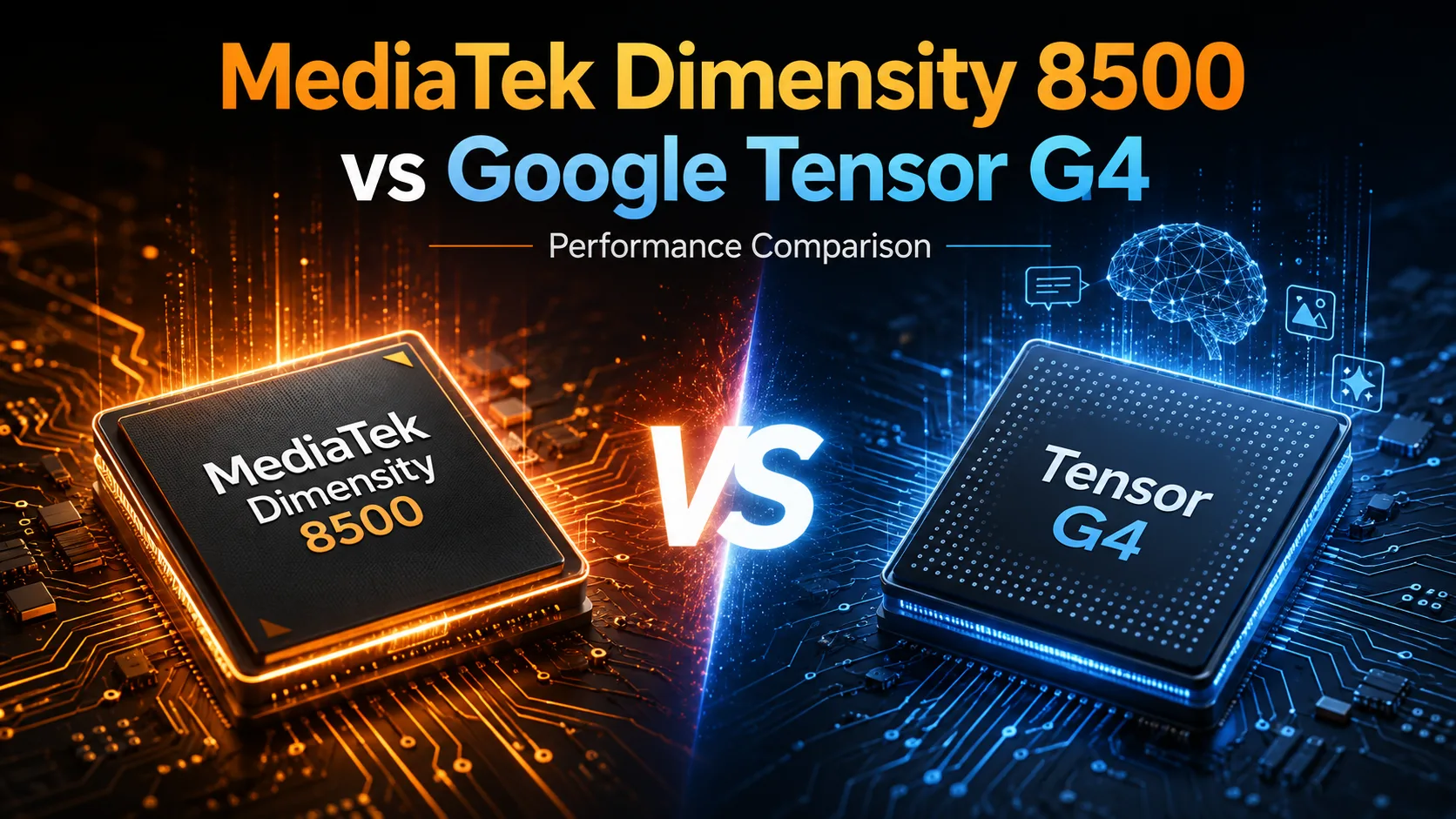
MediaTek Dimensity 8500 vs Google Tensor G4: Faster in Heavy Tasks and Gaming
The Dimensity 8500 was released about a year and a half after the Tensor G4 and significantly outpaces it in multi-threaded and graphical performance. The Tensor G4 is faster in single-core tests, but when the CPU is fully loaded, the advantage goes to MediaTek.
The difference is especially noticeable against the backdrop of pricing. The POCO X8 Pro with Dimensity 8500 can be found starting from €310, while the Pixel 9 with Tensor G4 costs from €510. At the same time, the more expensive Pixel lags in multi-threaded tests and graphics.
Key Differences
| Specification | MediaTek Dimensity 8500 | Google Tensor G4 |
|---|---|---|
| Release | January 2026 | August 2024 |
| CPU | 1x Cortex-A725 3.4 GHz + 3x A725 3.2 GHz + 4x A725 2.2 GHz | 1x Cortex-X4 3.1 GHz + 3x A720 2.6 GHz + 4x A520 1.92 GHz |
| GPU | Mali-G720 MC8 | Mali-G715 MP7 |
| Process Technology | 4 nm TSMC | 4 nm Samsung |
| Memory | LPDDR5X up to 9600 Mbps | LPDDR5X |
| Storage | UFS 4 + MCQ | UFS 3.1 / UFS 4.0 |
| NPU | MediaTek NPU 880 | Google TPU |
| Main Focus | CPU, GPU, gaming | AI, camera, and Pixel features |
In the Dimensity 8500, all eight cores are Cortex-A725. The Tensor G4 uses a tri-cluster scheme with Cortex-X4, Cortex-A720, and power-efficient Cortex-A520.
The Cortex-X4 gives the Tensor G4 an edge under single-core load. The Dimensity 8500, with its eight Cortex-A725 cores, significantly expands its advantage under full load.
CPU Performance
In the CPUTronic database, the Tensor G4 wins in Geekbench 6 Single-Core, but the Dimensity 8500 is significantly faster in Multi-Core.
| Benchmark | Dimensity 8500 | Tensor G4 |
|---|---|---|
| Geekbench 6 Single-Core | 1693 | 2045 |
| Geekbench 6 Multi-Core | 6897 | 4932 |
| AnTuTu 10 | 2,359,462 | 1,199,938 |
In Geekbench 6 Single-Core, the Tensor G4 is about 21% faster. In Multi-Core, the Dimensity 8500 wins by about 40%.
Specific Pixel models do not always showcase the maximum performance of Tensor G4 in Single-Core. The Pixel 9 scores roughly the same as smartphones with Dimensity 8500, whereas the Pixel 9 Pro XL is capable of approaching 2000 points.
Real Smartphone Benchmarks and Pricing
Results for specific models show the impact of cooling, memory, firmware, and power limits.
| Smartphone | Processor | Geekbench 6 Single | Geekbench 6 Multi | AnTuTu 11 | Price |
|---|---|---|---|---|---|
| Xiaomi Redmi Turbo 5 | Dimensity 8500 Ultra | 1729 | 6949 | 2,112,047 | around €387 |
| POCO X8 Pro | Dimensity 8500 Ultra | 1707 | 6611 | 2,085,754 | from €311 |
| Google Pixel 9 | Tensor G4 | 1707 | 4431 | 1,561,427 | from €513 |
| Google Pixel 9 Pro XL | Tensor G4 | 2001 | 4932 | 1,672,795 | from €689 |
Both POCO and Redmi use the name Dimensity 8500 Ultra, but the base configuration of CPU and GPU remains the same. The POCO X8 Pro features Cortex-A725 with frequencies of 3.4/3.2/2.2 GHz and Mali-G720 MC8.
Prices are for new smartphones as of early September 2026. The Redmi Turbo 5 is primarily sold in China, so the listed price refers to the imported version with 12/256 GB.
The POCO X8 Pro is about €200 cheaper than the Pixel 9 but outperforms it by more than 2000 points in Geekbench 6 Multi-Core and approximately half a million points in AnTuTu 11.
Graphics: Advantage of Dimensity 8500
In gaming, the Dimensity 8500 maintains its advantage. It is equipped with Mali-G720 MC8, while the Tensor G4 uses the previous generation Mali-G715 MP7.
In 3DMark Steel Nomad Light, the difference appears as follows:
| Device | GPU | 3DMark Steel Nomad Light |
|---|---|---|
| POCO X8 Pro | Mali-G720 MC8 | 1293 |
| Google Pixel 9 | Mali-G715 MP7 | 1047 |
The POCO X8 Pro is about 24% faster.
Under prolonged load, both smartphones reduce clock speeds. In stress tests, the POCO X8 Pro retains about 74-75% of its initial performance. The stability of the Pixel 9 in Steel Nomad Light is around 74%.
A short run of 3DMark therefore shows peak rather than sustained performance. However, even considering throttling, the Dimensity 8500 remains the stronger option for gaming.
Strengths of Tensor G4
Benchmarks alone do not encompass the role of Tensor G4 in Pixel devices. Google designed this processor with different priorities.
The Tensor G4 is used in computational photography, image processing, and local AI functions of Pixel devices. Google controls not only the SoC but also Android, cameras, and its proprietary software features.
Pixels are not bought solely for CPU speed. For the Pixel 9 series, Google promises seven years of operating system and security updates. This significantly strengthens the position of smartphones for long-term purchases.
However, in pure performance, the Tensor G4 does not justify the higher price of the Pixel. Its advantages are revealed specifically in conjunction with Google software and cameras.
Energy Efficiency and Heating
The same designation of 4 nm does not imply identical energy efficiency. The Dimensity 8500 is produced by TSMC, while the Tensor G4 is made by Samsung.
The Dimensity 8500 also employs a newer Cortex-A725 architecture. However, temperature and throttling depend on the specific smartphone and its cooling system. For example, the POCO X8 Pro can heat up considerably during prolonged gaming tests.
Thus, it is more accurate to speak of the higher performance of the Dimensity 8500 rather than promise it will result in lower heating in every smartphone.
What’s Better: Dimensity 8500 or Tensor G4
When comparing the processors specifically, the Dimensity 8500 is stronger. It is notably faster in Multi-Core, has more powerful graphics, and scores higher in AnTuTu.
The Tensor G4 is faster in Geekbench 6 Single-Core, but its advantage ends when transitioning to multi-threaded loads and graphics.
In terms of pricing, the advantage of the Dimensity 8500 is even more pronounced. The POCO X8 Pro costs around €200 less than the Pixel 9 and is also faster in the most demanding tests.
The price of the Pixel accounts for the cameras, Google features, and seven years of updates, not just SoC performance.
For gaming, emulation, and heavy multitasking, the Dimensity 8500 is preferable. The Tensor G4 should be chosen for the Pixel itself - its cameras, Google features, and long-term support. In pure performance, the Dimensity 8500 is significantly stronger.
Advantages
- Higher Frequency: 3400 MHz (3400 MHz vs 3100 MHz)
- Newer Launch Date: January 2026 (January 2026 vs August 2024)
Basic
3x 2.6 GHz – Cortex-A720
4x 1.92 GHz – Cortex-A520
GPU Specifications
Connectivity
Memory Specifications
Miscellaneous
Benchmarks
Comparison of Devices
Related SoC Comparisons




Share in social media
Or Link To Us
<a href="https://cputronic.com/en/soc/compare/mediatek-dimensity-8500-vs-google-tensor-g4" target="_blank">MediaTek Dimensity 8500 vs Google Tensor G4</a>