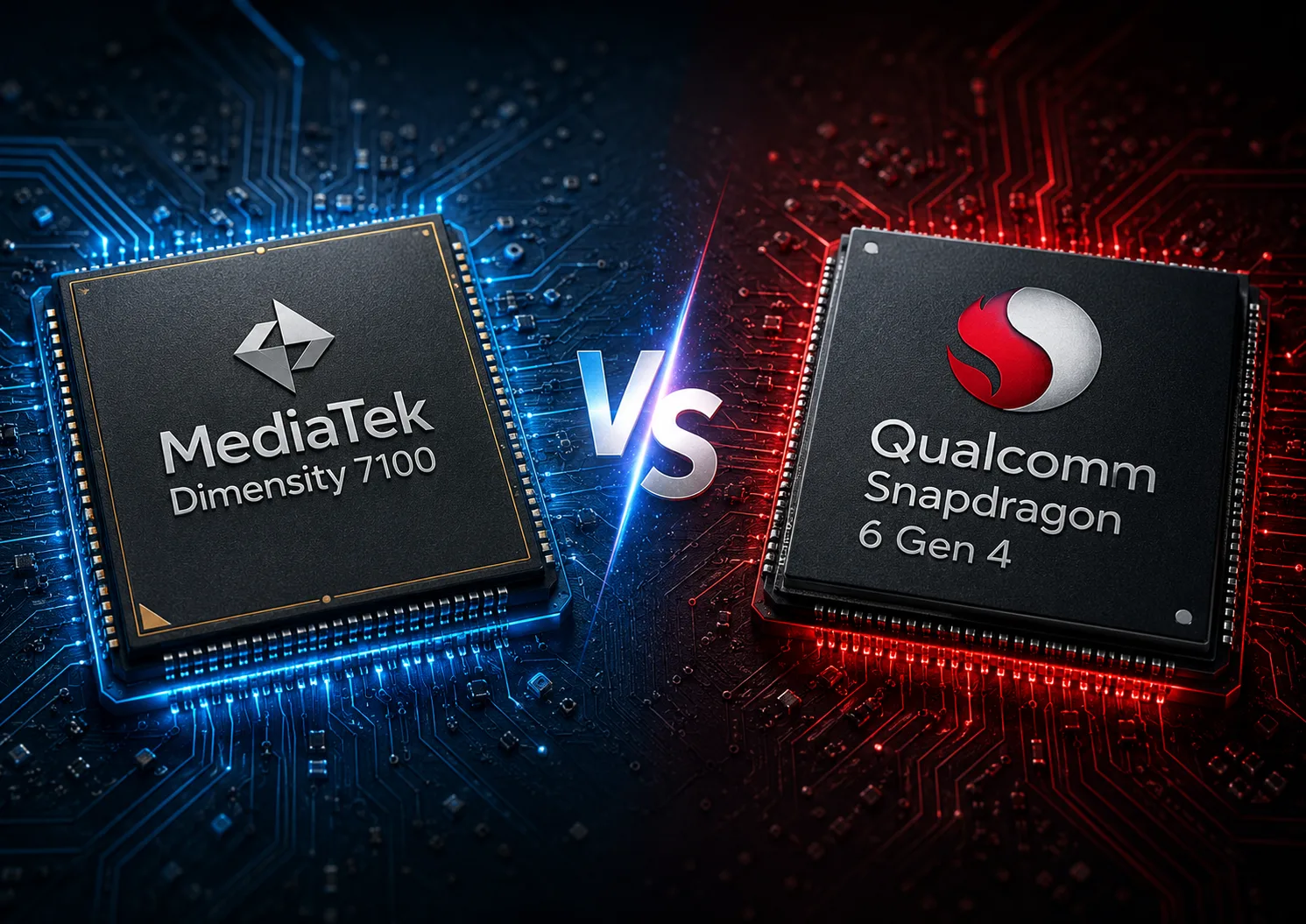
MediaTek Dimensity 7100
vs
Qualcomm Snapdragon 6 Gen 4
SoC Comparison Result
MediaTek Dimensity 7100 vs Qualcomm Snapdragon 6 Gen 4: a robust 6nm mid-tier against Qualcomm's new platform
MediaTek Dimensity 7100 and Qualcomm Snapdragon 6 Gen 4 are both mid-range chipsets, but they are not equal in terms of freshness. The Dimensity 7100 holds its ground with a strong CPU configuration: four Cortex-A78, four Cortex-A55, LPDDR5, UFS 3.1, and 5G capabilities. The Snapdragon 6 Gen 4, on the other hand, benefits from a 4nm process, a Kryo CPU configuration of 1+3+4, stronger graphics, Wi-Fi 6E, an advanced ISP, and gaming/AI features.
The main difference is simple: the Dimensity 7100 is not weak, but the Snapdragon 6 Gen 4 is more modern and stronger in terms of overall capabilities. Qualcomm offers better graphics, a more advanced multimedia block, newer wireless features, and higher energy efficiency potential.
Key Differences
| Parameter | MediaTek Dimensity 7100 | Qualcomm Snapdragon 6 Gen 4 | What Matters More |
|---|---|---|---|
| Process Tech | 6nm TSMC | 4nm | Snapdragon has a better foundation for energy efficiency |
| CPU | 4x Cortex-A78 up to 2.4 GHz + 4x Cortex-A55 up to 2.0 GHz | Kryo CPU: 1 Prime up to 2.3 GHz + 3 Performance up to 2.2 GHz + 4 Efficiency up to 1.8 GHz | Dimensity is strong in the number of large cores, Snapdragon is more modern |
| GPU | Mali-G610 MC2 | Qualcomm Adreno | Snapdragon significantly outperforms in graphics |
| Memory | LPDDR5 / LPDDR4x | LPDDR5 / LPDDR4x | Both options are decent |
| Storage | UFS 3.1 | UFS 3.1 | Parity |
| Camera | up to 200 MP | up to 200 MP, Triple 12-bit ISP | Snapdragon offers richer photo and video processing |
| Video | HDR video, 10-bit HDR display | 4K HDR 30 FPS, 10-bit HEIF/HEVC | Snapdragon is stronger |
| Display | up to 1200 x 2600, 120 Hz | FHD+ up to 144 Hz | Snapdragon is better for 144 Hz |
| Connectivity | 5G up to 3.3 Gbps, Wi-Fi 6 | 5G up to 2.9 Gbps, mmWave, Wi-Fi 6E | Qualcomm has a wider set of communication options |
CPU and Benchmarks
In terms of processing power, the Dimensity 7100 holds up well. The four Cortex-A78 cores are not a budget scheme with just two large cores but a solid foundation for browsing, social media, cameras, navigation, messaging, and multitasking.
The Snapdragon 6 Gen 4 relies not on a higher number of large cores, but on a more modern platform. It has a 1+3+4 configuration, a 4nm process, and a better performance-to-power consumption ratio. While the Dimensity 7100 has slightly higher clock speeds, comparing just gigahertz here is meaningless.
Estimated public benchmark results show the following:
| Test | Dimensity 7100 | Snapdragon 6 Gen 4 | Difference |
|---|---|---|---|
| AnTuTu 11 | around 768,000 | around 960,000 | Snapdragon usually leads by about 25% |
| Geekbench 6 Single-Core | around 990 | around 1070-1130 | Snapdragon is ahead |
| Geekbench 6 Multi-Core | around 3000 | around 3000-3100 | close |
| GPU / Compute | lower | significantly higher | advantage Snapdragon |
The conclusion regarding the CPU is calm: the Dimensity 7100 does not falter, especially in multi-threaded tasks. However, the Snapdragon 6 Gen 4 is stronger in overall performance and significantly better in graphics. Real-world performance will depend on cooling, firmware, memory, and the limits of the specific smartphone.
Gaming, Graphics, and Camera
In gaming, the advantage of the Snapdragon is more apparent than in CPU tests. The Qualcomm Adreno graphics are stronger, and features like Snapdragon Game Super Resolution, Adreno Frame Motion Engine, and HDR Fast Blend are helpful. This doesn’t turn the Snapdragon 6 Gen 4 into a gaming flagship, but it makes it better suited for demanding games compared to the Dimensity 7100.
The Dimensity 7100 uses Mali-G610 MC2. This is sufficient for online games, MOBAs, simple shooters, and everyday graphics. However, the MC2 configuration is limited in the number of graphical units, so it has less headroom for heavy projects.
The situation is similar with cameras: both chipsets support sensors up to 200 MP, but the sheer number doesn't decide much on its own. The Dimensity 7100 offers HDR video, multi-frame noise reduction, and hardware acceleration for face recognition. In contrast, the Snapdragon 6 Gen 4 is stronger in multimedia capabilities: it features a Triple 12-bit ISP, 4K HDR video at 30 FPS, 10-bit HEIF/HEVC support, Low Light Vision, and simultaneous use of multiple cameras.
This doesn’t mean that every smartphone on Snapdragon automatically captures better images. However, manufacturers have more tools for processing photos and videos.
Connectivity, Display, and Battery Life
The Dimensity 7100 boasts a higher theoretical peak 5G download speed of up to 3.3 Gbps. The Snapdragon 6 Gen 4 has a lower peak of up to 2.9 Gbps, but it offers sub-6 + mmWave and Wi-Fi 6E instead of Wi-Fi 6. In real-world smartphones, mmWave may not always be used, but Qualcomm's set of features is more versatile.
Regarding displays, Snapdragon supports FHD+ up to 144 Hz, while Dimensity 7100 supports up to 120 Hz at a resolution of up to 1200 x 2600. For most users, 120 Hz is sufficient, but for gaming models, Snapdragon is a clearer choice.
In terms of battery life, Snapdragon also has an advantage on paper due to its 4nm process. However, actual runtime will still depend on the battery, display, modem, firmware, and cooling.
Conclusion
MediaTek Dimensity 7100 is a robust mid-range chip. It features four Cortex-A78 cores, UFS 3.1, LPDDR5, 5G, 120Hz displays, and camera support up to 200 MP. For interface tasks, browsing, social media, video, navigation, photography, and light gaming, it suffices.
Qualcomm Snapdragon 6 Gen 4 is stronger across the board: it benefits from a 4nm process, more powerful graphics, Wi-Fi 6E, an advanced ISP, 4K HDR video, gaming features, and modern AI capabilities. At a similar price point, it's better to choose the Snapdragon 6 Gen 4. The Dimensity 7100 is interesting when a smartphone based on it is cheaper or significantly better in other specifications.
Advantages
- Higher Frequency: 2400 MHz (2400 MHz vs 2300 MHz)
- Newer Launch Date: January 2026 (January 2026 vs February 2025)
- Higher Technology: 4 nm (6 nm vs 4 nm)
Basic
4x 2 GHz – Cortex-A55
3x 2.2 GHz – Kryo Gold (Cortex-A720)
4x 1.8 GHz – Kryo Silver (Cortex-A520)
GPU Specifications
Connectivity
Memory Specifications
Miscellaneous
- FLAC
- HE-AACv1
- HE-AACv2
- MP3
- AIFF
- CAF
- MP3
- MP4
- WAV
- H.265
- VP9
- H.265
- VP9
Benchmarks
Comparison of Devices
Related SoC Comparisons


Share in social media
Or Link To Us
<a href="https://cputronic.com/en/soc/compare/mediatek-dimensity-7100-vs-qualcomm-snapdragon-6-gen-4" target="_blank">MediaTek Dimensity 7100 vs Qualcomm Snapdragon 6 Gen 4</a>