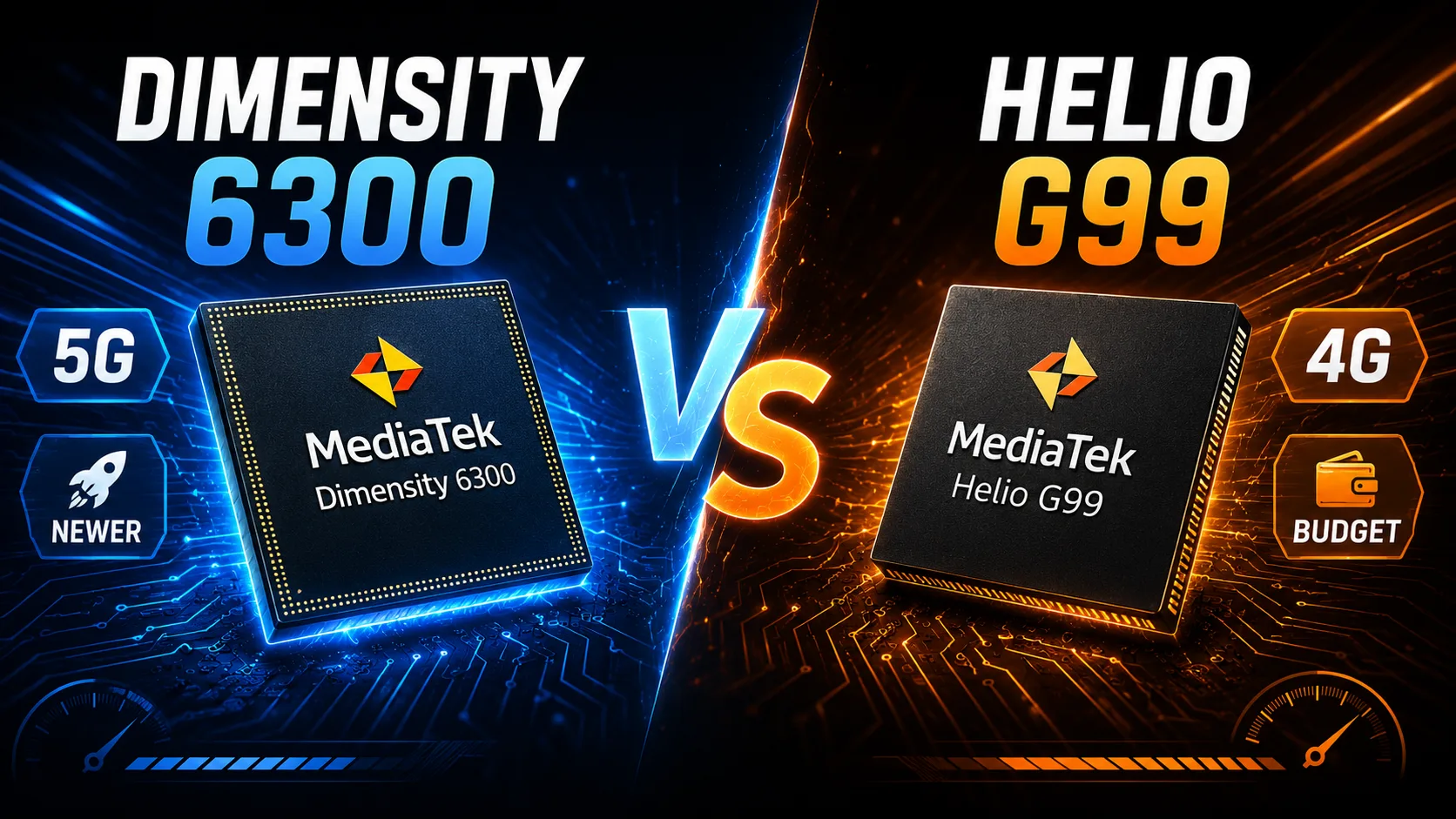
MediaTek Dimensity 6300
vs
MediaTek Helio G99
SoC Comparison Result
Dimensity 6300 vs Helio G99: Almost the Same Chip, But with 5G
MediaTek Dimensity 6300 and Helio G99 use a similar platform: a 6nm process technology, Cortex-A76/Cortex-A55 cores, Mali-G57 MC2 graphics, LPDDR4X memory, and UFS 2.2 storage. Therefore, the Dimensity 6300 does not belong to a higher performance class. Its main differences are 5G support and a higher frequency for the performance cores.
Helio G99 remains relevant for budget 4G smartphones, but in comparison to the Dimensity 6300, it is weaker in connectivity and overall performance. In Geekbench, the difference is small, especially in Multi-Core, but in AnTuTu 10, the Dimensity 6300 has a more noticeable lead. Thus, at a similar price, the presence of 5G and the potential for relevance take precedence over the difference in Geekbench scores.
Key Differences in Specifications
| Parameter | MediaTek Dimensity 6300 | MediaTek Helio G99 |
|---|---|---|
| Large CPU Cores | 2× Cortex-A76 up to 2.4 GHz | 2× Cortex-A76 up to 2.2 GHz |
| Connectivity | 5G SA/NSA + 4G LTE | 4G LTE |
| Device Class | budget 5G smartphones | budget 4G smartphones |
Other key parameters are similar: both chips use 6× Cortex-A55 up to 2.0 GHz, Mali-G57 MC2, LPDDR4X, UFS 2.2, Wi-Fi 5, Bluetooth 5.2, Full HD+ displays up to 120 Hz, and cameras up to 108 MP.
Performance
In CPU tests, the Dimensity 6300 is faster, but the advantage is moderate. It has the same core configuration as the Helio G99, but the two Cortex-A76 cores operate at a frequency of up to 2.4 GHz instead of 2.2 GHz. This provides an advantage in single-core sensitive tasks: app launches, web browsing, and interface responsiveness.
| Benchmark | MediaTek Dimensity 6300 | MediaTek Helio G99 | Difference |
|---|---|---|---|
| Geekbench 6 Single-Core | 790 | 733 | Dimensity 6300 +8% |
| Geekbench 6 Multi-Core | 2030 | 1994 | Dimensity 6300 +2% |
| AnTuTu 10 | 476569 | 423470 | Dimensity 6300 +13% |
In Geekbench 6 Single-Core, the Dimensity 6300 scores 790 points compared to 733 for the Helio G99. The difference is around 8%, logically linked to the higher frequency of the performance cores. In Multi-Core, the advantage becomes minimal: 2030 points against 1994. Here, both chips use six Cortex-A55 cores up to 2.0 GHz, so there is no significant gap for the Dimensity 6300.
In AnTuTu 10, the difference is more noticeable: 476569 points for the Dimensity 6300 against 423470 for the Helio G99. This is about 13%, but such an advantage should be seen as a difference within the same class rather than an upgrade to a higher level. The final AnTuTu score also depends on memory, cooling, and the firmware of the specific smartphone.
Gaming and Graphics
In gaming, the difference should be small. Both chips use Mali-G57 MC2, which is a lower mid-range graphics solution. It is suitable for less demanding games and medium settings in heavier projects, but these chips are not designed for stable high FPS at maximum settings.
Games like PUBG Mobile, Mobile Legends, Standoff 2, and casual titles are appropriate for this level. In Genshin Impact, Wuthering Waves, and other heavy projects, it's more realistic to aim for low or medium settings. If a smartphone with Helio G99 is significantly cheaper, the extra cost for the Dimensity 6300 for gaming may not always be justified.
Connectivity
The main advantage of the Dimensity 6300 is its 5G support. For a budget smartphone, this is more important for several years than the slight lead in Geekbench. Even if 5G is rarely used, its availability increases the device's relevance.
The Helio G99 is limited to 4G. In regions where 5G is not implemented or is unimportant, this is not always a problem. But at a similar price point, a smartphone with the Dimensity 6300 appears more rational: it is faster in AnTuTu, slightly stronger in CPU performance, and supports 5G.
Camera and Multimedia
In terms of camera specifications, the Dimensity 6300 and Helio G99 are on par: both support sensors up to 108 MP. Therefore, choosing a smartphone based solely on the chip's name does not make sense.
The photo quality depends on the specific sensor, optics, stabilization, processing algorithms, and firmware. A smartphone with Helio G99 that has a good camera module can take better photos than a budget model on Dimensity 6300 with a basic sensor. The same applies to the display: both chips support Full HD+ up to 120 Hz, but the quality of the panel depends on the smartphone manufacturer's choices.
Conclusion
The Dimensity 6300 is not an upgrade to another class, but rather an enhancement of the same formula: 5G, slightly faster CPU, and higher scores in AnTuTu 10. The advantage in Geekbench is small: +8% in Single-Core and just +2% in Multi-Core.
The Helio G99 makes sense if the smartphone is significantly cheaper and 5G is not needed. It is suitable for everyday tasks, budget 4G smartphones, and less demanding games. However, at a similar price, it is more rational to choose the Dimensity 6300: it is faster in overall performance, supports 5G, and has a greater potential for relevance.
Advantages
- Higher Frequency: 2400 MHz (2400 MHz vs 2200 MHz)
- Newer Launch Date: April 2024 (April 2024 vs May 2022)
Basic
GPU Specifications
Connectivity
Memory Specifications
Miscellaneous
Benchmarks
Comparison of Devices
Related SoC Comparisons




Share in social media
Or Link To Us
<a href="https://cputronic.com/en/soc/compare/mediatek-dimensity-6300-vs-mediatek-helio-g99" target="_blank">MediaTek Dimensity 6300 vs MediaTek Helio G99</a>