Intel Core 5 223PQE

Intel Core 5 223PQE: Why Intel Gave Up on E-Cores
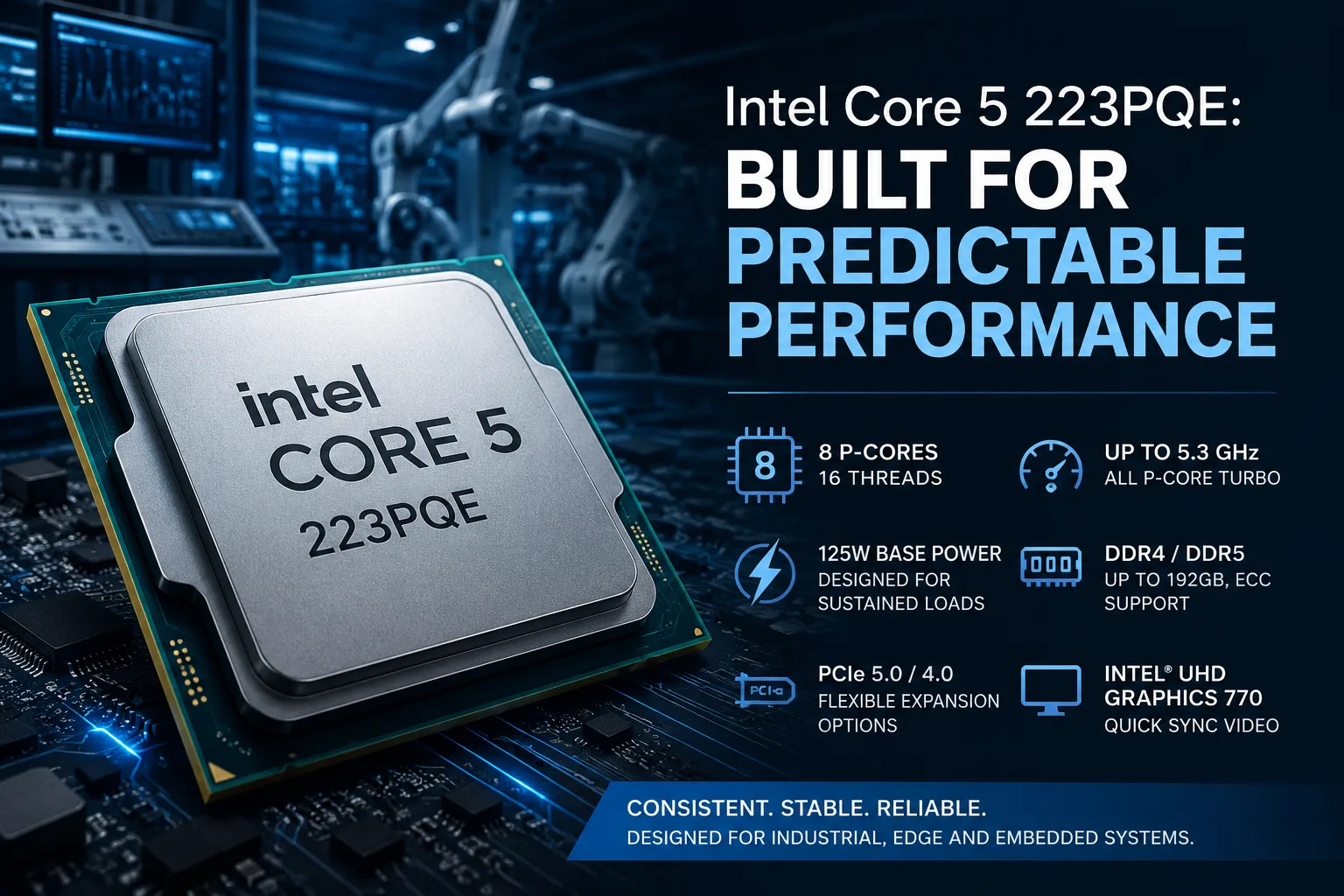
The Intel Core 5 223PQE stands out from the usual logic of the company's modern processors. Instead of a hybrid design with performance and efficient cores, it features eight identical P-cores with Hyper-Threading, totaling 16 threads. This choice is driven not by the pursuit of records in mass tests but by the demands of industrial computers, edge servers, and control systems.
The Core 5 223PQE belongs to the Bartlett Lake family and utilizes the LGA1700 platform. In light of new desktop architectures, this may seem like a conservative decision, but for the embedded segment, continuity is often more important than novelty. Equipment manufacturers benefit from high clock speeds, ECC support, compatibility with DDR4 and DDR5, and the ability to upgrade the system without a complete platform change.
Why There Are No E-Cores Here
Hybrid architecture works well for typical computers. P-cores handle heavy tasks, while E-cores take care of background processes and increase overall multithreaded performance.
In an industrial system, the differences between cores can complicate configuration. Developers must consider their performance, tie critical threads to specific cores, and test application behavior under different load scenarios. The more sensitive the program is to delays, the more attention the scheduler requires.
With the Core 5 223PQE, all eight cores are identical. This simplifies resource allocation between management software, virtual machines, and background services. The processor does not automatically become faster than hybrid models, but its behavior is easier to predict and reproduce.
This approach is particularly beneficial in automation systems, programmable controllers, robotics, and other equipment where predictable latencies and stable response times are essential.
Core 5 223PQE vs. Core 5 223PE
The closest relative of this model is the Core 5 223PE. Both processors feature eight P-cores, 16 threads, the same cache size, and integrated UHD Graphics 770. The main difference lies in power and clock speeds under sustained load.
| Parameter | Core 5 223PQE | Core 5 223PE |
|---|---|---|
| Cores and Threads | 8 / 16 | 8 / 16 |
| Base Clock Frequency | 4.0 GHz | 2.9 GHz |
| Max Clock Frequency | 5.5 GHz | 5.4 GHz |
| Turbo Boost for All P-Cores | Up to 5.3 GHz | Up to 4.8 GHz |
| Base Power | 125 W | 65 W |
The difference in maximum clock frequency for a single core is small-only 100 MHz. Much more critical is the sustained load mode for the entire processor: Intel claims up to 5.3 GHz for all P-cores in the 223PQE compared to 4.8 GHz for the 223PE.
The actual sustained frequency will depend on cooling, BIOS settings, power limits, and the nature of the workload. Nonetheless, the PQE version is initially designed for a higher sustained level of performance.
The Core 5 223PE looks more logical in compact industrial computers, while the 223PQE suits systems with full cooling where all cores are regularly loaded with work.
125 W is More Than Just a Number in the Specifications
A base power of 125 W indicates that the Core 5 223PQE is not only aimed at short frequency bursts. The high base clock and aggressive turbo mode for all cores are designed for long workloads: video stream processing, local analytics, virtualization, and equipment management.
In such scenarios, the peak frequency of 5.5 GHz is less important than the ability to maintain a high work pace over an extended period. This sets the 223PQE apart from energy-efficient embedded processors, which hit power or temperature limits more quickly.
The flip side is system requirements. The platform must support a 125-watt base profile and higher consumption in turbo mode. A reliable power subsystem, a large cooler, and a well-ventilated case will be necessary.
Fanless terminals and sealed industrial computers are poorly suited for this model unless the manufacturer has provided effective heat dissipation.
LGA1700 and DDR4 Here Do Not Appear Outdated
The Core 5 223PQE is manufactured using Intel 7 process technology and uses the LGA1700 socket. In a typical desktop PC, this might seem like a continuation of an old platform, but for industrial equipment, compatibility is often more important than moving to a new generation.
Replacing the processor in such a device might require retesting the motherboard, memory, storage, drivers, cooling system, and specialized software. The fewer components that change, the cheaper and faster the update to the finished product.
Support for DDR4-3200 allows preserving a proven hardware configuration, while DDR5-5600 provides the option to switch to newer memory where truly necessary. The maximum capacity reaches 192 GB, and ECC support is available.
This makes the Core 5 223PQE a convenient foundation for virtualization, local databases, and systems that must operate without interruption while minimizing the risk of memory errors.
However, identical sockets do not guarantee compatibility with every LGA1700 motherboard. A suitable chipset, current BIOS, and official support from the motherboard manufacturer will be required.
Integrated Graphics Solve Basic Tasks
UHD Graphics 770 is suitable for control panels, multi-monitor workplaces, video playback, and processing multiple video streams. Quick Sync support enables hardware acceleration for video encoding and decoding without taxing the main CPU cores.
However, the primary limitation remains graphics. UHD Graphics 770 significantly lags behind modern integrated solutions like Intel Arc and is not designed for heavy 3D visualization or intensive parallel computing.
There is also no separate NPU. Lightweight AI models can run on the CPU, but for multi-camera analytics, machine vision, and local work with large neural networks, a discrete accelerator will be needed.
For its connection, the processor provides PCI Express 5.0 and 4.0 lanes. A typical configuration allows installing a full-fledged graphics card or specialized compute module while simultaneously connecting a fast NVMe storage device.
Where the Core 5 223PQE Will Be Suitable
The processor is best suited for systems where high single-thread performance combines with prolonged loads on all cores:
- Industrial computers and automation systems;
- Edge data processing servers;
- Virtualized programmable controllers;
- Machine vision systems with a separate accelerator;
- Medical, measurement, and manufacturing equipment.
In a typical gaming computer, the benefits of the 223PQE are less apparent. Mass-market desktop processors offer more cores, more modern platforms, and a wide selection of inexpensive motherboards.
Here, the buyer is paying not only for speed but also for a homogeneous architecture, ECC, enterprise features, and the ability to produce equipment on the same hardware base for years.
Conclusion
The Intel Core 5 223PQE is a specialized eight-core processor for systems where a homogeneous architecture is more beneficial than a hybrid one. Eight identical P-cores simplify the tuning of latency-sensitive loads, while the high power limit allows for sustained performance under full processor load.
Its weaknesses are clear: high cooling requirements, outdated UHD Graphics 770, and lack of an NPU. However, for industrial equipment, edge servers, and control systems, this is not an attempt to catch up with new desktop CPUs but a focus on predictable operation, compatibility, and a long lifecycle.
CPU Comparison
Compare Core 5 223PQE with other CPUs
Basic
CPU Specifications
Memory Specifications
GPU Specifications
Interfaces and Ports
Share in social media
Or Link To Us
<a href="https://cputronic.com/en/cpu/intel-core-5-223pqe" target="_blank">Intel Core 5 223PQE</a>