Intel Core Ultra 7 270K Plus
vs
AMD Ryzen 7 9800X3D


CPU Comparison Result
Intel Core Ultra 7 270K Plus vs AMD Ryzen 7 9800X3D: More Cores or 3D V-Cache
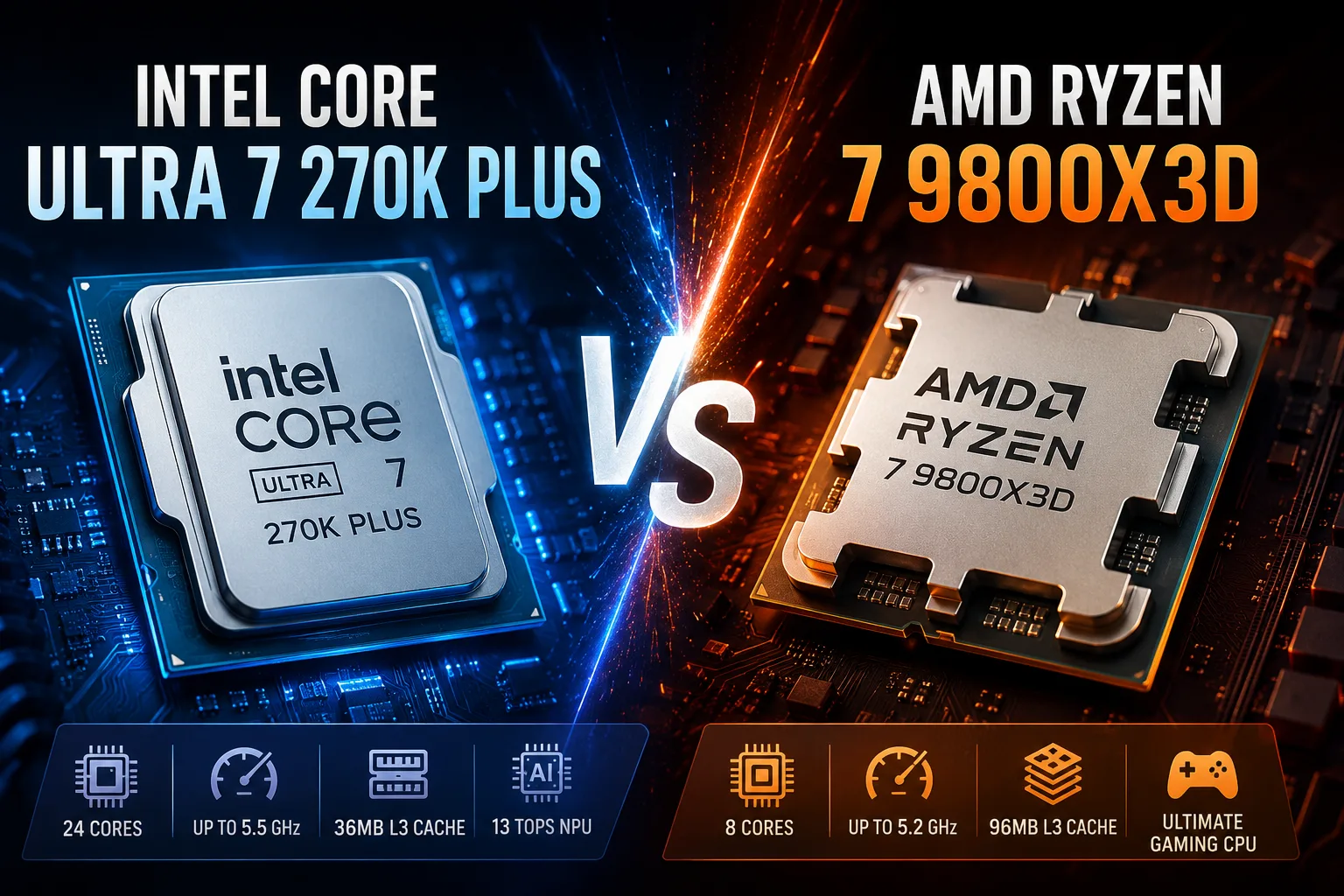
The Intel Core Ultra 7 270K Plus and AMD Ryzen 7 9800X3D serve different purposes. Intel features 24 physical cores and is aimed at rendering, encoding, compiling, and heavy multitasking. AMD utilizes eight Zen 5 cores and 96 MB of L3 cache, giving it an advantage in latency-sensitive games.
In single-threaded performance, the processors are quite close. The main choice is between the higher multi-threaded speed of the Core Ultra 7 270K Plus and the gaming performance of the Ryzen 7 9800X3D.
Key Differences
| Feature | Intel Core Ultra 7 270K Plus | AMD Ryzen 7 9800X3D |
|---|---|---|
| Architecture | Arrow Lake | Zen 5 |
| Cores / Threads | 24 / 24: 8 P-core + 16 E-core | 8 / 16 |
| Max Frequency | 5.5 GHz | 5.2 GHz |
| L2 Cache | 40 MB | 8 MB |
| L3 Cache | 36 MB | 96 MB |
| Reported Power | PBP 125 W, MTP 250 W | TDP 120 W |
| Official Memory Support | DDR5-7200 | DDR5-5600 |
| Socket | LGA1851 | AM5 |
| Integrated Graphics | Intel Graphics, 4 Xe cores | Radeon Graphics, 2 cores |
| NPU | 13 TOPS | No |
Intel has eight performance cores and sixteen efficient cores without Hyper-Threading. The Ryzen 7 9800X3D features eight identical Zen 5 cores with SMT and significantly larger L3 cache. Compared to the Core Ultra 7 265K, the new Intel model has gained four additional E-cores and higher internal connection frequencies.
The Core Ultra 7 270K Plus also comes equipped with four Xe graphics cores, hardware AV1 encoding, Quick Sync, and an NPU with 13 TOPS. The integrated graphics of the Ryzen 7 9800X3D consist of two cores and are primarily intended for video output without a discrete graphics card.
Geekbench 6 in Specific Systems
Desktop processors are not tied to a single computer model, so the table lists completed builds or motherboards where the results were obtained. Configurations vary in memory, BIOS, power plans, and processor settings.
| Processor | System / Motherboard | Memory | Single-Core | Multi-Core |
|---|---|---|---|---|
| Core Ultra 7 270K Plus | Gigabyte Z890 AORUS PRO ICE | 64 GB DDR5-6400 | 3,381 | 25,118 |
| Core Ultra 7 270K Plus | ASRock Z890 LiveMixer WiFi | 32 GB DDR5-8400 | 3,434 | 25,519 |
| Core Ultra 7 270K Plus | ASRock Z890 Taichi | 32 GB DDR5-7000 | 3,344 | 23,779 |
| Ryzen 7 9800X3D | ASUS TUF GAMING B850-PLUS WIFI | 32 GB DDR5-6000 | 3,326 | 18,135 |
| Ryzen 7 9800X3D | PCSpecialist Nexa 950, ASUS TUF B850-PLUS WIFI | 32 GB DDR5-5998 | 3,444 | 18,933 |
| Ryzen 7 9800X3D | iBUYPOWER, ASRock B650M-C | 32 GB DDR5-5988 | 3,434 | 18,657 |
In the single-threaded test, the ranges almost completely overlap: approximately 3340-3430 for Intel and 3330-3440 for AMD. There is no clear leader here.
In multi-core benchmarks, systems with the Core Ultra 7 270K Plus yield around 23,800-25,500 points, while selected builds with the Ryzen 7 9800X3D score about 18,100-18,900. This is an expected outcome when comparing a 24-core hybrid configuration with an eight-core processor.
However, Intel's results significantly depend on the entire configuration. For example, another system on the ASRock Z890 Taichi with DDR5-4800 scored 20,941 points in multi-core. This difference cannot be automatically attributed solely to memory; BIOS, power limits, cooling, and background processes may have varied.
Disclaimer on Intel Results
The Intel Binary Optimization Tool can modify Geekbench executable files. In specific loads, the gain can reach 40%, while the overall score can increase by approximately 8%.
The Geekbench Browser cannot reliably determine the use of the tool, so even a recording with a Valid status does not guarantee a completely standard configuration. Results from the Core Ultra 7 270K Plus should be viewed as examples of specific system behavior rather than as an average laboratory result for the processor.
Work Performance
The following tests were conducted on the same platform, making them more suitable for direct comparison of processors than separate Geekbench entries.
| Test | Core Ultra 7 270K Plus | Ryzen 7 9800X3D |
|---|---|---|
| Cinebench 2024 Single-Core | 143 | 133 |
| Cinebench 2024 Multi-Core | 2,435 | 1,307 |
| Blender 4.2 | 179 samples/min | 101 samples/min |
| HandBrake 1.8.1 | 123 FPS | 92 FPS |
| 7-Zip, Compression | 179 GIPS | 132 GIPS |
| 7-Zip, Decompression | 200 GIPS | 141 GIPS |
The Core Ultra 7 270K Plus is only slightly faster in single-threaded Cinebench but nearly doubles the Ryzen’s performance in multi-threaded scenarios. The difference in Blender is also substantial, while in HandBrake and 7-Zip, Intel maintains a notable advantage.
This pattern is typical for rendering, transcoding, compiling, and handling large data sets. The Ryzen 7 9800X3D can perform these tasks, but the 3D V-Cache does not compensate for the difference in core count.
Gaming Performance
Gaming tests were conducted at 1080p resolution using a Zotac GeForce RTX 4070, 32 GB of DDR5-6000 CL32 memory, and a Thermalright Peerless Assassin 120 SE cooler. The MSI MEG Z890 Ace motherboard was used for the Core Ultra 7 270K Plus, while the corresponding AM5 platform was used for the Ryzen 7 9800X3D.
The use of the RTX 4070 is important to consider when interpreting the results. In heavy graphical settings, especially with ray tracing, the GPU may partially limit performance and reduce the differences between processors.
Gaming Results with GeForce RTX 4070, 1080p
| Game | Core Ultra 7 270K Plus | Ryzen 7 9800X3D |
|---|---|---|
| Cyberpunk 2077, RT Ultra + DLSS Balanced | 119 / 98 FPS | 112 / 76 FPS |
| Baldur’s Gate 3, Ultra | 113 / 66 FPS | 146 / 76 FPS |
| Homeworld 3, Epic | 101 / 57 FPS | 117 / 55 FPS |
| Metro Exodus Enhanced, High | 143 / 79 FPS | 148 / 91 FPS |
| Total War: Warhammer III, High | 173 / 139 FPS | 152 / 79 FPS |
The first number is the average FPS, and the second is the 1% Low.
The Ryzen 7 9800X3D performs particularly well in Baldur’s Gate 3 and Homeworld 3. The Core Ultra 7 270K Plus is faster in Cyberpunk 2077 and Total War: Warhammer III, where both the average and minimum FPS are considerably higher.
This small sample does not allow for an overall percentage advantage to be determined for all games. However, the Ryzen 7 9800X3D remains the faster gaming processor in this pair, especially in titles that benefit from a large cache. Intel can outperform AMD in specific engines, however.
As the resolution moves to 4K, the differences between the processors tend to become less noticeable as the load shifts more onto the graphics card.
Power Consumption and Cooling
Intel’s high multi-threaded performance is accompanied by significantly greater power consumption. In multi-threaded Cinebench 2024, the Core Ultra 7 270K Plus consumed an average of 240 W and briefly reached 253 W. The Ryzen 7 9800X3D showed 109 W and 116 W, respectively.
In Baldur’s Gate 3, the Intel processor consumed an average of 111 W with a temperature of 67 °C. The Ryzen system consumed 67 W, and the processor temperature was 51 °C. These results pertain to the specific test bench but the difference is substantial enough to consider when choosing a power supply and cooler.
For prolonged multi-threaded workloads, the Core Ultra 7 270K Plus requires robust air cooling or liquid cooling solutions. The Ryzen 7 9800X3D is easier to keep within a comfortable temperature and noise level.
Platform
The Core Ultra 7 270K Plus fits into the LGA1851 socket and works with Intel 800 series desktop chipsets, including the B860 and Z890. The processor officially supports memory up to DDR5-7200.
The Ryzen 7 9800X3D uses AM5 and supports motherboards on A620, B650, B850, X670, and X870. The official memory speed with two modules is DDR5-5600, although high-performance builds often utilize memory overclocking through EXPO.
With AM5, there is a wider selection of motherboards across different generations and price ranges. When building a new computer, this can lower platform costs, but comparisons should be made between specific motherboards with the same set of interfaces and power quality.
What to Choose
Choose Ryzen 7 9800X3D when the priorities are:
- Games with a powerful discrete graphics card;
- High and stable FPS;
- Low power consumption;
- Quieter cooling;
- Upgrading an existing AM5 system.
Choose Core Ultra 7 270K Plus when the focus is on:
- Rendering and compiling;
- Video encoding;
- Archiving and data processing;
- Simultaneously running multiple heavy applications;
- Quick Sync, hardware AV1 encoding, and a separate NPU.
The Ryzen 7 9800X3D is the faster gaming processor in this pairing. It consumes less power and particularly excels in games that are sensitive to cache size.
The Core Ultra 7 270K Plus is significantly faster in multi-threaded workloads. Its advantage is clearly visible in Geekbench, Cinebench, Blender, HandBrake, and 7-Zip. The downside is a power consumption of around 240-250 W under full load and higher cooling requirements.
For a gaming computer, the Ryzen 7 9800X3D is the more logical choice. For a work system where gaming is combined with rendering, editing, or compiling, the Core Ultra 7 270K Plus offers superior multi-threaded performance.
Advantages
- More Total Cores: 24 (24 vs 8)
- Higher Technology: 3 nm (3 nm vs TSMC 4nm FinFET)
- Newer Launch Date: March 2026 (March 2026 vs November 2024)
- Larger L3 Cache: 96 MB (36 MB shared vs 96 MB)
Basic
CPU Specifications
Memory Specifications
GPU Specifications
Interfaces and Ports
Miscellaneous
Benchmarks
Related CPU Comparisons


Share in social media
Or Link To Us
<a href="https://cputronic.com/en/cpu/compare/intel-core-ultra-7-270k-plus-vs-amd-ryzen-7-9800x3d" target="_blank">Intel Core Ultra 7 270K Plus vs AMD Ryzen 7 9800X3D</a>